



VecTest as Diagnostic and Surveillance Tool for West Nile Virus in Dead Birds
Supporting Files

-
Dec 2004
File Language:
English
Details
-
Alternative Title:Emerg Infect Dis
-
Personal Author:
-
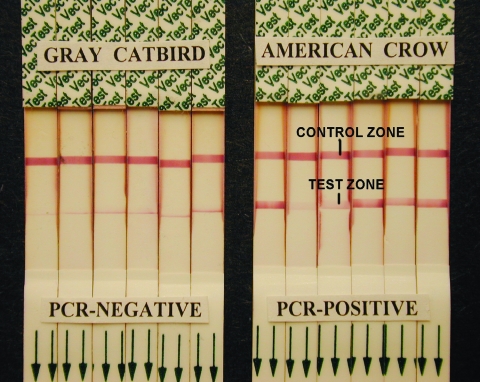
Description:The VecTest antigen-capture assay for West Nile virus was performed on oral and tissue swabs from dead birds in New York State from April 2003 through July 2004. Results were compared with those from real-time reverse transcriptase-polymerase chain reaction of kidney or brain. Oral VecTest sensitivity is adequate for surveillance in American Crows (Corvus brachyrhynchos) (87%), Blue Jays (Cyanocitta cristata) (80%), and House Sparrows (Passer domesticus) (76%). Oral VecTest performed well for small samples of American Kestrels (Falco sparverius), Northern Cardinals (Cardinalis cardinalis), Common Grackles (Quiscalus quiscula), and House Finches (Carpodacus mexicanus). Poor sensitivity occurred in most raptors, Mourning Doves (Zenaida macroura), Fish Crows (Corvus ossifragus), and American Robins (Turdus migratorius). Specificity was excellent (98%), except for false-positive results that occurred mostly in Gray Catbirds (Dumatella carolinensis), Green Herons (Butorides virescens), and tests of blood and tissues. Feather pulp and kidney may be useful for VecTest assays in corvids.
-
Subjects:
-
Source:Emerg Infect Dis. 10(12):2175-2181.
-
Document Type:
-
Funding:
-
Place as Subject:
-
Location:
-
Volume:10
-
Issue:12
-
Download URL:
-
File Type:
 [PDF - 210.42 KB]
 -
Collection(s):
-
Main Document Checksum:urn:sha256:90a92769d3fd696d46805fcb22b62244f669bd1f9ff166b553007ff752cd33be
Supporting Files


File Language:
English
 Was this page helpful?
 Found an issue?


CDC STACKS serves as an archival repository of CDC-published products including
scientific findings, journal articles, guidelines, recommendations, or other public health information authored or
co-authored by CDC or funded partners.
As a repository, CDC STACKS retains documents in their original published format to ensure public access to scientific information.
As a repository, CDC STACKS retains documents in their original published format to ensure public access to scientific information.
You May Also Like
COLLECTION
Emerging Infectious Diseases