



SARS Antibody Test for Serosurveillance
Supporting Files
Public Domain

-
Sep 2004
Details
-
Alternative Title:Emerg Infect Dis
-
Personal Author:Hsueh, Po-Ren ; Kao, Chuan-Liang ; Lee, Chun-Nan ; Chen, Li-Kuan ; Ho, Mei-Shang ; Sia, Charles ; De Fang, Xin ; Lynn, Shugene ; Chang, Tseng Yuan ; Liu, Shi Kau ; Walfield, Alan M. ; Wang, Chang Yi
-
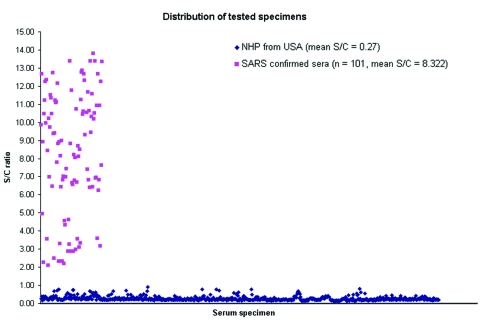
Description:A peptide-based enzyme-linked immunosorbent assay (ELISA) can be used for retrospective serosurveillance of severe acute respiratory syndrome (SARS) by helping identify undetected chains of disease transmission. The assay was developed by epitope mapping, using synthetic peptides from the spike, membrane, and nucleocapsid protein sequences of SARS-associated coronavirus. The new peptide ELISA consistently detected seroconversion by week 2 of onset of fever, and seropositivity remained through day 100. Specificity was 100% on normal blood donor samples, on serum samples associated with infection by other pathogens, and on an interference panel. The peptide-based test has advantages of safety, standardization, and automation over previous immunoassays for SARS. The assay was used for a retrospective survey of healthy healthcare workers in Taiwan who treated SARS patients. Asymptomatic seroconversions were detected in two hospitals that had nosocomial disease.
-
Subjects:
- Research
- research
- SARS-CoV
- serologic test
- enzyme-linked immunosorbent assay
- synthetic peptide
- S protein
- M protein
- N protein
- specificity
- sensitivity
- retrospective study
- Antibodies, Viral
- Disease Outbreaks
- Enzyme-Linked Immunosorbent Assay
- Humans
- Population Surveillance
- Retrospective Studies
- SARS Virus
- Sensitivity and Specificity
- Severe Acute Respiratory Syndrome
-
Source:Emerg Infect Dis. 10(9):1558-1562.
-
Document Type:
-
Volume:10
-
Issue:9
-
Download URL:
-
File Type:
 [PDF - 100.47 KB]
 -
Collection(s):
-
Main Document Checksum:urn:sha256:d0bf41429724de32ee5b3796e6bd8a29d00095d027269b411d3a5508fc4da9cc
Supporting Files


 Was this page helpful?
 Found an issue?




CDC STACKS serves as an archival repository of CDC-published products including
scientific findings, journal articles, guidelines, recommendations, or other public health information authored or
co-authored by CDC or funded partners.
As a repository, CDC STACKS retains documents in their original published format to ensure public access to scientific information.
As a repository, CDC STACKS retains documents in their original published format to ensure public access to scientific information.
You May Also Like
COLLECTION
Emerging Infectious Diseases