



Serotype III Streptococcus agalactiae from Bovine Milk and Human Neonatal Infections1
Supporting Files
Public Domain

-
Aug 2004
Details
-
Alternative Title:Emerg Infect Dis
-
Personal Author:
-
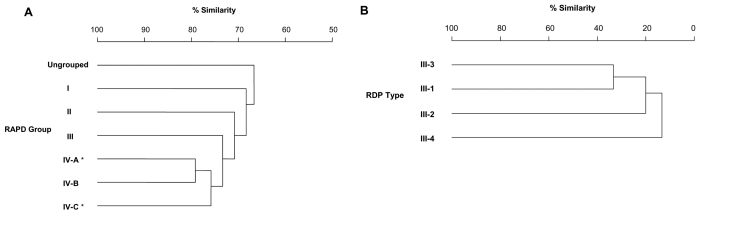
Description:Streptococcus agalactiae (group B streptococcus GBS) causes invasive human infections and bovine mastitis. This study examined the genetic relationship between bovine and human serotype III GBS by using molecular techniques that classify human serotype III GBS into four distinct phylogenetic lineages. Bovine serotype III GBS were largely contained in two lineages, which are distinct from the two major lineages (restriction digest types III-2 and III-3) that infect human neonates. One of the bovine lineages closely resembles the human III-1 lineage, whose members occasionally cause human neonatal infections. The bovine strains in the other lineage characteristically have an initiation factor IF2 gene (infB) H allele and multilocus sequence types that are not found in human GBS strains. Evidence suggests that this "H allele" lineage is related to the human III-3 lineage. These results support the assertion that human and bovine GBS are largely unrelated and provide further insight into the genetic relation between human and bovine GBS.
-
Subjects:
- Research
- Streptococcus agalactiae
- group B streptococcus
- bovine mastitis
- phylogeny
- infB
- neonatal sepsis
- Alleles
- Animals
- Cattle
- Cattle Diseases
- Female
- Humans
- Infant, Newborn
- Milk
- Molecular Sequence Data
- Pregnancy
- Pregnancy Complications, Infectious
- Prokaryotic Initiation Factor-2
- Random Amplified Polymorphic DNA Technique
- Sequence Analysis, DNA
- Serotyping
- Streptococcal Infections
-
Source:Emerg Infect Dis. 10(8):1412-1419.
-
Document Type:
-
Volume:10
-
Issue:8
-
Download URL:
-
File Type:
 [PDF - 216.94 KB]
 -
Collection(s):
-
Main Document Checksum:urn:sha256:6cf0cb21b0e5898ecff0a33586cc06ae02136064217a10f854ba8785a4c3e224
Supporting Files


 Was this page helpful?
 Found an issue?


CDC STACKS serves as an archival repository of CDC-published products including
scientific findings, journal articles, guidelines, recommendations, or other public health information authored or
co-authored by CDC or funded partners.
As a repository, CDC STACKS retains documents in their original published format to ensure public access to scientific information.
As a repository, CDC STACKS retains documents in their original published format to ensure public access to scientific information.
You May Also Like
COLLECTION
Emerging Infectious Diseases