



Serologic and Molecular Biologic Methods for SARS-associated Coronavirus Infection, Taiwan
Supporting Files
Public Domain

-
Feb 2004
File Language:
English
Details
-
Alternative Title:Emerg Infect Dis
-
Personal Author:Wu, Ho-Sheng ; Chiu, Shu-Chun ; Tseng, Tsan-Chang ; Lin, Szu-Fong ; Lin, Jih-Hui ; Hsu, Yu-Fen ; Wang, Mei-Ching ; Lin, Tsuey-Li ; Yang, Wen-Zieh ; Ferng, Tian-Lin ; Huang, Kai-Hung ; Hsu, Li-Ching ; Lee, Li-Li ; Yang, Jyh-Yuan ; Chen, Hour-Young ; Su, Shun-Pi ; Yang, Shih-Yan ; Lin, Ting-Hsiang ; Su, Ih-Jen
-
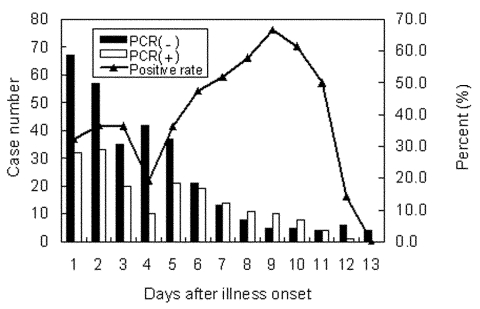
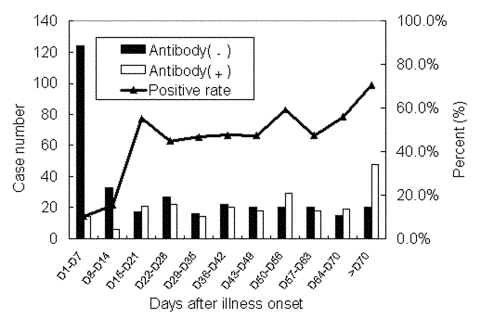
Description:Severe acute respiratory syndrome (SARS) has raised a global alert since March 2003. After its causative agent, SARS-associated coronavirus (SARS-CoV), was confirmed, laboratory methods, including virus isolation, reverse transcriptase-polymerase chain reaction (RT-PCR), and serologic methods, have been quickly developed. In this study, we evaluated four serologic tests ( neutralization test, enzyme-linked immunosorbent assay ELISA, immunofluorescent assay IFA, and immunochromatographic test ICT) for detecting antibodies to SARS-CoV in sera of 537 probable SARS case-patients with correlation to the RT-PCR. With the neutralization test as a reference method, the sensitivity, specificity, positive predictive value, and negative predictive value were 98.2%, 98.7%, 98.7%, and 98.4% for ELISA; 99.1%, 87.8%, 88.1% and 99.1% for IFA; 33.6%, 98.2%, 95.7%, and 56.1% for ICT, respectively. We also compared the recombinant-based western blot with the whole virus-based IFA and ELISA; the data showed a high correlation between these methods, with an overall agreement of >90%. Our results provide a systematic analysis of serologic and molecular methods for evaluating SARS-CoV infection.
-
Subjects:
- Antibodies, Viral
- Antigens, Viral
- Blotting, Western
- Chromatography
- Cross Reactions
- Enzyme-Linked Immunosorbent Assay
- Fluorescent Antibody Technique
- Humans
- Neutralization Tests
- Predictive Value of Tests
- Recombinant Proteins
- Reverse Transcriptase Polymerase Chain Reaction
- SARS Virus
- Sensitivity and Specificity
- Severe Acute Respiratory Syndrome
- Taiwan
-
Source:Emerg Infect Dis. 10(2):305-310.
-
Document Type:
-
Volume:10
-
Issue:2
-
Download URL:
-
File Type:
 [PDF - 383.62 KB]
 -
Collection(s):
-
Main Document Checksum:urn:sha256:5d74d0cb09090e1ab6885b0c18c0c14ffe40db81b9713e3a2e6fa0a83e975baa
Supporting Files


File Language:
English
 Was this page helpful?
 Found an issue?


CDC STACKS serves as an archival repository of CDC-published products including
scientific findings, journal articles, guidelines, recommendations, or other public health information authored or
co-authored by CDC or funded partners.
As a repository, CDC STACKS retains documents in their original published format to ensure public access to scientific information.
As a repository, CDC STACKS retains documents in their original published format to ensure public access to scientific information.
You May Also Like
COLLECTION
Emerging Infectious Diseases