



Alert Threshold Algorithms and Malaria Epidemic Detection
Supporting Files
Public Domain

-
2004/07/01
File Language:
English
Details
-
Alternative Title:Emerg Infect Dis
-
Personal Author:
-
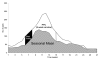
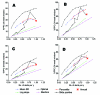
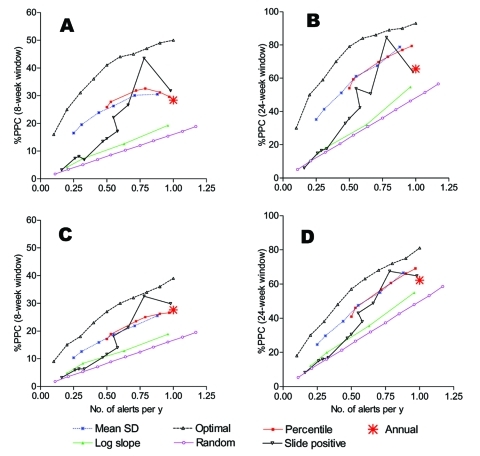
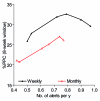
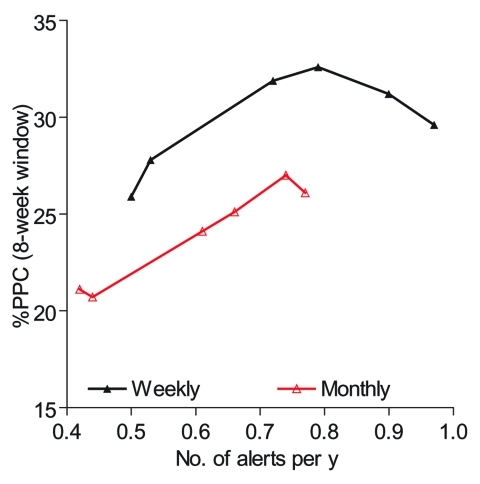
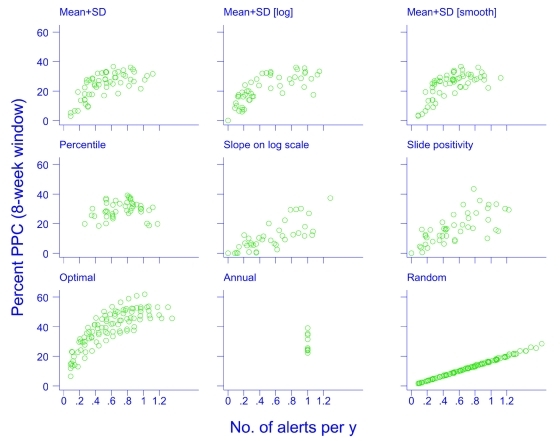
Description:We describe a method for comparing the ability of different alert threshold algorithms to detect malaria epidemics and use it with a dataset consisting of weekly malaria cases collected from health facilities in 10 districts of Ethiopia from 1990 to 2000. Four types of alert threshold algorithms are compared: weekly percentile, weekly mean with standard deviation (simple, moving average, and log-transformed case numbers), slide positivity proportion, and slope of weekly cases on log scale. To compare dissimilar alert types on a single scale, a curve was plotted for each type of alert, which showed potentially prevented cases versus number of alerts triggered over 10 years. Simple weekly percentile cutoffs appear to be as good as more complex algorithms for detecting malaria epidemics in Ethiopia. The comparative method developed here may be useful for testing other proposed alert thresholds and for application in other populations.
-
Subjects:
-
Source:Emerg Infect Dis. 10(7):1220-1226.
-
Document Type:
-
Genre:
-
Place as Subject:
-
Location:
-
Volume:10
-
Issue:7
-
Download URL:
-
File Type:
 [PDF - 173.46 KB]
 -
Collection(s):
-
Main Document Checksum:urn:sha-512:3e884cd88d97f4a08e60d045dfef3ee2570f30189cf3fcd6cceb57007e8e637f3d6fde373fc42543b867640f7190f5515160b929df50d5d8a913feb197e06be4
Supporting Files


File Language:
English
 Was this page helpful?
 Found an issue?



















CDC STACKS serves as an archival repository of CDC-published products including
scientific findings, journal articles, guidelines, recommendations, or other public health information authored or
co-authored by CDC or funded partners.
As a repository, CDC STACKS retains documents in their original published format to ensure public access to scientific information.
As a repository, CDC STACKS retains documents in their original published format to ensure public access to scientific information.
You May Also Like
COLLECTION
Emerging Infectious Diseases