



Endemic Venezuelan Equine Encephalitis in Northern Peru
Supporting Files

-
May 2004
File Language:
English
Details
-
Alternative Title:Emerg Infect Dis
-
Personal Author:Aguilar, Patricia V. ; Greene, Ivorlyne P. ; Coffey, Lark L. ; Medina, Gladys ; Moncayo, Abelardo C. ; Anishchenko, Michael ; Ludwig, George V. ; Turell, Michael J. ; O’Guinn, Monica L. ; Lee, John ; Tesh, Robert B. ; Watts, Douglas M. ; Russell, Kevin L. ; Hice, Christine ; Yanoviak, Stephen ; Morrison, Amy C. ; Klein, Terry A. ; Dohm, David J. ; Guzman, Hilda ; Travassos da Rosa, Amelia P.A. ; Guevara, Carolina ; Kochel, Tadeusz ; Olson, James ; Cabezas, Cesar ; Weaver, Scott C.
-
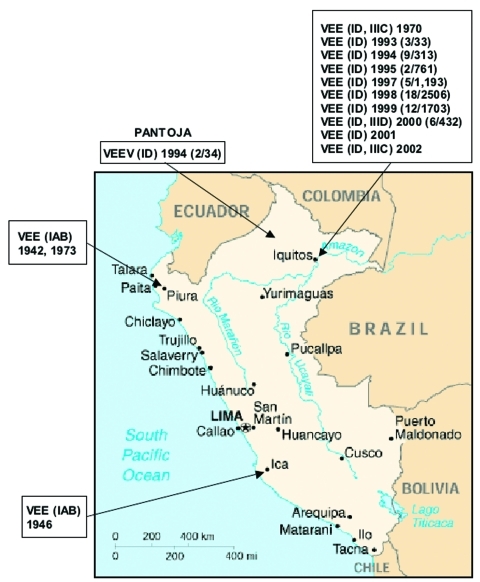
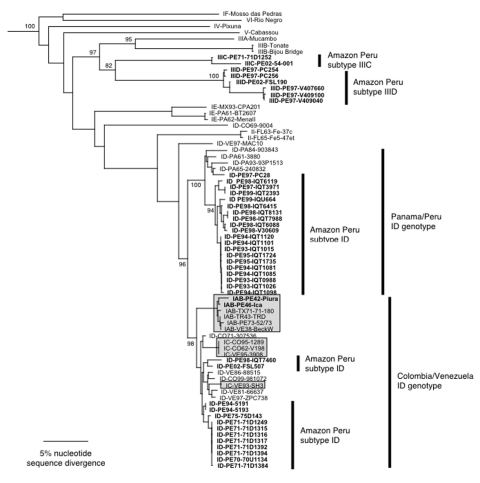
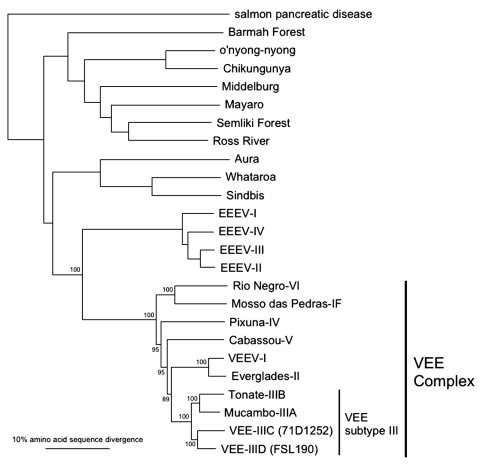
Description:Since Venezuelan equine encephalitis virus (VEEV) was isolated in Peru in 1942, >70 isolates have been obtained from mosquitoes, humans, and sylvatic mammals primarily in the Amazon region. To investigate genetic relationships among the Peru VEEV isolates and between the Peru isolates and other VEEV strains, a fragment of the PE2 gene was amplified and analyzed by single-stranded conformation polymorphism. Representatives of seven genotypes underwent sequencing and phylogenetic analysis. The results identified four VEE complex lineages that cocirculate in the Amazon region: subtypes ID (Panama and Colombia/Venezuela genotypes), IIIC, and a new, proposed subtype IIID, which was isolated from a febrile human, mosquitoes, and spiny rats. Both ID lineages and the IIID subtype are associated with febrile human illness. Most of the subtype ID isolates belonged to the Panama genotype, but the Colombia/Venezuela genotype, which is phylogenetically related to epizootic strains, also continues to circulate in the Amazon basin.
-
Subjects:
-
Source:Emerg Infect Dis. 10(5):880-888.
-
Document Type:
-
Funding:
-
Place as Subject:
-
Volume:10
-
Issue:5
-
Download URL:
-
File Type:
 [PDF - 480.28 KB]
 -
Collection(s):
-
Main Document Checksum:urn:sha256:e08dc96a7370709ec945352cbfd35e15d968b7dd2fe57c83590254666276c2b3
Supporting Files


File Language:
English
 Was this page helpful?
 Found an issue?



CDC STACKS serves as an archival repository of CDC-published products including
scientific findings, journal articles, guidelines, recommendations, or other public health information authored or
co-authored by CDC or funded partners.
As a repository, CDC STACKS retains documents in their original published format to ensure public access to scientific information.
As a repository, CDC STACKS retains documents in their original published format to ensure public access to scientific information.
You May Also Like
COLLECTION
Emerging Infectious Diseases