



SARS Outbreak, Taiwan, 2003
Supporting Files
Public Domain

-
Feb 2004
Details
-
Alternative Title:Emerg Infect Dis
-
Personal Author:
-
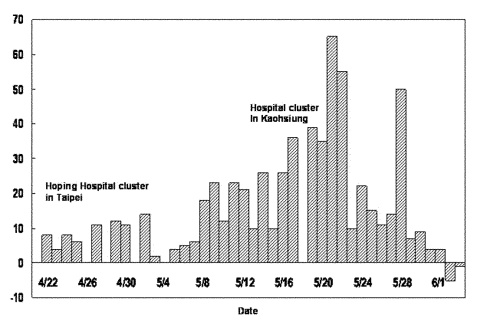
Description:We studied the severe acute respiratory syndrome (SARS) outbreak in Taiwan, using the daily case-reporting data from May 5 to June 4 to learn how it had spread so rapidly. Our results indicate that most SARS-infected persons had symptoms and were admitted before their infections were reclassified as probable cases. This finding could indicate efficient admission, slow reclassification process, or both. The high percentage of nosocomial infections in Taiwan suggests that infection from hospitalized patients with suspected, but not yet classified, cases is a major factor in the spread of disease. Delays in reclassification also contributed to the problem. Because accurate diagnostic testing for SARS is currently lacking, intervention measures aimed at more efficient diagnosis, isolation of suspected SARS patients, and reclassification procedures could greatly reduce the number of infections in future outbreaks.
-
Subjects:
- Research
- severe acute respiratory syndrome
- SARS-CoV
- infectious diseases
- epidemiology
- Taiwan
- nosocomial infections
- quarantine and isolation
- prevention and control
- theoretical model
- effective reproductive number
- Cross Infection
- Disease Outbreaks
- Humans
- Models, Biological
- Severe Acute Respiratory Syndrome
-
Source:Emerg Infect Dis. 10(2):201-206.
-
Document Type:
-
Volume:10
-
Issue:2
-
Download URL:
-
File Type:
 [PDF - 80.96 KB]
 -
Collection(s):
-
Main Document Checksum:urn:sha256:081a6003e7f889b091ecd537c4260fe081e304c6dfd1b83d0311ec120f9a7fd0
Supporting Files


 Was this page helpful?
 Found an issue?




CDC STACKS serves as an archival repository of CDC-published products including
scientific findings, journal articles, guidelines, recommendations, or other public health information authored or
co-authored by CDC or funded partners.
As a repository, CDC STACKS retains documents in their original published format to ensure public access to scientific information.
As a repository, CDC STACKS retains documents in their original published format to ensure public access to scientific information.
You May Also Like
COLLECTION
Emerging Infectious Diseases