



Detecting Bioterror Attacks by Screening Blood Donors: A Best-Case Analysis
Supporting Files
Public Domain

-
Aug 2003
File Language:
English
Details
-
Alternative Title:Emerg Infect Dis
-
Personal Author:
-
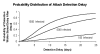
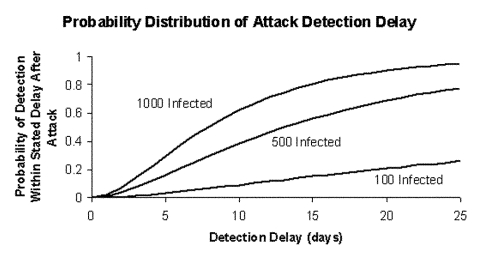
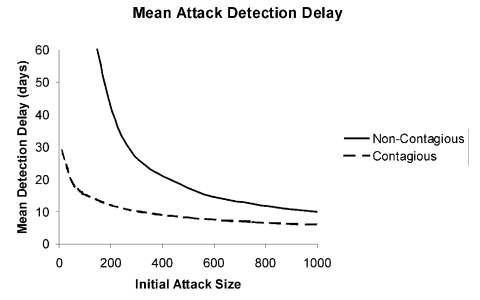
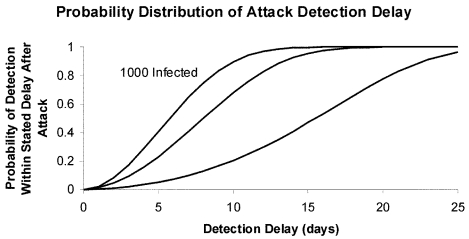
Description:To assess whether screening blood donors could provide early warning of a bioterror attack, we combined stochastic models of blood donation and the workings of blood tests with an epidemic model to derive the probability distribution of the time to detect an attack under assumptions favorable to blood donor screening. Comparing the attack detection delay to the incubation times of the most feared bioterror agents shows that even under such optimistic conditions, victims of a bioterror attack would likely exhibit symptoms before the attack was detected through blood donor screening. For example, an attack infecting 100 persons with a noncontagious agent such as Bacillus anthracis would only have a 26% chance of being detected within 25 days; yet, at an assumed additional charge of $10 per test, donor screening would cost $139 million per year. Furthermore, even if screening tests were 99.99% specific, 1,390 false-positive results would occur each year. Therefore, screening blood donors for bioterror agents should not be used to detect a bioterror attack.
-
Subjects:
-
Source:Emerg Infect Dis. 9(8):909-914
-
Pubmed ID:12967486
-
Pubmed Central ID:PMC3020608
-
Document Type:
-
Volume:9
-
Issue:8
-
Download URL:
-
File Type:
 [PDF - 344.23 KB]
 -
Collection(s):
-
Main Document Checksum:urn:sha256:3ffc9958dda7cfbae254b383293cc82b1a1fee8cf470e101c21800c3b8206210
Supporting Files


File Language:
English
 Was this page helpful?
 Found an issue?

CDC STACKS serves as an archival repository of CDC-published products including
scientific findings, journal articles, guidelines, recommendations, or other public health information authored or
co-authored by CDC or funded partners.
As a repository, CDC STACKS retains documents in their original published format to ensure public access to scientific information.
As a repository, CDC STACKS retains documents in their original published format to ensure public access to scientific information.
You May Also Like
COLLECTION
Emerging Infectious Diseases