



Enzootic Transmission of Yellow Fever Virus in Peru
Supporting Files

-
Aug 2003
File Language:
English
Details
-
Alternative Title:Emerg Infect Dis
-
Personal Author:
-
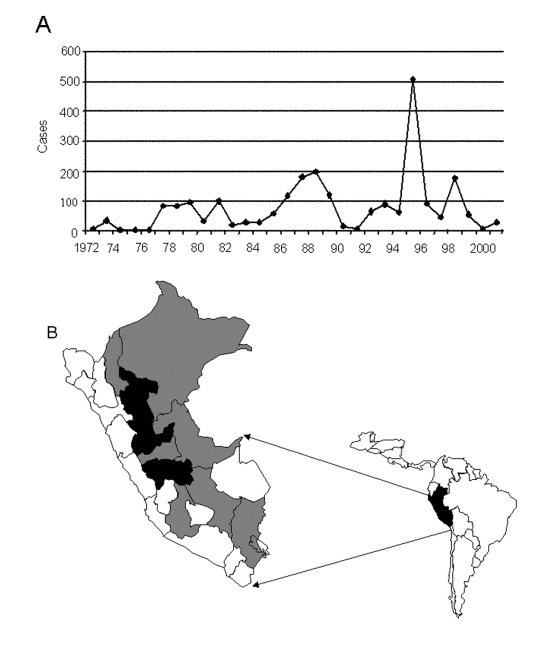
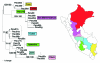
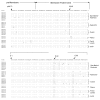
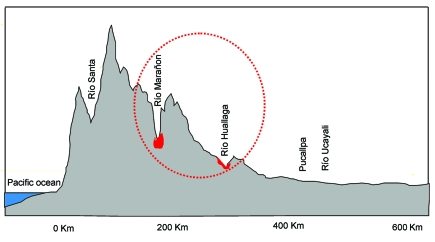
Description:The prevailing paradigm of yellow fever virus (YFV) ecology in South America is that of wandering epizootics. The virus is believed to move from place to place in epizootic waves involving monkeys and mosquitoes, rather than persistently circulating within particular locales. After a large outbreak of YFV illness in Peru in 1995, we used phylogenetic analyses of virus isolates to reexamine the hypothesis of virus movement. We sequenced a 670-nucleotide fragment of the prM/E gene region from 25 Peruvian YFV samples collected from 1977 to 1999, and delineated six clades representing the states (Departments) of Puno, Pasco, Junin, Ayacucho, San Martin/Huanuco, and Cusco. The concurrent appearance of at least four variants during the 1995 epidemic and the genetic stability of separate virus lineages over time indicate that Peruvian YFV is locally maintained and circulates continuously in discrete foci of enzootic transmission.
-
Subjects:
-
Source:Emerg Infect Dis. 9(8):926-933
-
Pubmed ID:12967489
-
Pubmed Central ID:PMC3023271
-
Document Type:
-
Funding:
-
Volume:9
-
Issue:8
-
Download URL:
-
File Type:
 [PDF - 426.97 KB]
 -
Collection(s):
-
Main Document Checksum:urn:sha256:dce4d8abe1b9ee252fa1b97719d59477cb45e0880992c4326f47f187e3251598
Supporting Files


File Language:
English
 Was this page helpful?
 Found an issue?




CDC STACKS serves as an archival repository of CDC-published products including
scientific findings, journal articles, guidelines, recommendations, or other public health information authored or
co-authored by CDC or funded partners.
As a repository, CDC STACKS retains documents in their original published format to ensure public access to scientific information.
As a repository, CDC STACKS retains documents in their original published format to ensure public access to scientific information.
You May Also Like
COLLECTION
Emerging Infectious Diseases