



Hantavirus Pulmonary Syndrome in Uruguay
Supporting Files
Public Domain

-
2003/07/01
-
Series: Emerging Infectious Diseases
File Language:
English
Details
-
Journal Article:Emerging Infectious Diseases
-
Personal Author:
-
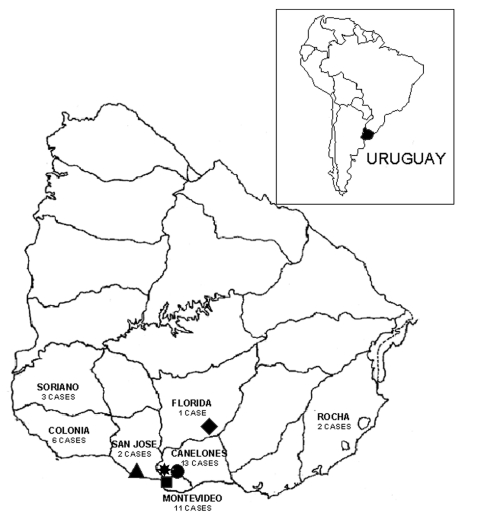
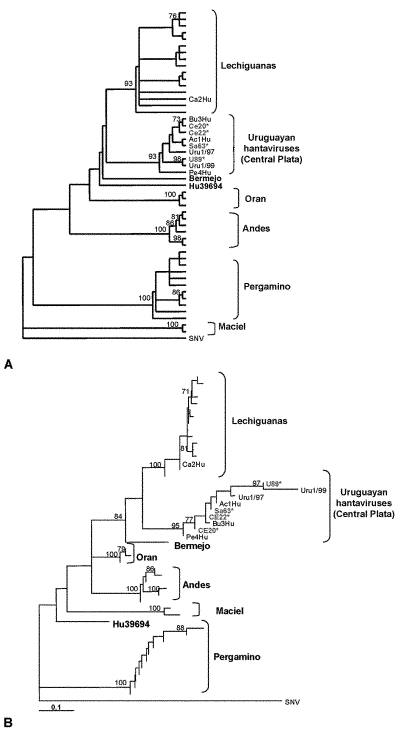
Description:During 5,230 trapping nights, 672 small mammals were trapped in the areas where most hantavirus pulmonary syndrome (HPS) cases occur in Uruguay. Yellow pygmy rice rats (Oligoryzomys flavescens) were the only rodents that showed evidence of antibodies to hantavirus, with a seroprevalence of 2.6%. The rodents were trapped in all the explored environments, and most of the seropositive rodents were found in habitats frequented by humans. Nucleotide sequences were obtained from four HPS case-patients and four yellow pygmy rice rats of the M genome segment. Sequence comparison and phylogenetic analysis showed that rodent-borne viruses and viruses from three HPS case-patients form a well-supported clade and share a 96.4% identity with the previously characterized Central Plata hantavirus. These results suggest that yellow pygmy rice rat (O. flavescens) may be the host for Central Plata, a hantavirus associated with HPS in the southern area of Uruguay.
-
Subjects:
-
Series:
-
DOI:
-
ISSN:1080-6059 (digital) ; 1080-6040 (print)
-
Pubmed ID:12890326
-
Document Type:
-
Genre:
-
Place as Subject:
-
Rights:Public Domain
-
Topic:
-
Location:
-
Volume:9
-
Issue:7
-
Citation:Emerg Infect Dis. 9(7):846-852.
-
Download URL:
-
File Type:
 [PDF - 291.12 KB]
 -
Collection(s):
-
Main Document Checksum:urn:sha-512:e356f9a36d9499a0883402fa315d14491a13de72a324624434b98b0edf739241cd029b34ade93405020302db1a293207019b1ab16f05a14ee56c27318cdf6ae9
Supporting Files


File Language:
English
 Was this page helpful?
 Found an issue?



CDC STACKS serves as an archival repository of CDC-published products including
scientific findings, journal articles, guidelines, recommendations, or other public health information authored or
co-authored by CDC or funded partners.
As a repository, CDC STACKS retains documents in their original published format to ensure public access to scientific information.
As a repository, CDC STACKS retains documents in their original published format to ensure public access to scientific information.
You May Also Like
COLLECTION
Emerging Infectious Diseases