



Mycobacterium abscessus and Children with Cystic Fibrosis
Supporting Files
Public Domain

-
Dec 2003
Details
-
Alternative Title:Emerg Infect Dis
-
Personal Author:Sermet-Gaudelus, Isabelle ; Le Bourgeois, Muriel ; Pierre-Audigier, Catherine ; Offredo, Catherine ; Guillemot, Didier ; Halley, Sophie ; Akoua-Koffi, Chantal ; Vincent, Véronique ; Sivadon-Tardy, Valérie ; Ferroni, Agnès ; Berche, Patrick ; Scheinmann, Pierre ; Lenoir, Gérard ; Gaillard, Jean-Louis
-
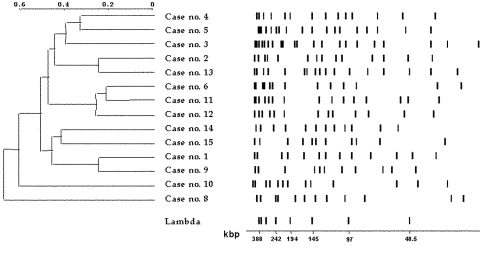
Description:We prospectively studied 298 patients with cystic fibrosis (mean age 11.3 years; range 2 months to 32 years; sex ratio, 0.47) for nontuberculous mycobacteria in respiratory samples from January 1, 1996, to December 31, 1999. Mycobacterium abscessus was by far the most prevalent nontuberculous mycobacterium: 15 patients (6 male, 9 female; mean age 11.9 years; range 2.5-22 years) had at least one positive sample for this microorganism (versus 6 patients positive for M. avium complex), including 10 with >3 positive samples (versus 3 patients for M. avium complex). The M. abscessus isolates from 14 patients were typed by pulsed-field gel electrophoresis: each of the 14 patients harbored a unique strain, ruling out a common environmental reservoir or person-to-person transmission. Water samples collected in the cystic fibrosis center were negative for M. abscessus. This major mycobacterial pathogen in children and teenagers with cystic fibrosis does not appear to be acquired nosocomially.
-
Subjects:
- Research
- Cystic Fibrosis
- Mycobacterium Abscessus
- Nontuberculous Mycobacteria
- Hsp65 Sequencing
- Pulsed-Field Gel Electrophoresis
- Epidemiology
- Adolescent
- Bacterial Proteins
- Chaperonin 60
- Chaperonins
- Child
- Child, Preschool
- DNA, Bacterial
- Electrophoresis, Gel, Pulsed-Field
- Female
- Humans
- Male
- Mycobacterium Infections
- Mycobacterium Chelonae
- Phylogeny
- Prospective Studies
- Sputum
-
Source:Emerg Infect Dis. 9(12):1587-1591.
-
Document Type:
-
Volume:9
-
Issue:12
-
Download URL:
-
File Type:
 [PDF - 206.25 KB]
 -
Collection(s):
-
Main Document Checksum:urn:sha256:160a61b06279760effe887464b749acc14edcd8f9eab493277d3edfdbd2066c4
Supporting Files


 Was this page helpful?
 Found an issue?

CDC STACKS serves as an archival repository of CDC-published products including
scientific findings, journal articles, guidelines, recommendations, or other public health information authored or
co-authored by CDC or funded partners.
As a repository, CDC STACKS retains documents in their original published format to ensure public access to scientific information.
As a repository, CDC STACKS retains documents in their original published format to ensure public access to scientific information.
You May Also Like
COLLECTION
Emerging Infectious Diseases