



Airborne Infection with Bacillus anthracis—from Mills to Mail
Supporting Files
Public Domain

-
Jun 2004
File Language:
English
Details
-
Alternative Title:Emerg Infect Dis
-
Personal Author:
-
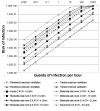
Description:The lack of identified exposures in 2 of the 11 cases of bioterrorism-related inhalation anthrax in 2001 raised uncertainty about the infectious dose and transmission of Bacillus anthracis. We used the Wells-Riley mathematical model of airborne infection to estimate 1) the exposure concentrations in postal facilities where cases of inhalation anthrax occurred and 2) the risk for infection in various hypothetical scenarios of exposure to B. anthracis aerosolized from contaminated mail in residential settings. These models suggest that a small number of cases of inhalation anthrax can be expected when large numbers of persons are exposed to low concentrations of B. anthracis. The risk for inhalation anthrax is determined not only by bacillary virulence factors but also by infectious aerosol production and removal rates and by host factors.
-
Subjects:
-
Source:Emerg Infect Dis. 10(6):996-1001.
-
Document Type:
-
Volume:10
-
Issue:6
-
Download URL:
-
File Type:
 [PDF - 129.23 KB]
 -
Collection(s):
-
Main Document Checksum:urn:sha256:5f9b3b4a9a42d70edd5ca00a73d97f776dc9095c8be06ace5991bf8209fb9000
Supporting Files


File Language:
English
 Was this page helpful?
 Found an issue?


CDC STACKS serves as an archival repository of CDC-published products including
scientific findings, journal articles, guidelines, recommendations, or other public health information authored or
co-authored by CDC or funded partners.
As a repository, CDC STACKS retains documents in their original published format to ensure public access to scientific information.
As a repository, CDC STACKS retains documents in their original published format to ensure public access to scientific information.
You May Also Like
COLLECTION
Emerging Infectious Diseases