



Vector Interactions and Molecular Adaptations of Lyme Disease and Relapsing Fever Spirochetes Associated with Transmission by Ticks
Supporting Files
Public Domain

-
Feb 2002
Details
-
Alternative Title:Emerg Infect Dis
-
Personal Author:
-
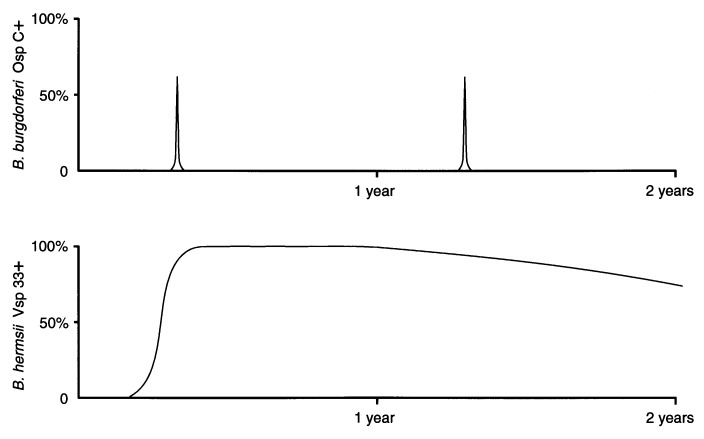
Description:Pathogenic spirochetes in the genus Borrelia are transmitted primarily by two families of ticks. The Lyme disease spirochete, Borrelia burgdorferi, is transmitted by the slow-feeding ixodid tick Ixodes scapularis, whereas the relapsing fever spirochete, B. hermsii, is transmitted by Ornithodoros hermsi, a fast-feeding argasid tick. Lyme disease spirochetes are generally restricted to the midgut in unfed I. scapularis. When nymphal ticks feed, the bacteria pass through the hemocoel to the salivary glands and are transmitted to a new host in the saliva after 2 days. Relapsing fever spirochetes infect the midgut in unfed O. hermsi but persist in other sites including the salivary glands. Thus, relapsing fever spirochetes are efficiently transmitted in saliva by these fast-feeding ticks within minutes of their attachment to a mammalian host. We describe how B. burgdorferi and B. hermsii change their outer surface during their alternating infections in ticks and mammals, which in turn suggests biological functions for a few surface-exposed lipoproteins.
-
Subjects:
-
Source:Emerg Infect Dis. 8(2):115-121.
-
Document Type:
-
Volume:8
-
Issue:2
-
Download URL:
-
File Type:
 [PDF - 105.94 KB]
 -
Collection(s):
-
Main Document Checksum:urn:sha256:13a1402eb3f2f73373b9b76e1cf4ad702ae3ee8071631f60abde129ee49b0bfb
Supporting Files


 Was this page helpful?
 Found an issue?




CDC STACKS serves as an archival repository of CDC-published products including
scientific findings, journal articles, guidelines, recommendations, or other public health information authored or
co-authored by CDC or funded partners.
As a repository, CDC STACKS retains documents in their original published format to ensure public access to scientific information.
As a repository, CDC STACKS retains documents in their original published format to ensure public access to scientific information.
You May Also Like
COLLECTION
Emerging Infectious Diseases