



Fatalism and Psychological Distress Among Chinese American Breast Cancer Survivors: Mediating Role of Perceived Self-control and Fear of Cancer Recurrence
Supporting Files

-
10 2023 ; 10-2023
-
Available in CDC Stacks on 2023-10-01T00:00:00Z

File Language:
English
Details
-
Alternative Title:Int J Behav Med
-
Personal Author:
-
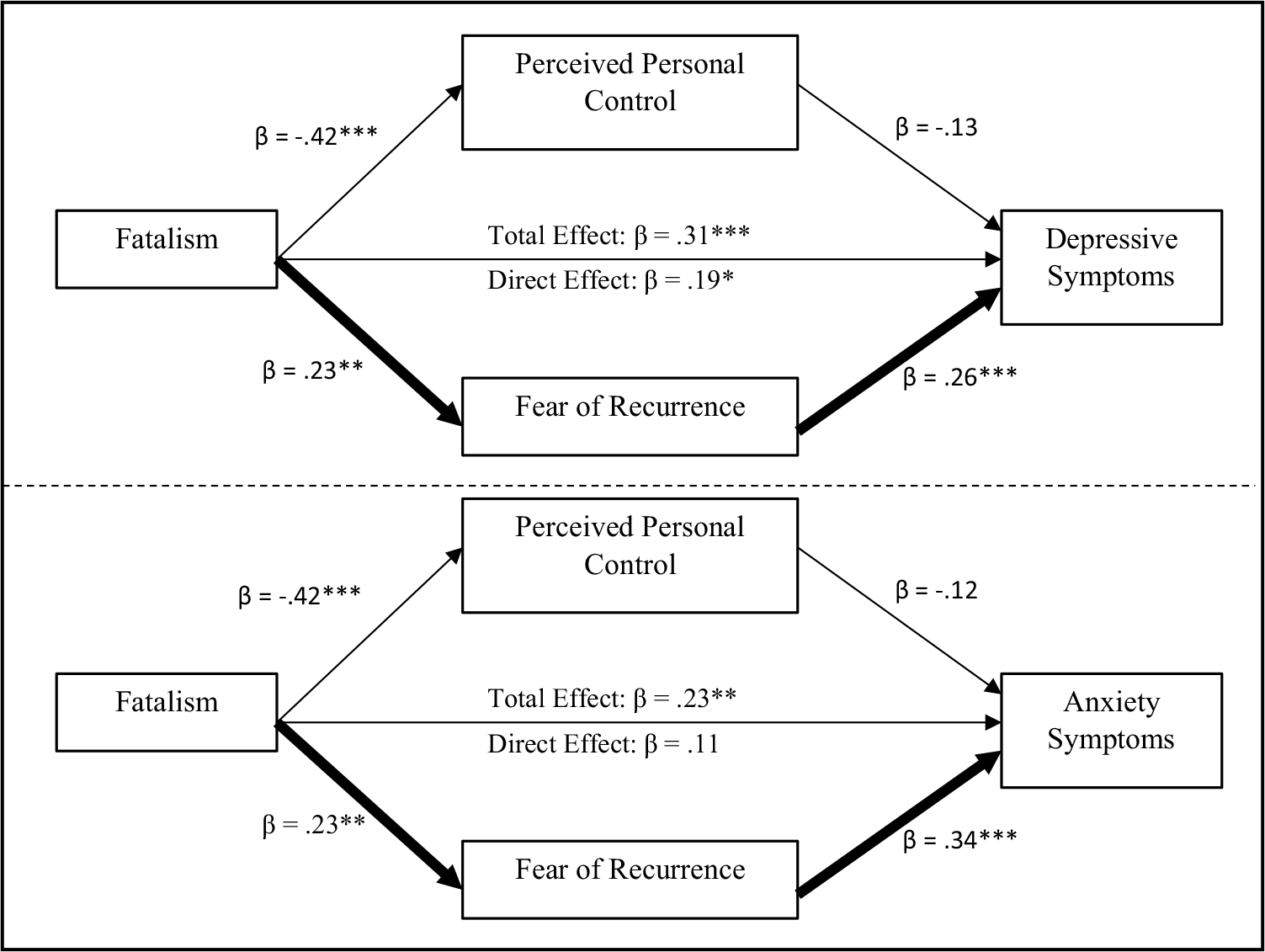
Description:Background ; Extant literature on the relationship between cancer fatalism and psychological distress among Chinese American breast cancer survivors has been mixed, and few studies have examined potential mediators of this relationship. The current study examined how cancer fatalism is associated with psychological distress by investigating perceived personal control and fear of cancer recurrence as mediators, and acculturation as a moderator of these relationships. ; Method ; A total of 220 Chinese American women diagnosed with stage 0–III breast cancer were recruited from California cancer registries and completed a telephone survey. The measurement of cancer fatalism examined one’s view of health as a result of destiny. Validated measures of psychological distress (i.e., depressive and anxiety symptoms), fear of cancer recurrence, and perceived personal control were used. Acculturation was defined by English proficiency, preferred interview language, and number of years lived in the USA. ; Results ; Higher cancer fatalism was directly associated with greater depressive and anxiety symptoms after controlling for covariates. This association was also mediated by higher fear of cancer recurrence, but not by perceived control. The mediation was not moderated by acculturation. ; Conclusion ; Our findings suggest that Chinese American breast cancer survivors’ fatalistic beliefs may exacerbate fear of cancer recurrence, and, in turn, depressive and anxiety symptoms. Fear of recurrence was more salient than perceived control in their associations with psychological distress among Chinese American cancer survivors. Future intervention research may adopt cognitive approaches to alter Chinese survivors’ fatalistic views of health outcomes to reduce their psychological distress.
-
Subjects:
-
Keywords:
-
Source:Int J Behav Med. 30(5):705-713
-
Pubmed ID:36333553
-
Pubmed Central ID:PMC10494707
-
Document Type:
-
Funding:HHSN261201000140C/CA/NCI NIH HHSUnited States/ ; R21CA139408/CA/NCI NIH HHSUnited States/ ; HHSN261201000035C/CA/NCI NIH HHSUnited States/ ; K01 MD014750/MD/NIMHD NIH HHSUnited States/ ; U01 AR057971/AR/NIAMS NIH HHSUnited States/ ; R21 CA139408/CA/NCI NIH HHSUnited States/ ; HHSN261201000035I/CA/NCI NIH HHSUnited States/ ; HHSN261201000034C/CA/NCI NIH HHSUnited States/ ; 1K01MD014750/MD/NIMHD NIH HHSUnited States/ ; U58 DP003862/DP/NCCDPHP CDC HHSUnited States/
-
Volume:30
-
Issue:5
-
Download URL:
-
File Type:
 [PDF - 376.40 KB]
 -
Collection(s):
-
Main Document Checksum:urn:sha-512:2aaaab10535c86bbf1c7ffc44878339f35f621534ce97c23dc232c7dbf03d1011c939d6b8fa852740fc3d6aa33b095a84301bd54a6725b390a9bbc04a01cf709
Supporting Files


File Language:
English
 Was this page helpful?
 Found an issue?

CDC STACKS serves as an archival repository of CDC-published products including
scientific findings, journal articles, guidelines, recommendations, or other public health information authored or
co-authored by CDC or funded partners.
As a repository, CDC STACKS retains documents in their original published format to ensure public access to scientific information.
As a repository, CDC STACKS retains documents in their original published format to ensure public access to scientific information.
You May Also Like
COLLECTION
CDC Public Access