



Isotemporal Associations of Device-Measured Sedentary Time and Physical Activity with Cardiac-Autonomic Regulation in Previously Pregnant Women
Supporting Files

-
8 2023 ; 8-2023
-
Available in CDC Stacks on 2024-08-01T00:00:00Z
File Language:
English
Details
-
Alternative Title:Int J Behav Med
-
Personal Author:
-
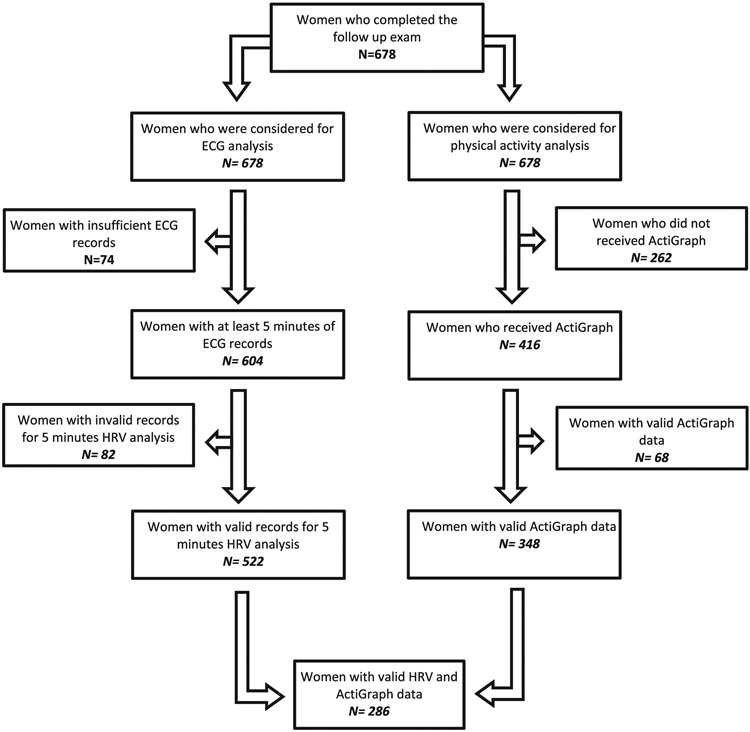
Description:Background: ; High sedentary time (ST) and low physical activity may increase cardiovascular risk, potentially though cardiac-autonomic dysregulation. This study investigated associations of statistically exchanging device-measured ST and physical activity with measures of cardiac-autonomic regulation in previously pregnant women. ; Methods: ; This cross-sectional, secondary analysis included 286 women (age=32.6±5.7 yrs; 68% white) measured 7-15 years after delivery. ST and light (LPA), moderate (MPA), vigorous (VPA), and moderate-to-vigorous (MVPA) intensity physical activity were measured by ActiGraph GT3X. ST was further partitioned into long (≥30 minutes) and short (<30 minutes) bouts. MVPA was also partitioned into long (≥10-minute) and short (<10-minute) bouts. Cardiac-autonomic regulation was assessed by heart rate variability (HRV) (resting heart rate, natural log transformed standard deviation of normal R-R intervals lnSDNN, natural log-transformed root mean square of successive differences lnRMSSD) from a 5-minute seated ECG. Progressive isotemporal substitution models adjusted for confounders. Sensitivity analyses removed women with related underlying medical conditions and who did not meet respiration rate criteria. ; Results: ; Initial analyses found no significant associations with HRV when exchanging 30 minutes of ST and physical activity (p>0.05). Yet, replacing long- and short-bout ST with 30 minutes of long-bout MVPA yielded significantly higher (healthier) lnRMSSD (B=0.063±0.030 and B=0.056±0.027, respectively; both p<0.05). Sensitivity analyses strengthened these associations and yielded further associations of higher lnSDNN and lnRMSSD when replacing 30 minutes of short-bout MVPA with equivalent amounts of long-bout MVPA (B=0.074±0.037 and B=0.091±0.046, respectively). ; Conclusion: ; Replacing ST with long-bout MVPA is a potential strategy to improve cardiac-autonomic function in previously pregnant women.
-
Subjects:
-
Keywords:
-
Source:Int J Behav Med. 30(4):497-508
-
Pubmed ID:35819720
-
Pubmed Central ID:PMC9832172
-
Document Type:
-
Funding:
-
Volume:30
-
Issue:4
-
Download URL:
-
File Type:
 [PDF - 510.46 KB]
 -
Collection(s):
-
Main Document Checksum:urn:sha-512:cde7777c8d97d571b56934b5ca920236d69dd0ae5b0d449010e826ab227218ce776891d4f520209a12e2bc08544b84120cdbae9e7ed59e72c0a8e305a04e9f77
Supporting Files


File Language:
English
 Was this page helpful?
 Found an issue?

CDC STACKS serves as an archival repository of CDC-published products including
scientific findings, journal articles, guidelines, recommendations, or other public health information authored or
co-authored by CDC or funded partners.
As a repository, CDC STACKS retains documents in their original published format to ensure public access to scientific information.
As a repository, CDC STACKS retains documents in their original published format to ensure public access to scientific information.
You May Also Like
COLLECTION
CDC Public Access