



Occupational risk factors for work disability following carpal tunnel syndrome: a pooled prospective study.
Supporting Files

-
7 2022 ; 7-2022
-
Available in CDC Stacks on July 01, 2023, 12:00 AM
File Language:
English
Details
-
Alternative Title:Occup Environ Med
-
Personal Author:
-
Description:Background:
Although recent studies have identified important risk factors associated with incident carpal tunnel syndrome(CTS), risk factors associated with its severity have not been well explored.
Objective:
To examine the associations between personal, workplace psychosocial and biomechanical factors and incident work disability among workers with carpal tunnel syndrome.
Methods:
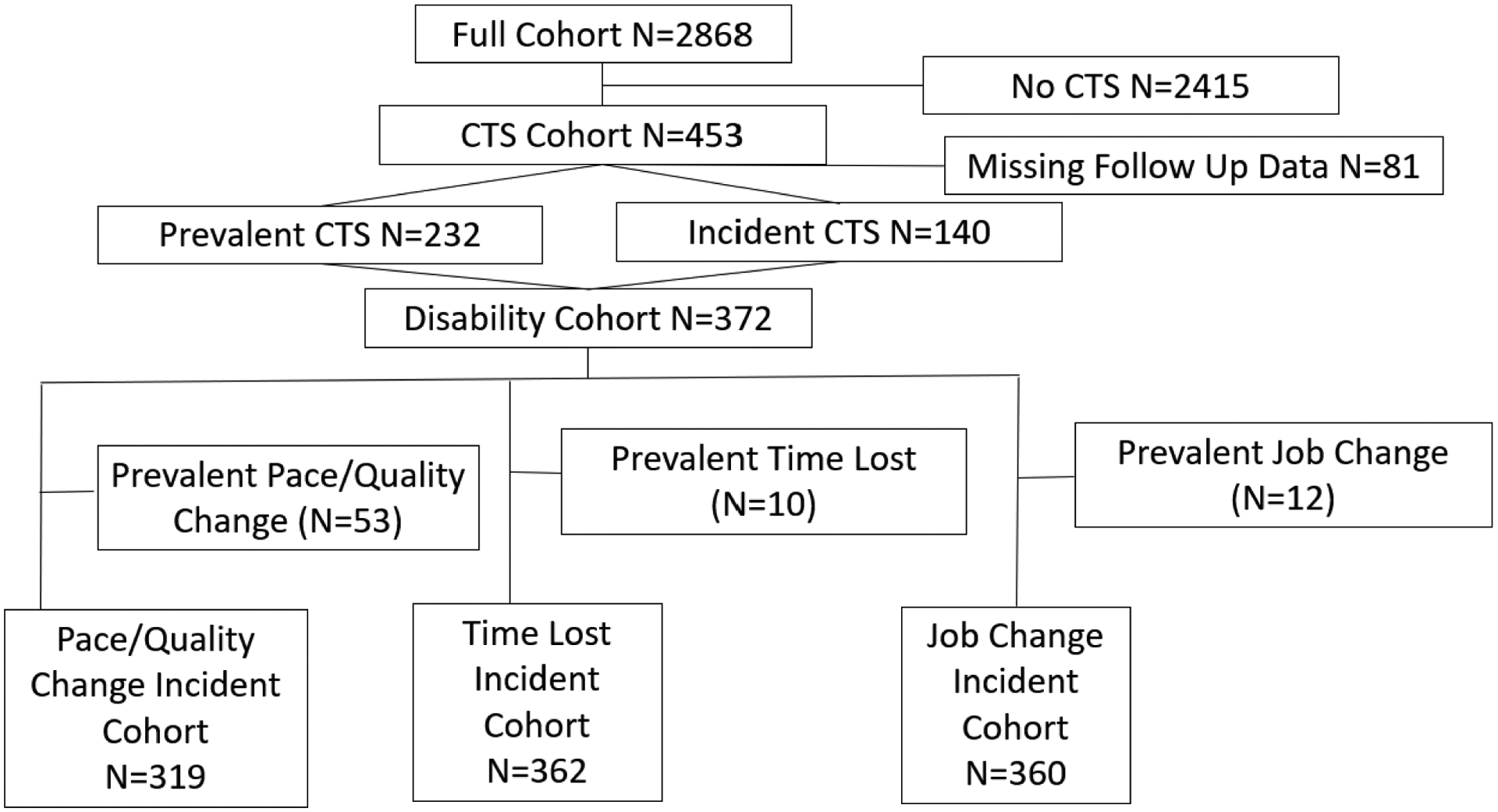
Between 2001 and 2010 five research groups conducted coordinated prospective studies of CTS and related work disability among US workers from various industries. Workers with prevalent or incident CTS (N=372) were followed for up to 6.4 years. Incident work disability was measured as: (1)change in work pace or work quality, (2)lost time, or (3)job change following the development of CTS. Psychosocial factors were assessed by questionnaire. Biomechanical exposures were assessed by observation and measurements and included force, repetition, duty cycle and posture. Hazard ratios(HR) were estimated using Cox models.
Results:
Disability incidence rates(IR) per 100 person-years were 33.2 for changes in work pace or quality, 16.3 for lost time, and 20.0 for job change. There was a near doubling of risk for job change among those in the upper tertile of the Hand Activity Level(HAL) Scale (HR=2.17; 95%CI: 1.17–4.01), total repetition rate (HR=1.75; 95% CI:1.02–3.02), %time spent in all hand exertions (HR=2.20; 95%CI:1.21–4.01), and a 6-fold increase for high job strain. Sensitivity analyses indicated attenuation due to inclusion of the prevalent CTS cases.
Conclusion:
Personal, biomechanical and psychosocial job factors predicted CTS–related disability. Results suggest that prevention of severe disability requires a reduction of both biomechanical and organizational work stressors. -
Subjects:
-
Source:Occup Environ Med. 79(7):442-451
-
Pubmed ID:35074886
-
Pubmed Central ID:PMC10291503
-
Document Type:
-
Funding:R01 OH007914/OH/NIOSH CDC HHSUnited States/ ; T42OH008414/ACL/ACL HHSUnited States/ ; UL1 RR024992/RR/NCRR NIH HHSUnited States/ ; CC999999/ImCDC/Intramural CDC HHSUnited States/ ; R01 OH010474/OH/NIOSH CDC HHSUnited States/ ; R01 OH009712/OH/NIOSH CDC HHSUnited States/ ; T42OH008429/ACL/ACL HHSUnited States/ ; T42 OH008429/OH/NIOSH CDC HHSUnited States/ ; T42 OH008414/OH/NIOSH CDC HHSUnited States/ ; U01 OH007917/OH/NIOSH CDC HHSUnited States/
-
Volume:79
-
Issue:7
-
Download URL:
-
File Type:
 [PDF - 646.09 KB]
 -
Collection(s):
-
Main Document Checksum:urn:sha256:c868e20a7369df95623d6da3d93483e479753f0c7f92381c849cb469fbe3f3c1
Supporting Files


File Language:
English
 Was this page helpful?
 Found an issue?

CDC STACKS serves as an archival repository of CDC-published products including
scientific findings, journal articles, guidelines, recommendations, or other public health information authored or
co-authored by CDC or funded partners.
As a repository, CDC STACKS retains documents in their original published format to ensure public access to scientific information.
As a repository, CDC STACKS retains documents in their original published format to ensure public access to scientific information.
You May Also Like
COLLECTION
CDC Public Access