



Early SARS-CoV-2 Reinfections Involving the Same or Different Genomic Lineages, Spain
Supporting Files
Public Domain

-
6 2023 ; 6-2023
File Language:
English
Details
-
Alternative Title:Emerg Infect Dis
-
Personal Author:Rodríguez-Grande, Cristina ; Estévez, Agustín ; Palomino-Cabrera, Rosalía ; Molero-Salinas, Andrea ; Peñas-Utrilla, Daniel ; Herranz, Marta ; Sanz-Pérez, Amadeo ; Alcalá, Luis ; Veintimilla, Cristina ; Catalán, Pilar ; Martínez-Laperche, Carolina ; Alonso, Roberto ; Muñoz, Patricia ; Pérez-Lago, Laura ; de Viedma, Darío García
-
Corporate Authors:
-
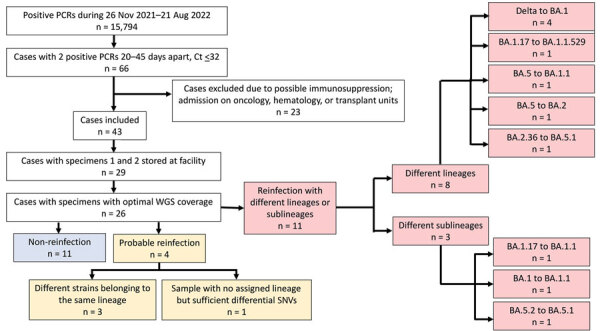
Description:Centers for Disease Control and Prevention guidelines consider SARS-CoV-2 reinfection when sequential COVID-19 episodes occur >90 days apart. However, genomic diversity acquired over recent COVID-19 waves could mean previous infection provides insufficient cross-protection. We used genomic analysis to assess the percentage of early reinfections in a sample of 26 patients with 2 COVID-19 episodes separated by 20-45 days. Among sampled patients, 11 (42%) had reinfections involving different SARS-CoV-2 variants or subvariants. Another 4 cases were probable reinfections; 3 involved different strains from the same lineage or sublineage. Host genomic analysis confirmed the 2 sequential specimens belonged to the same patient. Among all reinfections, 36.4% involved non-Omicron, then Omicron lineages. Early reinfections showed no specific clinical patterns; 45% were among unvaccinated or incompletely vaccinated persons, 27% were among persons <18 years of age, and 64% of patients had no risk factors. Time between sequential positive SARS-CoV-2 PCRs to consider reinfection should be re-evaluated.
-
Subjects:
- Research
- Early SARS-CoV-2 Reinfections Involving the Same or Different Genomic Lineages, Spain
- COVID-19
- SARS-CoV-2
- respiratory infections
- severe acute respiratory syndrome coronavirus 2
- SARS
- coronavirus disease
- zoonoses
- viruses
- coronavirus
- Spain
- United States
- Humans
- Reinfection
- Genomics
- Risk Factors
-
Source:Emerg Infect Dis. 2023; 29(6):1154-1161
-
Pubmed ID:37130503
-
Pubmed Central ID:PMC10202887
-
Document Type:
-
Volume:29
-
Issue:6
-
Download URL:
-
File Type:
 [PDF - 984.78 KB]
 -
Collection(s):
-
Main Document Checksum:urn:sha256:4e868b120a8ad1d0d1d4fca1231442bcdaab72fdb6a45d329fde3bba8d5fe211
Supporting Files


File Language:
English
 Was this page helpful?
 Found an issue?

CDC STACKS serves as an archival repository of CDC-published products including
scientific findings, journal articles, guidelines, recommendations, or other public health information authored or
co-authored by CDC or funded partners.
As a repository, CDC STACKS retains documents in their original published format to ensure public access to scientific information.
As a repository, CDC STACKS retains documents in their original published format to ensure public access to scientific information.
You May Also Like
COLLECTION
Emerging Infectious Diseases