



Isomer-Specific Serum Concentrations of Perfluorooctane Sulfonic Acid among U.S. Adults: Results from the National Health and Nutrition Examination Survey (NHANES) and the Study of Women’s Health Across the Nation Multi-Pollutant Study (SWAN-MPS)
Supporting Files

-
1 10 2023 ; 1-10-
-
Available in CDC Stacks on 2024-01-10T00:00:00Z

File Language:
English
Details
-
Alternative Title:Environ Sci Technol
-
Personal Author:
-
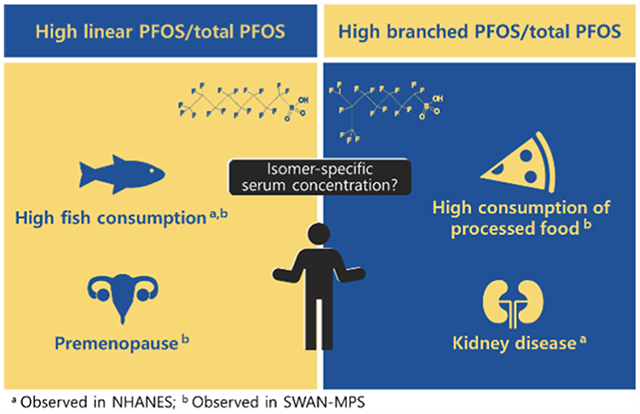
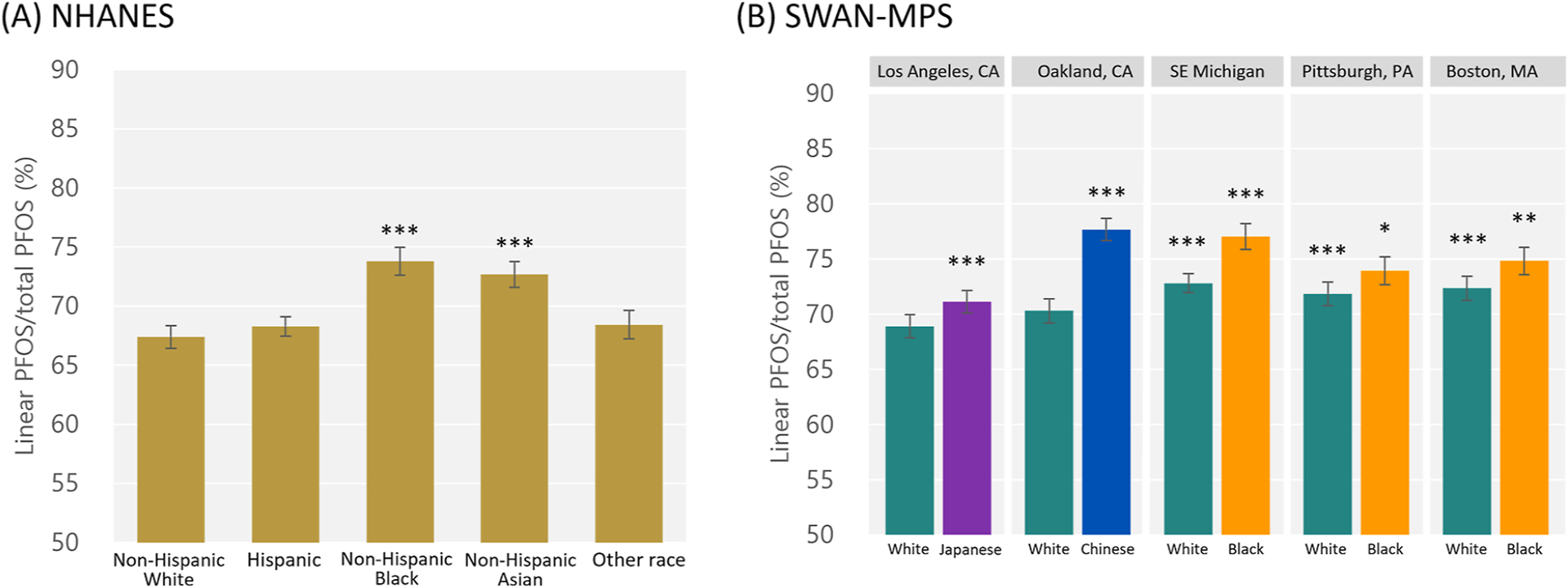
Description:Electrochemical fluorination manufacture of perfluorooctane sulfonic acid (PFOS), one of the most studied per- and polyfluoroalkyl substances, produces mixtures of linear and branched isomers, but little is known about human exposure to linear or branched PFOS isomers. We examined determinants affecting isomer-specific patterns of PFOS in serum in two adult populations in the United States, the National Health and Nutrition Examination Survey (NHANES) and the Study of Women's Health Across the Nation Multi-Pollutant Study (SWAN-MPS). After adjusting for demographic variables, fish consumption (in both populations), a glomerular filtration rate above 90 mL/min/1.73 m| (observed in NHANES; not tested in SWAN-MPS), premenopausal status (only observed in SWAN-MPS), and less consumption of processed food (observed in SWAN-MPS; not tested in NHANES) were associated with a higher proportion of linear PFOS. Non-Hispanic Black and Asian participants were likely to have a higher proportion of linear PFOS than non-Hispanic White participants in both populations. Our findings suggest that isomer-specific patterns of PFOS serum concentrations in humans vary depending on population characteristics that affect PFOS exposure and excretion. Consideration of specific PFOS isomers in future human biomonitoring and epidemiologic studies can provide useful insight to better understand PFOS exposure.
-
Subjects:
-
Keywords:
-
Source:Environ Sci Technol. 57(1):385-394
-
Pubmed ID:36534511
-
Pubmed Central ID:PMC10103141
-
Document Type:
-
Funding:U01 AG012554/AG/NIA NIH HHSUnited States/ ; UL1 RR024131/RR/NCRR NIH HHSUnited States/ ; T42OH008455/ACL/ACL HHSUnited States/ ; CC999999/ImCDC/Intramural CDC HHSUnited States/ ; P30 ES017885/ES/NIEHS NIH HHSUnited States/ ; U01 AG012505/AG/NIA NIH HHSUnited States/ ; U01 AG012535/AG/NIA NIH HHSUnited States/ ; U01 AG012553/AG/NIA NIH HHSUnited States/ ; U01 NR004061/NR/NINR NIH HHSUnited States/ ; U01 AG012539/AG/NIA NIH HHSUnited States/ ; R01 ES026578/ES/NIEHS NIH HHSUnited States/ ; U01 AG012546/AG/NIA NIH HHSUnited States/ ; U19 AG063720/AG/NIA NIH HHSUnited States/ ; U01 AG012495/AG/NIA NIH HHSUnited States/ ; U01 AG012531/AG/NIA NIH HHSUnited States/ ; R01 ES026964/ES/NIEHS NIH HHSUnited States/ ; U01 AG017719/AG/NIA NIH HHSUnited States/
-
Volume:57
-
Issue:1
-
Download URL:
-
File Type:
 [PDF - 598.77 KB]
 -
Collection(s):
-
Main Document Checksum:urn:sha-512:5435f86a1f3284c1a7e9e2b5bf4a663cb302b3d109aa65aabb2651e0517b6265b6cbd5ec9d161593e65be00961e0101121960374a831e1263cd771a9284bb4b2
Supporting Files


File Language:
English
 Was this page helpful?
 Found an issue?

CDC STACKS serves as an archival repository of CDC-published products including
scientific findings, journal articles, guidelines, recommendations, or other public health information authored or
co-authored by CDC or funded partners.
As a repository, CDC STACKS retains documents in their original published format to ensure public access to scientific information.
As a repository, CDC STACKS retains documents in their original published format to ensure public access to scientific information.
You May Also Like
COLLECTION
CDC Public Access