


Development and validation of an electronic health records-based opioid use disorder algorithm by expert clinical adjudication among patients with prescribed opioids
Supporting Files

-
5 2023
-
File Language:
English
Details
-
Alternative Title:Pharmacoepidemiol Drug Saf
-
Personal Author:
-
Description:Background:
In the US, over 200 lives are lost from opioid overdoses each day. Accurate and prompt diagnosis of opioid use disorders (OUD) may help prevent overdose deaths. However, International Classification of Disease (ICD) codes for OUD are known to underestimate prevalence, and their specificity and sensitivity are unknown. We developed and validated algorithms to identify OUD in electronic health records (EHR) and examined the validity of OUD ICD codes.
Methods:
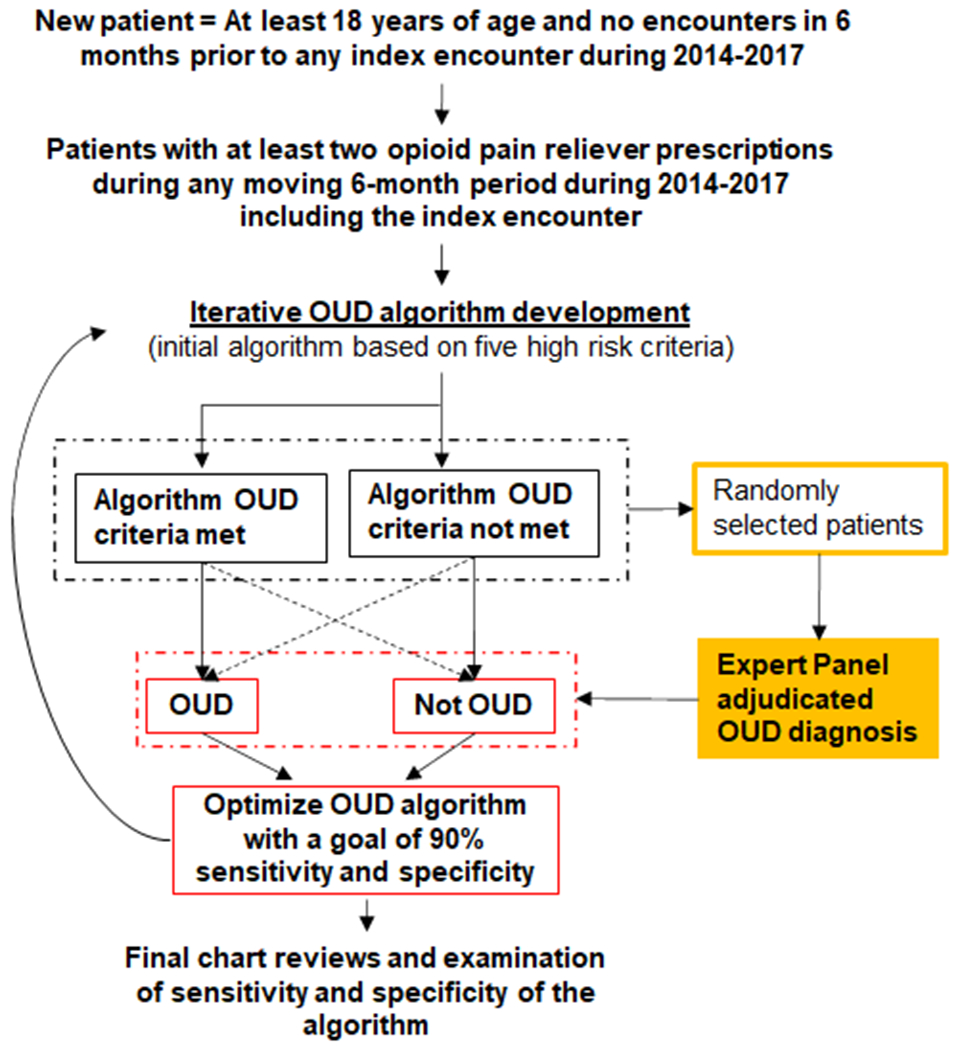
Through four iterations, we developed EHR-based OUD identification algorithms among patients who were prescribed opioids from 2014-2017. The algorithms and OUD ICD codes were validated against 169 independent “gold standard” EHR chart reviews conducted by an expert adjudication panel across four healthcare systems. After using 2014-2020 EHR for validating iteration 1, the experts were advised to use 2014-2017 EHR thereafter.
Results:
Of the 169 EHR charts, 81 (48%) were reviewed by more than one expert and exhibited 85% expert agreement. The experts identified 54 OUD cases. The experts endorsed all 11 OUD criteria from the Diagnostic and Statistical Manual of Mental Disorders-5, including craving (72%), tolerance (65%), withdrawal (56%), and recurrent use in physically hazardous conditions (50%). The OUD ICD codes had 10% sensitivity and 99% specificity, underscoring large underestimation. In comparison our algorithm identified OUD with 23% sensitivity and 98% specificity.
Conclusions and Relevance:
This is the first study to estimate the validity of OUD ICD codes and develop validated EHR-based OUD identification algorithms. This work will inform future research on early intervention and prevention of OUD.
-
Subjects:
-
Keywords:
-
Source:Pharmacoepidemiol Drug Saf. 32(5):577-585
-
Pubmed ID:36585827
-
Pubmed Central ID:PMC10073250
-
Document Type:
-
Funding:R49CE003092/ACL/ACL HHSUnited States/ ; R01CE003009/ACL/ACL HHSUnited States/ ; R49 CE003092/CE/NCIPC CDC HHSUnited States/ ; UL1 TR002489/TR/NCATS NIH HHSUnited States/ ; UL1 TR001420/TR/NCATS NIH HHSUnited States/ ; R21 DA046048/DA/NIDA NIH HHSUnited States/ ; UL1 TR001450/TR/NCATS NIH HHSUnited States/ ; UL1 TR002553/TR/NCATS NIH HHSUnited States/ ; R01 CE003009/CE/NCIPC CDC HHSUnited States/
-
Volume:32
-
Issue:5
-
Collection(s):
-
Main Document Checksum:urn:sha-512:1e4df7208ef852631690e91f9334dea7244dcca258b695c5cfe9d9d9da639979a2ef0e28a2c155fed32b8ef749218a17222d19a007d27679aa0c02d9c66dc4e4
-
Download URL:
-
File Type:
 [PDF
- 289.71 KB
]
[PDF
- 289.71 KB
]
Supporting Files


File Language:
English
ON THIS PAGE

CDC STACKS serves as an archival repository of CDC-published products including
scientific findings,
journal articles, guidelines, recommendations, or other public health information authored or
co-authored by CDC or funded partners.
As a repository, CDC STACKS retains documents in their original published format to ensure public access to scientific information.
As a repository, CDC STACKS retains documents in their original published format to ensure public access to scientific information.
You May Also Like
COLLECTION
CDC Public Access