


Biological Effects of Inhaled Crude Oil Vapor V. Altered Biogenic Amine Neurotransmitters and Neural Protein Expression
Supporting Files

-
2022/08/15
-
File Language:
English
Details
-
Journal Article:Toxicology and Applied Pharmacology
-
Personal Author:
-
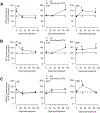
Description:Workers in the oil and gas industry are at risk for exposure to a number of physical and chemical hazards at the workplace. Chemical hazard risks include inhalation of crude oil or its volatile components. While several studies have investigated the neurotoxic effects of volatile hydrocarbons, in general, there is a paucity of studies assessing the neurotoxicity of crude oil vapor (COV). Consequent to the 2010 Deepwater Horizon (DWH) oil spill, there is growing concern about the short- and long-term health effects of exposure to COV. NIOSH surveys suggested that the DWH oil spill cleanup workers experienced neurological symptoms, including depression and mood disorders, but the health effects apart from oil dispersants were difficult to discern. To investigate the potential neurological risks of COV, male Sprague-Dawley rats were exposed by whole-body inhalation to COV (300 ppm; Macondo surrogate crude oil) following an acute (6 h/d × 1 d) or sub-chronic (6 h/d × 4 d/wk. × 4 wks) exposure regimen. At 1, 28 or 90 d post-exposure, norepinephrine (NE), epinephrine (EPI), dopamine (DA) and serotonin (5-HT) were evaluated as neurotransmitter imbalances are associated with psychosocial-, motor- and cognitive- disorders. Sub-chronic COV exposure caused significant reductions in NE, EPI and DA in the dopaminergic brain regions, striatum (STR) and midbrain (MB), and a large increase in 5-HT in the STR. Further, sub-chronic exposure to COV caused upregulation of synaptic and Parkinson's disease-related proteins in the STR and MB. Whether such effects will lead to neurodegenerative outcomes remain to be investigated. [Description provided by NIOSH]
-
Subjects:
-
Keywords:Author Keywords: Brain; Inhalants; Inhalation Studies; Neurological Disorders; Neurotoxicity; Neurotoxicology; Occupational Exposure Limits; Oil And Gas; Parkinsonism; Psychosocial; Toxicology; Volatile Organic Compounds Oil Vapors; Oil Industry; Gas Industry; Crude Oil; Inhalation; Health Effects; Animal Studies; Volatile Organic Compounds; VOCs; Neurological System; Neurotoxic Effects; Neurotransmitters;
-
Source:Toxicol Appl Pharmacol 2022 Aug; 449:116137
-
ISSN:0041-008X
-
Pubmed ID:35750205
-
Pubmed Central ID:PMC9936428
-
Document Type:
-
Funding:
-
Genre:
-
Place as Subject:
-
CIO:
-
Division:
-
Topic:
-
Location:
-
Pages in Document:32 pdf pages
-
Volume:449
-
NIOSHTIC Number:nn:20065551
-
Contact Point Address:Krishnan Sriram, Toxicology and Molecular Biology Branch, National Institute for Occupational Safety and Health, 1000 Frederick Drive, Mailstop L-3014, Morgantown, WV 26508, United States of America
-
Email:kos4@cdc.gov
-
Federal Fiscal Year:2022
-
NORA Priority Area:
-
Peer Reviewed:True
-
Collection(s):
-
Main Document Checksum:urn:sha-512:bb7b08dfc19544e33189995287547041d9eadc80fe8463781147dea13839d38c27093fd7d782978cdbb31f490adbfac5ef29c0e0e08bf6ccf23a909f71b17a4d
-
Download URL:
-
File Type:
 [PDF
- 4.15 MB
]
[PDF
- 4.15 MB
]

Supporting Files


File Language:
English
ON THIS PAGE




CDC STACKS serves as an archival repository of CDC-published products including
scientific findings,
journal articles, guidelines, recommendations, or other public health information authored or
co-authored by CDC or funded partners.
As a repository, CDC STACKS retains documents in their original published format to ensure public access to scientific information.
As a repository, CDC STACKS retains documents in their original published format to ensure public access to scientific information.
You May Also Like