



Leveraging Electronic Health Record Data for Timely Chronic Disease Surveillance: The Multi-State EHR-Based Network for Disease Surveillance
Supporting Files

-
3 2023 ; Mar-Apr 2023
-
Available in CDC Stacks on January 01, 2024, 12:00 AM
File Language:
English
Details
-
Alternative Title:J Public Health Manag Pract
-
Personal Author:
-
Description:Context:
Electronic health record (EHR) data can potentially make chronic disease surveillance more timely, actionable, and sustainable. Although use of EHR data can address numerous limitations of traditional surveillance methods, timely surveillance data with broad population coverage requires scalable systems. This report describes implementation, challenges, and lessons learned from the Multi-State EHR-Based Network for Disease Surveillance (MENDS) to help inform how others work with EHR data to develop distributed networks for surveillance.
Program:
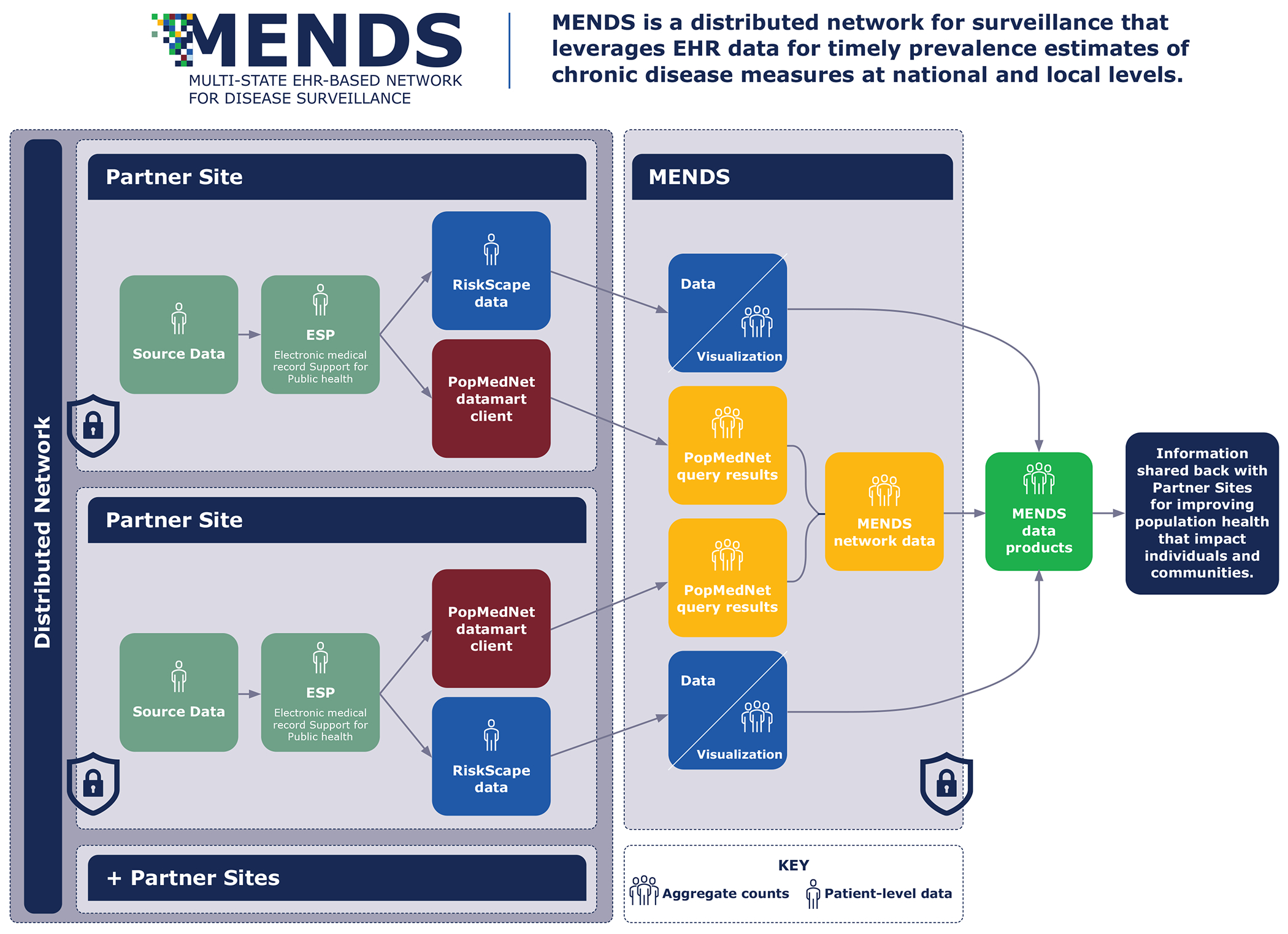
Funded by the Centers for Disease Control and Prevention (CDC), MENDS is a data modernization demonstration project that aims to develop a timely national chronic disease sentinel surveillance system using EHR data. It facilitates partnerships between data contributors (health information exchanges, other data aggregators) and data users (state and local health departments). MENDS uses query and visualization software to track local emerging trends. The program also uses statistical and geospatial methods to generate prevalence estimates of chronic disease risk measures at national and local levels. Resulting data products are designed to inform public health practice and improve the health of the population.
Implementation:
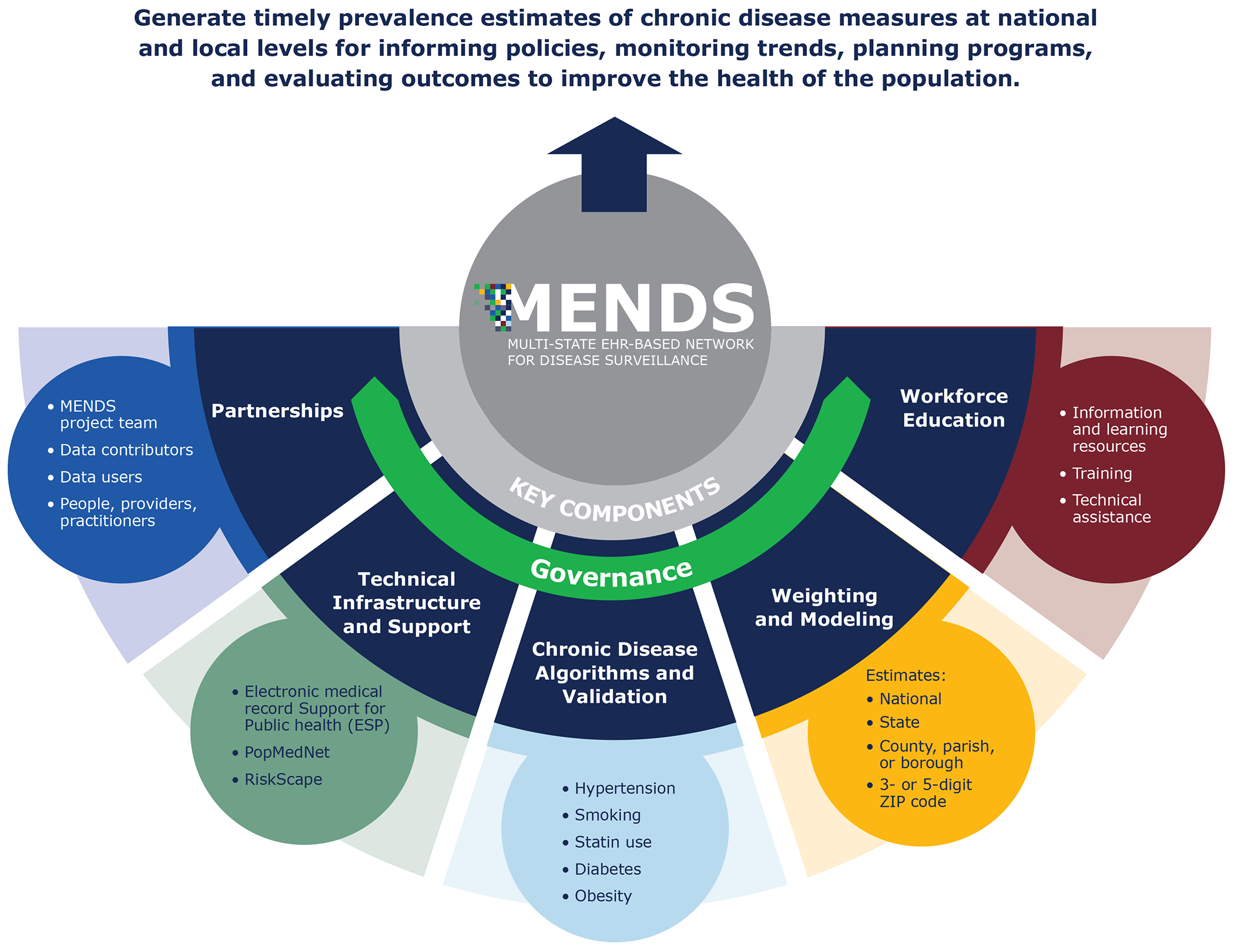
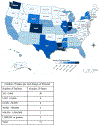
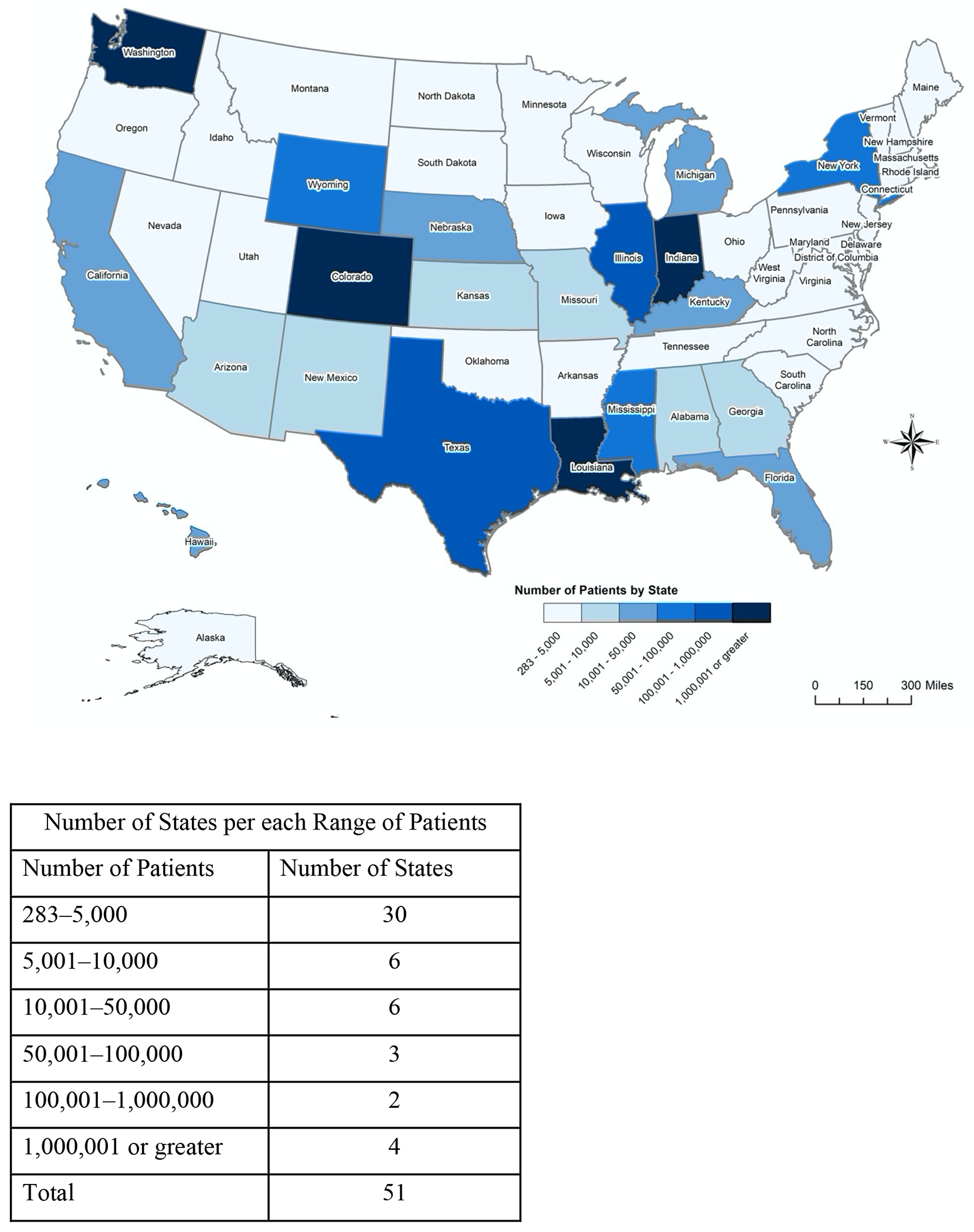
MENDS includes five partner sites that leverage EHR data from 91 health system and clinic partners and represents approximately 10 million patients across the United States. Key areas of implementation include governance, partnerships, technical infrastructure and support, chronic disease algorithms and validation, weighting and modeling, and workforce education for public health data users.
Discussion:
MENDS presents a scalable distributed network model for implementing national chronic disease surveillance that leverages EHR data. Priorities as MENDS matures include producing prevalence estimates at various geographic and subpopulation levels, developing enhanced data sharing and interoperability capacity using international data standards, scaling the network to improve coverage nationally and among underrepresented geographic areas and subpopulations, and expanding surveillance of additional chronic disease measures and social determinants of health. -
Keywords:
- Surveillance
- data network
- chronic disease
- hypertension
- electronic health record
- health information technology
- health informatics
- interoperability
- public health practice
- population health
- Humans
- United States
- Electronic Health Records
- Chronic Disease Indicators
- Public Health
- Prevalence
- Chronic Disease
- Population Surveillance
-
Source:J Public Health Manag Pract. 29(2):162-173
-
Pubmed ID:36715594
-
Pubmed Central ID:PMC9897452
-
Document Type:
-
Funding:
-
Volume:29
-
Issue:2
-
Download URL:
-
File Type:
 [PDF - 1.16 MB]
 -
Collection(s):
-
Main Document Checksum:urn:sha256:3f41c9a37349cd2396de95cfe17a291cc2bd587ca81c4a3a822d2a7d00c2273c
Supporting Files


File Language:
English
 Was this page helpful?
 Found an issue?

CDC STACKS serves as an archival repository of CDC-published products including
scientific findings, journal articles, guidelines, recommendations, or other public health information authored or
co-authored by CDC or funded partners.
As a repository, CDC STACKS retains documents in their original published format to ensure public access to scientific information.
As a repository, CDC STACKS retains documents in their original published format to ensure public access to scientific information.
You May Also Like
COLLECTION
CDC Public Access