


Risk Factors for Recurrent Colonization With Methicillin-Resistant Staphylococcus aureus in Community-Dwelling Adults and Children
Supporting Files

-
7 2015
-
File Language:
English
Details
-
Alternative Title:Infect Control Hosp Epidemiol
-
Personal Author:Cluzet, Valerie C. ; Gerber, Jeffrey S. ; Nachamkin, Irving ; Metlay, Joshua P. ; Zaoutis, Theoklis E. ; Davis, Meghan F. ; Julian, Kathleen G. ; Linkin, Darren R. ; Coffin, Susan E. ; Margolis, David J. ; Hollander, Judd E. ; Bilker, Warren B. ; Han, Xiaoyan ; Mistry, Rakesh D. ; Gavin, Laurence J. ; Tolomeo, Pam ; Wise, Jacqueleen A. ; Wheeler, Mary K. ; Hu, Baofeng ; Fishman, Neil O. ; Royer, David ; Lautenbach, Ebbing
-
Corporate Authors:
-
Description:OBJECTIVE.
To identify risk factors for recurrent methicillin-resistant Staphylococcus aureus (MRSA) colonization.
DESIGN.
Prospective cohort study conducted from January 1, 2010, through December 31, 2012.
SETTING.
Five adult and pediatric academic medical centers.
PARTICIPANTS.
Subjects (ie, index cases) who presented with acute community-onset MRSA skin and soft-tissue infection.
METHODS.
Index cases and all household members performed self-sampling for MRSA colonization every 2 weeks for 6 months. Clearance of colonization was defined as 2 consecutive sampling periods with negative surveillance cultures. Recurrent colonization was defined as any positive MRSA surveillance culture after clearance. Index cases with recurrent MRSA colonization were compared with those without recurrence on the basis of antibiotic exposure, household demographic characteristics, and presence of MRSA colonization in household members.
RESULTS.
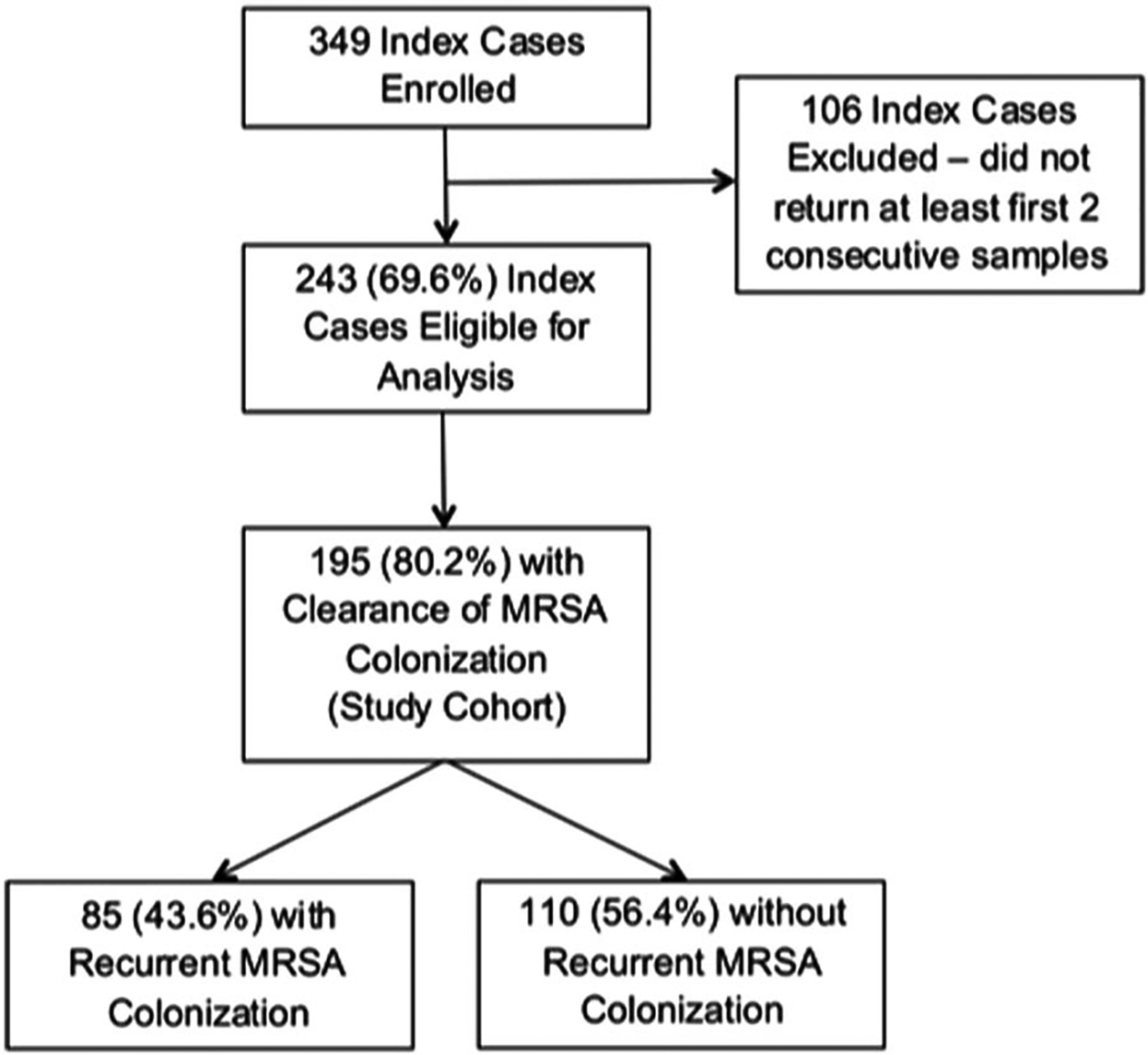
The study cohort comprised 195 index cases; recurrent MRSA colonization occurred in 85 (43.6%). Median time to recurrence was 53 days (interquartile range, 36–84 days). Treatment with clindamycin was associated with lower risk of recurrence (odds ratio, 0.52; 95% CI, 0.29–0.93). Higher percentage of household members younger than 18 was associated with increased risk of recurrence (odds ratio, 1.01; 95% CI, 1.00–1.02). The association between MRSA colonization in household members and recurrent colonization in index cases did not reach statistical significance in primary analyses.
CONCLUSION.
A large proportion of patients initially presenting with MRSA skin and soft-tissue infection will have recurrent colonization after clearance. The reduced rate of recurrent colonization associated with clindamycin may indicate a unique role for this antibiotic in the treatment of such infection.
-
Subjects:
-
Source:Infect Control Hosp Epidemiol. 36(7):786-793
-
Pubmed ID:25869756
-
Pubmed Central ID:PMC9859687
-
Document Type:
-
Funding:
-
Volume:36
-
Issue:7
-
Collection(s):
-
Main Document Checksum:urn:sha256:759337c10cf70278e037d4032fba4beec6797095fa697bbeae2bd8550ef14313
-
Download URL:
-
File Type:
 [PDF
- 440.71 KB
]
[PDF
- 440.71 KB
]
Supporting Files


File Language:
English
ON THIS PAGE

CDC STACKS serves as an archival repository of CDC-published products including
scientific findings,
journal articles, guidelines, recommendations, or other public health information authored or
co-authored by CDC or funded partners.
As a repository, CDC STACKS retains documents in their original published format to ensure public access to scientific information.
As a repository, CDC STACKS retains documents in their original published format to ensure public access to scientific information.
You May Also Like
COLLECTION
CDC Public Access