



Racial Disparities in Invasive Methicillin-resistant Staphylococcus aureus Infections, 2005–2014
Supporting Files

-
9 28 2018
-
Available in CDC Stacks on November 13, 2018, 12:00 AM
File Language:
English
Details
-
Journal Article:Clin Infect Dis
-
Personal Author:
-
Description:Background.
Despite substantial attention to the individual topics, little is known about the relationship between racial disparities and antimicrobial-resistant and/or healthcare-associated infection trends, such as for methicillin-resistant Staphylococcus aureus (MRSA).
Methods.
We analyzed Emerging Infections Program 2005–2014 surveillance data (9 US states) to determine whether reductions in invasive MRSA incidence (isolated from normally sterile body sites) affected racial disparities in rates. Case classification included hospital-onset (HO, culture >3 days after admission), healthcare-associated community onset (HACO, culture <3 days after admission and dialysis, hospitalization, surgery, or long-term care residence within 1 year prior), or community-associated (CA, all others). Negative binomial regression models were used to evaluate the adjusted rate ratio (aRR) of MRSA in black patients (vs in white patients) controlling for age, sex, and temporal trends.
Results.
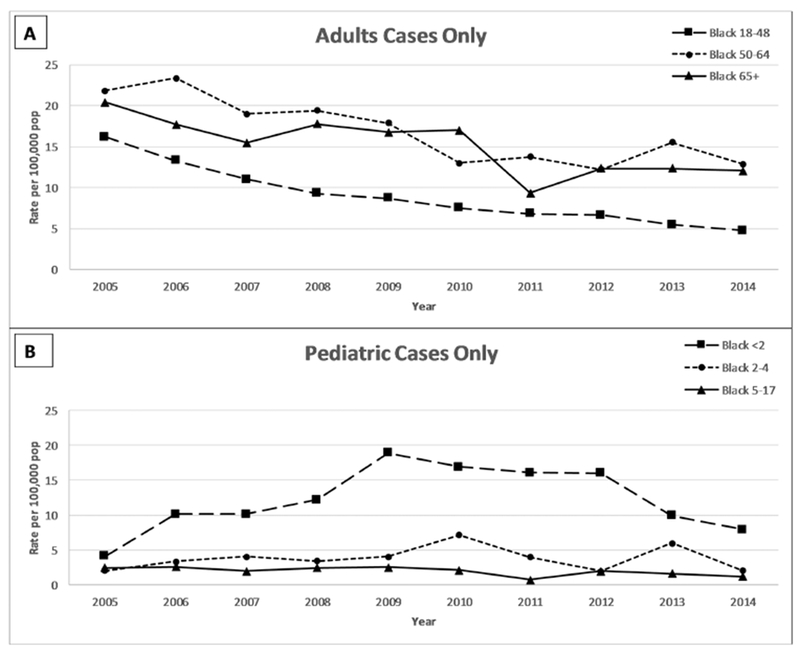
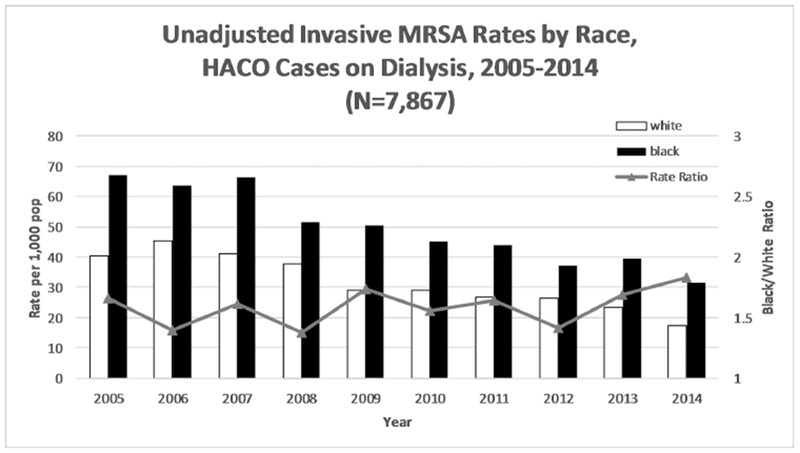
During 2005–2014, invasive HO and HACO (but not CA) MRSA rates decreased. Despite this, blacks had higher rates for HO (aRR, 3.20; 95% confidence interval CI, 2.35–4.35), HACO (aRR, 3.84; 95% CI, 2.94–5.01), and CA (aRR, 2.78; 95% CI, 2.30–3.37) MRSA. Limiting the analysis to chronic dialysis patients reduced, but did not eliminate, the higher HACO MRSA rates among blacks (aRR, 1.83; 95% CI, 1.72–1.96), even though invasive MRSA rates among dialysis patients decreased during 2005–2014. These racial differences did not change over time.
Conclusions.
Previous reductions in healthcare-associated MRSA infections have not affected racial disparities in MRSA rates. Improved understanding of the underlying causes of these differences is needed to develop effective prevention interventions that reduce racial disparities in MRSA infections. -
Subjects:
- Adolescent
- Adult
- Aged
- Black People
- Child
- Child, Preschool
- Community-Acquired Infections
- Cross Infection
- Epidemiological Monitoring
- Female
- Health Status Disparities
- Hospitalization
- Humans
- Incidence
- Infant
- Long-Term Care
- Male
- Methicillin-Resistant Staphylococcus aureus
- Middle Aged
- Models, Statistical
- Race Factors
- Regression Analysis
- Risk Factors
- Staphylococcal Infections
- United States
- White People
- Young Adult
-
Keywords:
-
Source:Clin Infect Dis. 67(8):1175-1181
-
DOI:
-
Pubmed ID:29659728
-
Pubmed Central ID:PMC6232852
-
Document Type:
-
Funding:U50 CK000197/CK/NCEZID CDC HHSUnited States/ ; U50 CK000198/CK/NCEZID CDC HHSUnited States/ ; U50 CK000199/CK/NCEZID CDC HHSUnited States/ ; U01 CI000305/CI/NCPDCID CDC HHSUnited States/ ; U50 CK000196/CK/NCEZID CDC HHSUnited States/ ; U50 CK000201/CK/NCEZID CDC HHSUnited States/ ; U50 CK000195/CK/NCEZID CDC HHSUnited States/ ; CC999999/Intramural CDC HHSUnited States/ ; U01 CI000311/CI/NCPDCID CDC HHSUnited States/ ; U50 CK000204/CK/NCEZID CDC HHSUnited States/ ; U50 CK000194/CK/NCEZID CDC HHSUnited States/ ; U50 CK000203/CK/NCEZID CDC HHSUnited States/
-
Genre:
-
Volume:67
-
Issue:8
-
Download URL:
-
File Type:
 [PDF - 245.99 KB]
 -
Collection(s):
-
Main Document Checksum:urn:sha-512:e0b64d581b2cd56f71f8ab10de4eb7dd10e2b70439b54fd6a2864db38afa1a0bc4e3de993baf59c5b9f2efcfb6fb30da0cc9332ba483ca65b8a5aa32af793551
Supporting Files


File Language:
English
 Was this page helpful?
 Found an issue?


CDC STACKS serves as an archival repository of CDC-published products including
scientific findings, journal articles, guidelines, recommendations, or other public health information authored or
co-authored by CDC or funded partners.
As a repository, CDC STACKS retains documents in their original published format to ensure public access to scientific information.
As a repository, CDC STACKS retains documents in their original published format to ensure public access to scientific information.
You May Also Like
COLLECTION
CDC Public Access