


Preconception Antidiabetic Drugs in Men and Birth Defects in Offspring
Supporting Files

-
5 2022
-
File Language:
English
Details
-
Alternative Title:Ann Intern Med
-
Personal Author:
-
Description:Background:
Diabetes reduces semen quality and increasingly occurs during reproductive years. Diabetes medications, such as metformin, have glucose-independent effects on the male reproductive system. Associations with birth defects in offspring are unknown.
Objective:
To evaluate whether the risk for birth defects in offspring varies with preconceptional pharmacologic treatment of fathers with diabetes.
Design:
Nationwide prospective registry-based cohort study.
Setting:
Denmark from 1997 to 2016.
Participants:
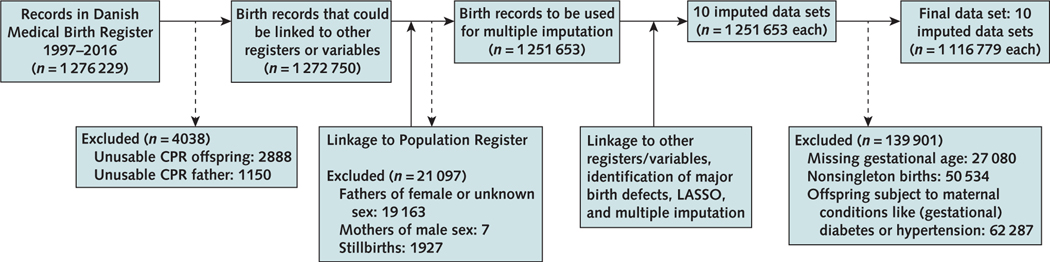
All liveborn singletons from mothers without histories of diabetes or essential hypertension.
Measurements:
Offspring were considered exposed if their father filled 1 or more prescriptions for a diabetes drug during the development of fertilizing sperm. Sex and frequencies of major birth defects were compared across drugs, times of exposure, and siblings.
Results:
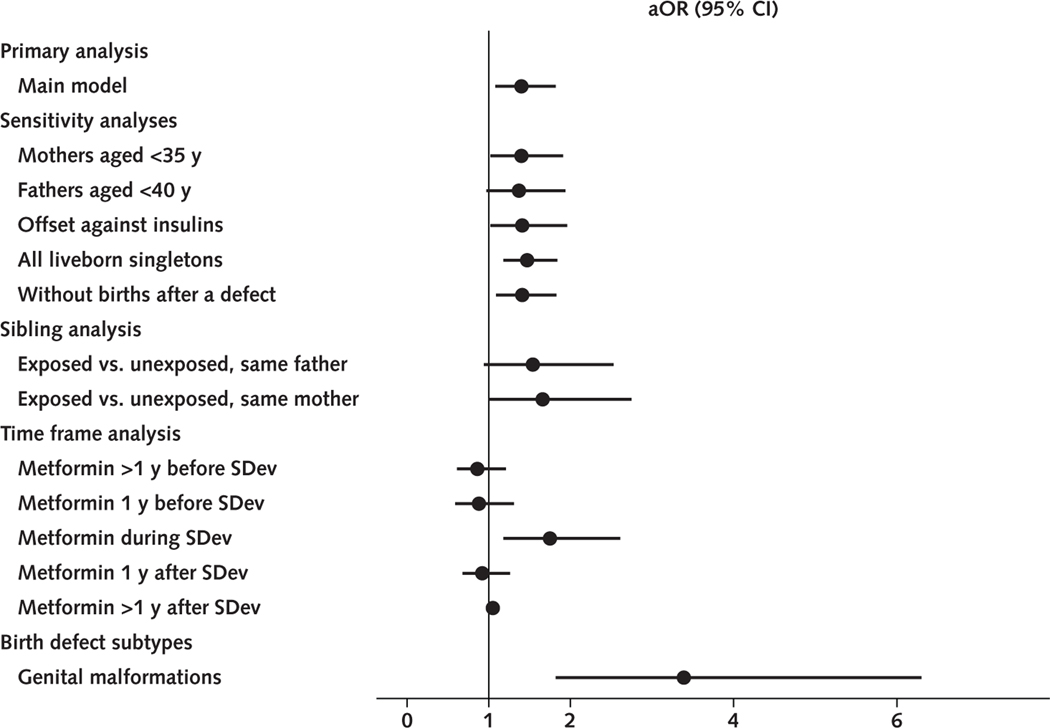
Of 1116779 offspring included, 3.3% had 1 or more major birth defects (reference). Insulin-exposed offspring (n = 5298) had the reference birth defect frequency (adjusted odds ratio [aOR], 0.98 [95% CI, 0.85 to 1.14]). Metformin-exposed offspring (n = 1451) had an elevated birth defect frequency (aOR, 1.40 [CI, 1.08 to 1.82]). For sulfonylurea-exposed offspring (n = 647), the aOR was 1.34 (CI, 0.94 to 1.92). Offspring whose fathers filled a metformin prescription in the year before (n = 1751) or after (n = 2484) sperm development had reference birth defect frequencies (aORs, 0.88 [CI, 0.59 to 1.31] and 0.92 [CI, 0.68 to 1.26], respectively), as did unexposed siblings of exposed offspring (3.2%; exposed vs. unexposed OR, 1.54 [CI, 0.94 to 2.53]). Among metformin-exposed offspring, genital birth defects, all in boys, were more common (aOR, 3.39 [CI, 1.82 to 6.30]), while the proportion of male offspring was lower (49.4% vs. 51.4%, P = 0.073).
Limitation:
Information on underlying disease status was limited.
Conclusion:
Preconception paternal metformin treatment is associated with major birth defects, particularly genital birth defects in boys. Further research should replicate these findings and clarify the causation.
Primary Funding Source:
National Institutes of Health.
-
Subjects:
-
Source:Ann Intern Med. 175(5):665-673
-
Pubmed ID:35344380
-
Pubmed Central ID:PMC9844982
-
Document Type:
-
Funding:
-
Volume:175
-
Issue:5
-
Collection(s):
-
Main Document Checksum:urn:sha-512:97d90cf70ce277bfcdcbb67d89b18b0092ec4b0237974af35f4598ce2c62977f70a94ef8b55fc356c5bd3a0a30afb7ba673de31b314995aadb1e9aab31ea1e17
-
Download URL:
-
File Type:
 [PDF
- 965.37 KB
]
[PDF
- 965.37 KB
]
Supporting Files


File Language:
English
ON THIS PAGE




CDC STACKS serves as an archival repository of CDC-published products including
scientific findings,
journal articles, guidelines, recommendations, or other public health information authored or
co-authored by CDC or funded partners.
As a repository, CDC STACKS retains documents in their original published format to ensure public access to scientific information.
As a repository, CDC STACKS retains documents in their original published format to ensure public access to scientific information.
You May Also Like
COLLECTION
CDC Public Access