



Retaliatory attitudes as mediator of exposure to violence and firearm aggression among youth: The protective role of organized activity involvement
Supporting Files

-
5 2022 ; 5-2022
-
Available in CDC Stacks on 2023-05-01T00:00:00Z
File Language:
English
Details
-
Alternative Title:Dev Psychol
-
Personal Author:
-
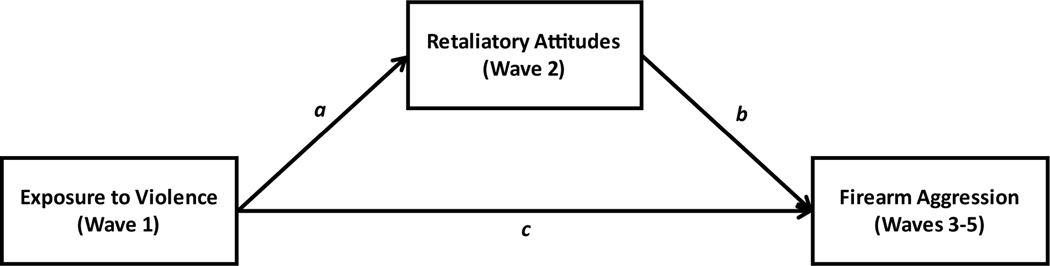
Description:Firearm injury is a significant public health concern among youth living in the United States. Youth with exposure to violence (ETV) are more susceptible to carrying and using a firearm. Few researchers, however, have examined psychological mechanisms undergirding the association between ETV and firearm aggression. Retaliatory attitudes have been discussed as a potential mediator linking ETV with firearm aggression. Moreover, organized activity participation may disrupt direct and indirect pathways connecting ETV to firearm aggression. We tested: (a) the mediating role of retaliatory attitudes in the ETV-firearm aggression link, and (b) the moderating role of organized activity participation among 570 youth with past year illicit drug use and seeking emerging department care in an urban emergency department (ages 14-24; 58.8% males). Using multigroup path analysis, ETV indirectly influenced firearm aggression through retaliatory attitudes for youth not involved organized activities. Organized activities also buffered the association between retaliatory attitudes (mediator) and firearm aggression (outcome). Organized activities may, therefore, prevent firearm aggression by reducing retaliatory attitudes among youth contending with ETV. (PsycInfo Database Record (c) 2022 APA, all rights reserved).
-
Keywords:
-
Source:Dev Psychol. 58(5):990-1002
-
Pubmed ID:35377700
-
Pubmed Central ID:PMC9716642
-
Document Type:
-
Funding:
-
Volume:58
-
Issue:5
-
Download URL:
-
File Type:
 [PDF - 486.59 KB]
 -
Collection(s):
-
Main Document Checksum:urn:sha256:452a797b8ffc2f1f3ba3063243df6a1e6733df0470b1be2c30dc94be547bf178
Supporting Files


File Language:
English
 Was this page helpful?
 Found an issue?


CDC STACKS serves as an archival repository of CDC-published products including
scientific findings, journal articles, guidelines, recommendations, or other public health information authored or
co-authored by CDC or funded partners.
As a repository, CDC STACKS retains documents in their original published format to ensure public access to scientific information.
As a repository, CDC STACKS retains documents in their original published format to ensure public access to scientific information.
You May Also Like
COLLECTION
CDC Public Access