


Blood Cadmium, Lead, Manganese, Mercury, and Selenium Levels in American Indian Populations: the Strong Heart Study
Supporting Files

-
12 2022
-
File Language:
English
Details
-
Alternative Title:Environ Res
-
Personal Author:
-
Description:Background:
Many American Indian (AI) communities are in areas affected by environmental contamination, such as toxic metals. However, studies assessing exposures in AI communities are limited. We measured blood metals in AI communities to assess historical exposure and identify participant characteristics associated with these levels in the Strong Heart Study (SHS) cohort.
Method:
Archived blood specimens collected from 2,014 participants (all participants were 50 years of age and older) in Arizona, Oklahoma, and North and South Dakota during SHS Phase-III (1998–1999) were analyzed for cadmium, lead, manganese, mercury, and selenium using inductively coupled plasma triple quadrupole mass spectrometry. We conducted descriptive analyses for the entire cohort and stratified by selected subgroups, including selected demographics, health behaviors, income, waist circumference, and body mass index. Bivariate associations were conducted to examine associations between blood metal levels and selected socio-demographic and behavioral covariates. Finally, multivariate regression models were used to assess the best model fit that predicted blood metal levels.
Findings:
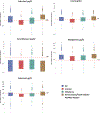
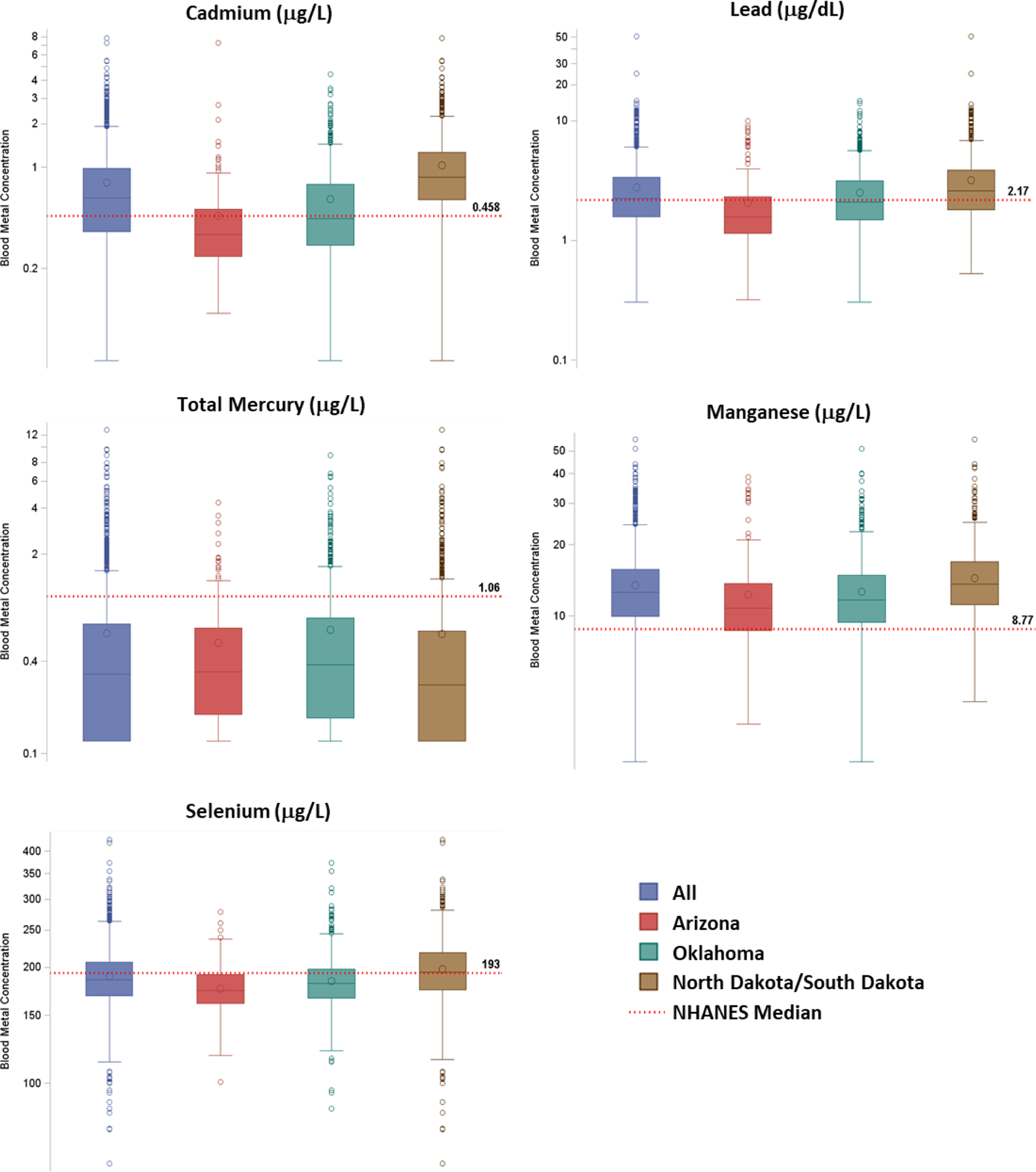
All elements were detected in 100% of study participants, with the exception of mercury (detected in 73% of participants). The SHS population had higher levels of blood cadmium and manganese than the general U.S. population 50 years and older. The blood mercury median of the SHS population was at about 30% of the U.S. reference population, potentially due to low fish consumption. Participants in North and South Dakota had the highest blood cadmium, lead, manganese, and selenium, and the lowest total mercury levels, even after adjusting for covariates. In addition, each of the blood metals was associated with selected demographic, behavioral, income, and/or weight-related factors in multivariate models. These findings will help guide the tribes to develop education, outreach, and strategies to reduce harmful exposures and increase beneficial nutrient intake in these AI communities.
-
Subjects:
-
Keywords:
-
Source:Environ Res. 215(Pt 3):114101
-
Pubmed ID:35977585
-
Pubmed Central ID:PMC9644284
-
Document Type:
-
Funding:U01 HL041642/HL/NHLBI NIH HHSUnited States/ ; U01 HL041654/HL/NHLBI NIH HHSUnited States/ ; R01 ES025216/ES/NIEHS NIH HHSUnited States/ ; P42 ES010349/ES/NIEHS NIH HHSUnited States/ ; 75N92019D00030/HL/NHLBI NIH HHSUnited States/ ; CC999999/ImCDC/Intramural CDC HHSUnited States/ ; R01 HL109319/HL/NHLBI NIH HHSUnited States/ ; R01 HL109284/HL/NHLBI NIH HHSUnited States/ ; U01 HL065521/HL/NHLBI NIH HHSUnited States/ ; 75N92019D00027/HL/NHLBI NIH HHSUnited States/ ; R01 HL109301/HL/NHLBI NIH HHSUnited States/ ; R01 HL109282/HL/NHLBI NIH HHSUnited States/ ; P30 ES009089/ES/NIEHS NIH HHSUnited States/ ; 75N92019D00028/HL/NHLBI NIH HHSUnited States/ ; P42 ES033719/ES/NIEHS NIH HHSUnited States/ ; R01 HL090863/HL/NHLBI NIH HHSUnited States/ ; U01 HL041652/HL/NHLBI NIH HHSUnited States/ ; 75N92019D00029/HL/NHLBI NIH HHSUnited States/ ; R01 ES032638/ES/NIEHS NIH HHSUnited States/ ; R01 HL109315/HL/NHLBI NIH HHSUnited States/ ; U01 HL065520/HL/NHLBI NIH HHSUnited States/ ; R01 ES021367/ES/NIEHS NIH HHSUnited States/
-
Volume:215
-
Collection(s):
-
Main Document Checksum:urn:sha-512:b91cf7d1e6f4de68da4118edfc700ad3b81ebeb34ff02441eef6c9f2d64b293e10526cecf21987aa65448ac3fd7bc82baa0b50fab1386e166b2fb42bed80aff1
-
Download URL:
-
File Type:
 [PDF
- 593.01 KB
]
[PDF
- 593.01 KB
]
Supporting Files


File Language:
English
ON THIS PAGE

CDC STACKS serves as an archival repository of CDC-published products including
scientific findings,
journal articles, guidelines, recommendations, or other public health information authored or
co-authored by CDC or funded partners.
As a repository, CDC STACKS retains documents in their original published format to ensure public access to scientific information.
As a repository, CDC STACKS retains documents in their original published format to ensure public access to scientific information.
You May Also Like
COLLECTION
CDC Public Access