



Temporal trends in alcohol, cannabis, and simultaneous use among 12th grade US adolescents from 2000 to 2020: Differences by sex, parental education, and race and ethnicity
Supporting Files

-
2022/09/01
-
Available in CDC Stacks on September 20, 2023, 12:00 AM
File Language:
English
Details
-
Alternative Title:Alcohol Clin Exp Res
-
Personal Author:
-
Description:Background
Simultaneous use of alcohol and cannabis to enhance each other's effect can cause potential harm. Time trends are diverging in adolescent use of alcohol, which is declining, and cannabis, which is increasing among certain subgroups. However, little is known about trends in their simultaneous and non-simultaneous use. Racial and socio-economic disparities are emerging in cannabis use, which may portend consequences to public health.
Methods
The 2000-2020 Monitoring the Future surveys included approximately 38,000 US 12th grade students with information on simultaneous use and pertinent demographic factors. A 5-level alcohol/cannabis measure included past-year simultaneous use (i.e., alcohol and cannabis use at the same time), non-simultaneous alcohol and cannabis use, alcohol-use-only, cannabis-use-only, and no use. Multinomial logistic regressions estimated associations (adjusted relative risk ratios; aRRR) with time period (2000-2004, 2005-2009, 2010-2014, 2015-2020). Models were adjusted and included interactions with sex, race/ethnicity, and parental education.
Results
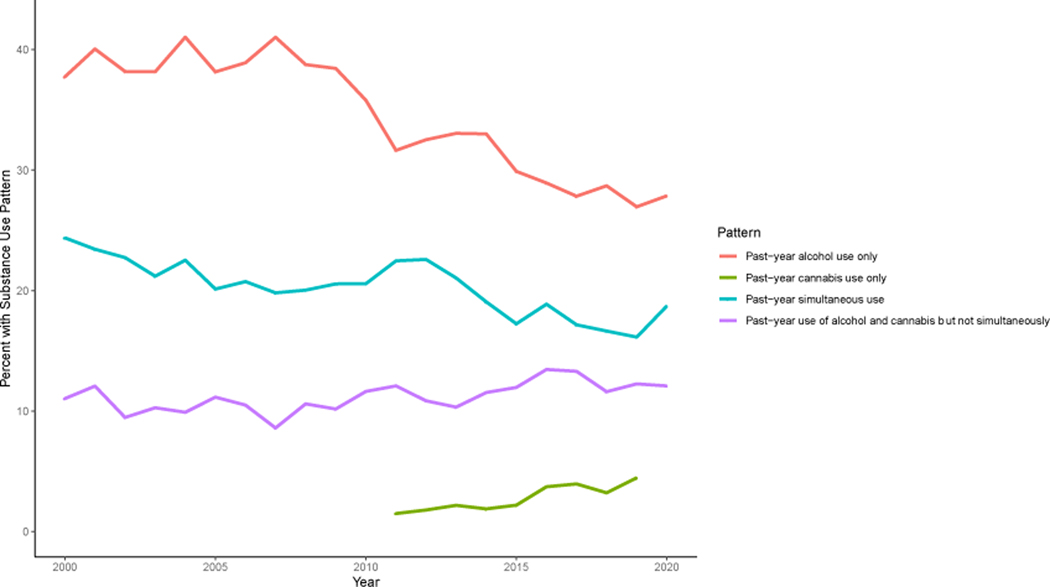
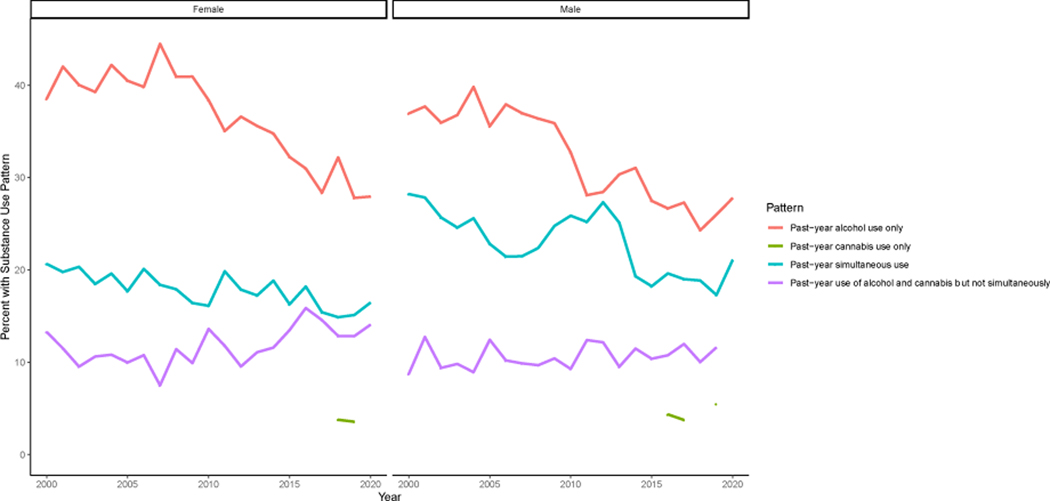
Between 2000-2020, simultaneous alcohol/cannabis use among 12th graders decreased from 24.4% to 18.7%. In 2015-2020 compared to 2000-2004, odds of simultaneous use (adjusted relative risk ratio (aRRR) vs. no use =0.57, 95% CI: 0.50, 0.66) and alcohol-use-only (aRRR=0.55, 95% CI: 0.49, 0.61) decreased, while cannabis-use-only odds increased (aRRR=2.59, 95% CI: 1.87, 3.59). Indeed, prevalence of cannabis-use-only more than doubled from 2011 to 2019. Simultaneous use, alcohol-use-only, and non-simultaneous use of alcohol and cannabis odds declined more rapidly for males than females, whereas odds for cannabis-use-only increased faster for females than males. Increases in cannabis-use-only are faster for non-white adolescents.
Conclusion
Simultaneous use of alcohol and cannabis is declining among US adolescents, but this decline is slower among females than males. Declines in simultaneous use are largely concomitant with historical declines in alcohol use, indicating that continued focus on reducing alcohol use among adolescents and young adults has extended benefits to other adolescent substance use. However, cannabis use without any reported past-year alcohol use more than doubled in the last decade, a concerning trend. -
Subjects:
-
Source:Alcohol Clin Exp Res. 46(9):1677-1686
-
Pubmed ID:36125706
-
Pubmed Central ID:PMC9635013
-
Document Type:
-
Funding:
-
Genre:
-
Place as Subject:
-
Volume:46
-
Issue:9
-
Download URL:
-
File Type:
 [PDF - 586.18 KB]
 -
Collection(s):
-
Main Document Checksum:urn:sha-512:da658cc3376f59c02e6829729e639194c368b71efb0d5d4a7d98266eb6c7c29fd74d40760092df15882594864144784801a666878d489d794d39152ffb9bba38
Supporting Files


File Language:
English
 Was this page helpful?
 Found an issue?



CDC STACKS serves as an archival repository of CDC-published products including
scientific findings, journal articles, guidelines, recommendations, or other public health information authored or
co-authored by CDC or funded partners.
As a repository, CDC STACKS retains documents in their original published format to ensure public access to scientific information.
As a repository, CDC STACKS retains documents in their original published format to ensure public access to scientific information.
You May Also Like
COLLECTION
CDC Public Access