


Selecting a target population for type 2 diabetes lifestyle prevention programs: A cost-effectiveness perspective
Supporting Files

-
7-2022
-
File Language:
English
Details
-
Alternative Title:Diabet Med
-
Personal Author:
-
Description:Aims:
Cost-effectiveness (CE) of lifestyle change programs (LCP) for type 2 diabetes (T2D) prevention is influenced by a participant’s risk. We identified the risk threshold of developing T2D in the intervention population that was cost-effective for three formats of the LCP: delivered in-person individually or in groups, or delivered virtually. We compared the cost-effectiveness across program formats when there were more than one cost-effective formats.
Methods:
Using the CDC-RTI T2D CE Simulation model, we estimated CEs associated with 3 program formats in 8 population groups with an annual T2D incidence of 1% to 8%. We generated a nationally representative simulation population for each risk level using the 2011–2016 National Health and Nutrition Examination Survey data. We used an incremental cost-effectiveness ratio (ICER), cost per quality-adjusted life year (QALY) gained in 25-years, to measure the CEs of the programs. We took a health care system perspective.
Results:
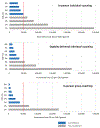
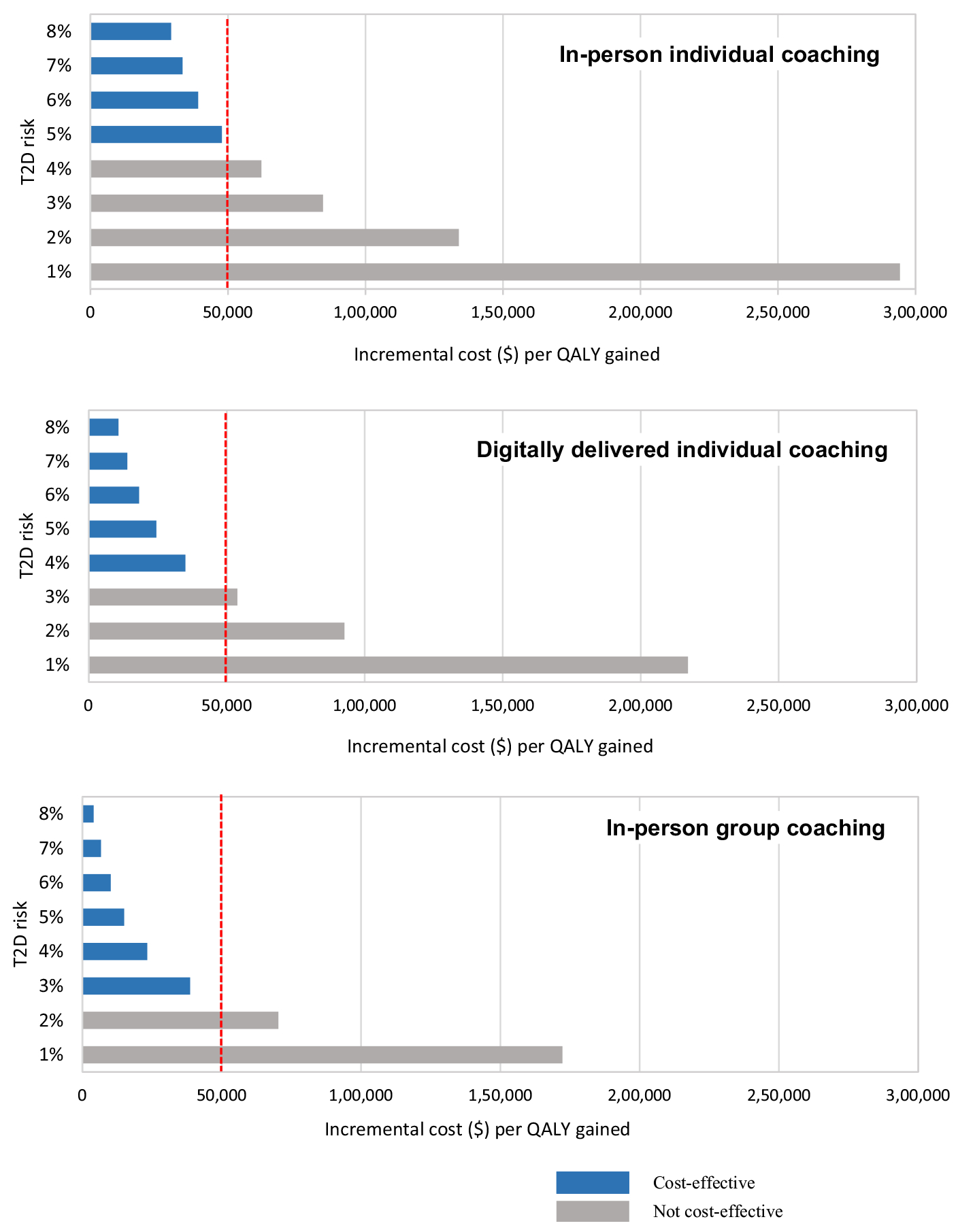
To achieve an ICER of $50,000/QALY or lower, the annual T2D incidence of the program participant needed to be ≥5% for the in-person individual program, ≥4% for the digital individual program, and ≥3% for the in-person group program. For those with T2D risk of ≥4%, the in-person group program always dominated the digital individual program. The in-person individual program was cost-effective compared with the in-person group program only among persons with T2D risk of ≥8%.
Conclusions:
Our findings could assist decision-makers in selecting the most appropriate target population for different formats of lifestyle intervention programs to prevent T2D.
-
Subjects:
-
Source:Diabet Med. 39(7):e14847
-
Pubmed ID:35434784
-
Pubmed Central ID:PMC9578149
-
Document Type:
-
Funding:
-
Volume:39
-
Issue:7
-
Collection(s):
-
Main Document Checksum:urn:sha256:6ee16aa5a58a76746b99197cad6aeaf0ea7be14b435e021e38fa46d15d07d767
-
Download URL:
-
File Type:
 [PDF
- 191.36 KB
]
[PDF
- 191.36 KB
]
Supporting Files


File Language:
English
ON THIS PAGE


CDC STACKS serves as an archival repository of CDC-published products including
scientific findings,
journal articles, guidelines, recommendations, or other public health information authored or
co-authored by CDC or funded partners.
As a repository, CDC STACKS retains documents in their original published format to ensure public access to scientific information.
As a repository, CDC STACKS retains documents in their original published format to ensure public access to scientific information.
You May Also Like
COLLECTION
CDC Public Access