



Association of Environmental Factors with Seasonal Intensity of Erysipelothrix rhusiopathiae Seropositivity among Arctic Caribou
Supporting Files
Public Domain

-
8 2022
File Language:
English
Details
-
Alternative Title:Emerg Infect Dis
-
Personal Author:Aleuy, O. Alejandro ; Anholt, Michele ; Orsel, Karin ; Mavrot, Fabien ; Gagnon, Catherine A. ; Beckmen, Kimberlee ; Côté, Steeve D. ; Cuyler, Christine ; Dobson, Andrew ; Elkin, Brett ; Leclerc, Lisa-Marie ; Taillon, Joëlle ; Kutz, Susan
-
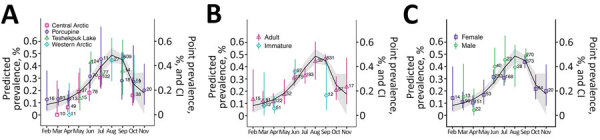
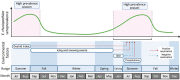
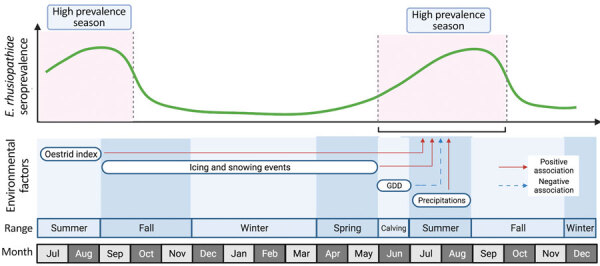
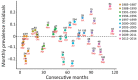
Description:Several caribou (Rangifer tarandus) populations have been declining concurrently with increases in infectious diseases in the Arctic. Erysipelothrix rhusiopathiae, a zoonotic bacterium, was first described in 2015 as a notable cause of illness and death among several Arctic wildlife species. We investigated epidemiologic and environmental factors associated with the seroprevalence of E. rhusiopathiae in the Arctic and found that seropositivity was highest during warmer months, peaking in September, and was highest among adult males. Summer seroprevalence increases tracked with the oestrid index from the previous year, icing and snowing events, and precipitation from the same year but decreased with growing degree days in the same year. Seroprevalence of E. rhusiopathiae varied more during the later years of the study. Our findings provide key insights into the influence of environmental factors on disease prevalence that can be instrumental for anticipating and mitigating diseases associated with climate change among Arctic wildlife and human populations.
-
Subjects:
-
Source:Emerg Infect Dis. 2022; 28(8):1650-1658
-
Pubmed ID:35876625
-
Pubmed Central ID:PMC9328914
-
Document Type:
-
Place as Subject:
-
Volume:28
-
Issue:8
-
Download URL:
-
File Type:
 [PDF - 2.50 MB]
 -
Collection(s):
-
Main Document Checksum:urn:sha256:c64c4d912f42bbe8b2ae6a8e6be4219fa9568e51428b2f73361b011b549579c0
Supporting Files


File Language:
English
 Was this page helpful?
 Found an issue?





CDC STACKS serves as an archival repository of CDC-published products including
scientific findings, journal articles, guidelines, recommendations, or other public health information authored or
co-authored by CDC or funded partners.
As a repository, CDC STACKS retains documents in their original published format to ensure public access to scientific information.
As a repository, CDC STACKS retains documents in their original published format to ensure public access to scientific information.
You May Also Like
COLLECTION
Emerging Infectious Diseases