



Use of TaqMan Array Card for the Detection of Respiratory Viral Pathogens in Children under 5 Years Old Hospitalised with Acute Medical Illness in Ballabgarh, Haryana, India
Supporting Files

-
2019 ; Jan-Mar 2019
-
Available in CDC Stacks on 2022-07-06T00:00:00Z
File Language:
English
Details
-
Alternative Title:Indian J Med Microbiol
-
Personal Author:
-
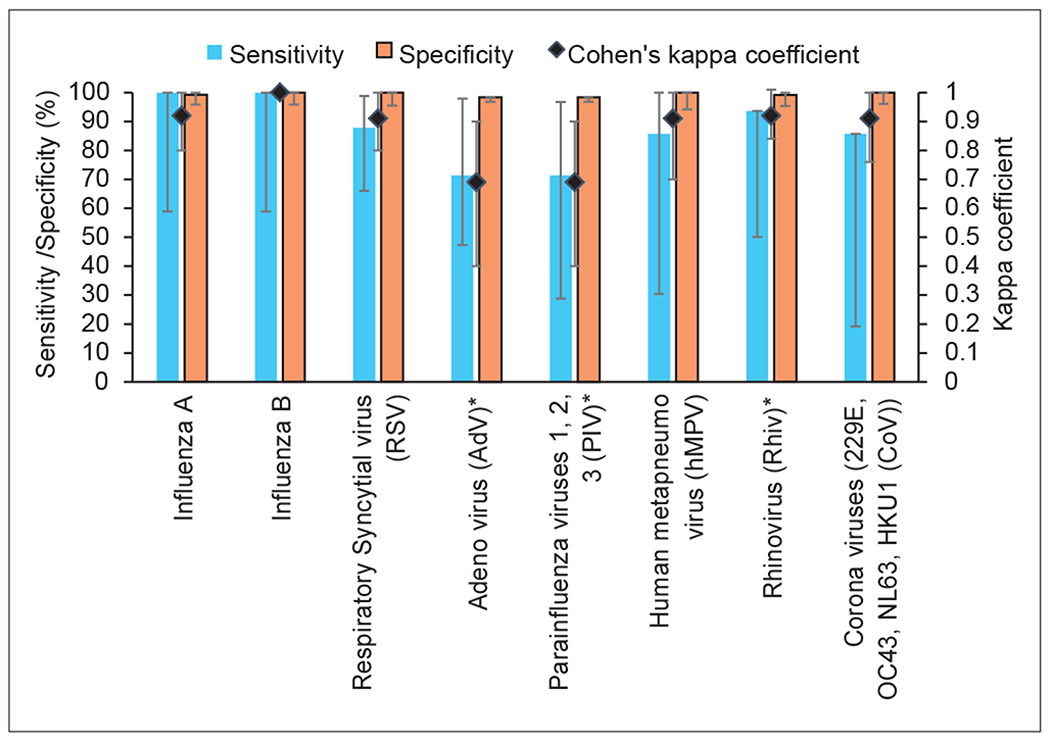
Description:Historical specimens collected from hospitalized children were tested for the following 13 viruses: influenza A and B; respiratory syncytial virus (RSV); parainfluenza viruses 1-3; human metapneumovirus; rhinovirus; coronaviruses 229E, OC43, NL63 and HKU1 and Adenovirus using monoplex real-time reverse transcriptase polymerase chain reaction (rRT-PCR). They were retested using TaqMan Array Card (TAC), a micro-fluidic system, capable of simultaneous multi-pathogen testing, to evaluate its sensitivity and specificity against monoplex rRT-PCR. TAC showed high sensitivity (71%-100%) and specificity (98%-100%) for these viruses in comparison to monoplex rRT-PCR. Multi-specimen detection with high sensitivity and specificity makes TAC a potentially useful tool for both surveillance and outbreak investigations.
-
Subjects:
-
Keywords:
-
Source:Indian J Med Microbiol. 37(1):105-108
-
Pubmed ID:31424019
-
Pubmed Central ID:PMC9257431
-
Document Type:
-
Funding:
-
Volume:37
-
Issue:1
-
Download URL:
-
File Type:
 [PDF - 167.39 KB]
 -
Collection(s):
-
Main Document Checksum:urn:sha256:df61eb3c41e6ac2409d26f3d009989ff16d60c78dfcde1197718a4ece2b6153c
Supporting Files


File Language:
English
 Was this page helpful?
 Found an issue?

CDC STACKS serves as an archival repository of CDC-published products including
scientific findings, journal articles, guidelines, recommendations, or other public health information authored or
co-authored by CDC or funded partners.
As a repository, CDC STACKS retains documents in their original published format to ensure public access to scientific information.
As a repository, CDC STACKS retains documents in their original published format to ensure public access to scientific information.
You May Also Like
COLLECTION
CDC Public Access