


What Parents Want: Does Provider Knowledge of Written Parental Expectations Improve Satisfaction in the Emergency Department?
Supporting Files

-
2016
File Language:
English
Details
-
Alternative Title:Acad Pediatr
-
Personal Author:
-
Description:Objective:
Satisfaction is an important measure of care quality. Interventions to improve satisfaction in the pediatric emergency department (ED) are limited, especially for patients with non-urgent conditions. Our objective was to determine if clinician knowledge of written parental expectations improves parental satisfaction for non-urgent ED visits.
Methods:
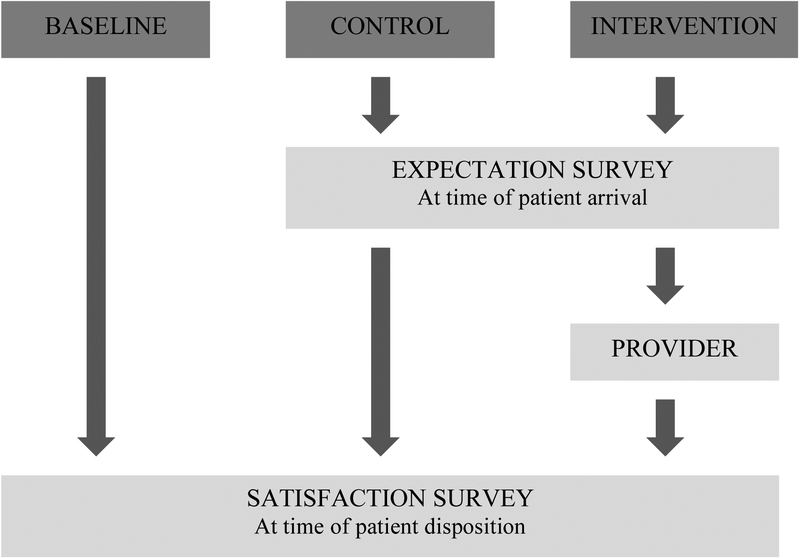
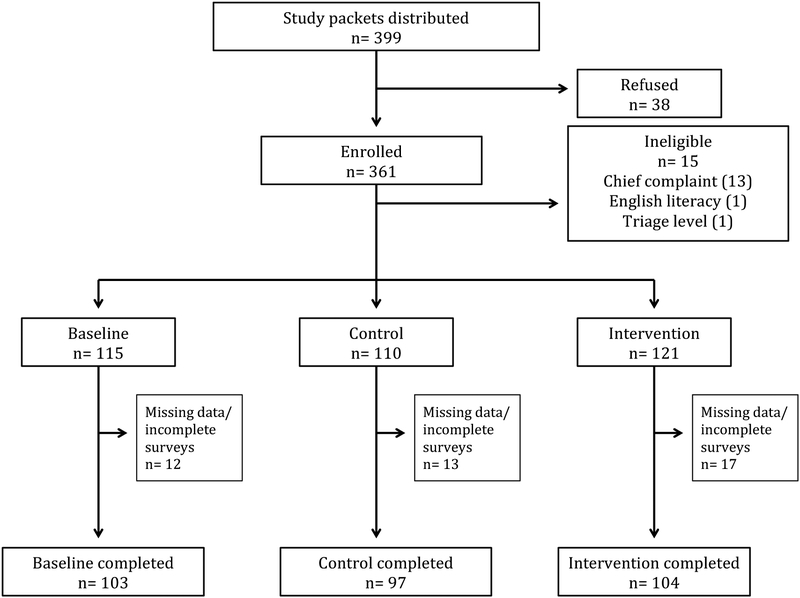
Randomized controlled trial conducted in a tertiary-care pediatric ED. Parents of children presenting for non-urgent visits (Emergency Severity Index [ESI] level 4 or 5) were randomized into 3 groups: 1) the intervention group completed an expectation survey on arrival, which was reviewed by the clinician, 2) the control group completed the expectation survey, which was not reviewed, 3) the baseline group did not complete an expectation survey. At ED disposition, all groups completed a 3-item satisfaction survey, scored using 5-point Likert scales (1=Very poor, 5=Very good). The primary outcome was rating of “overall care”. Secondary outcomes included “likelihood of recommending the ED” and “staff sensitivity to concerns”. Proportions were compared using χ2.
Results:
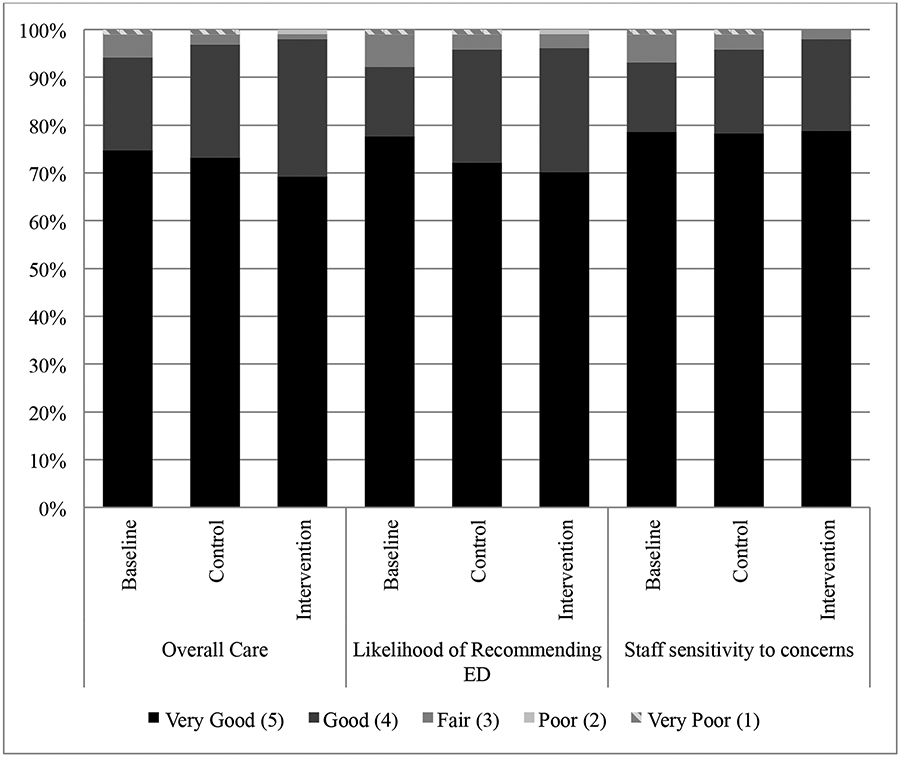
304 subjects were enrolled. The proportion of parents rating 5/5 for “overall care” did not differ among the baseline, control, and intervention groups (74.8% vs. 73.2% vs. 69.2%, p=0.56). The proportion of parents rating 5/5 also did not differ for “likelihood of recommending the ED” (77.7% vs. 72.2% vs. 70.2%, p=0.45) or “staff sensitivity to concerns” (78.6% vs. 78.4% vs. 78.8%, p=0.71).
Conclusions:
For non-urgent pediatric ED visits, clinician knowledge of written parental expectations does not improve parental satisfaction.
-
Subjects:
-
Keywords:
-
Source:Acad Pediatr. 16(4):343-349
-
Pubmed ID:26854207
-
Pubmed Central ID:PMC6915063
-
Document Type:
-
Funding:
-
Volume:16
-
Issue:4
-
Collection(s):
-
Main Document Checksum:urn:sha-512:aa4b5efe52176418f68474f5dc41e806c3646ca667a54f7023e600b137334100ea6218cbd2c690400e41315c388953a13a82df3cc87e163b190475821aed9387
-
Download URL:
-
File Type:
 [PDF
- 628.98 KB
]
[PDF
- 628.98 KB
]
Supporting Files


File Language:
English
ON THIS PAGE


CDC STACKS serves as an archival repository of CDC-published products including
scientific findings,
journal articles, guidelines, recommendations, or other public health information authored or
co-authored by CDC or funded partners.
As a repository, CDC STACKS retains documents in their original published format to ensure public access to scientific information.
As a repository, CDC STACKS retains documents in their original published format to ensure public access to scientific information.
You May Also Like
COLLECTION
CDC Public Access