



Cancer incidence in World Trade Center-exposed and non-exposed male firefighters, as compared with the US adult male population: 2001–2016
Supporting Files

-
10 2021
File Language:
English
Details
-
Alternative Title:Occup Environ Med
-
Personal Author:
-
Description:Objective
To compare cancer incidence in Fire Department of the City of New York (FDNY) firefighters who worked at the World Trade Center (WTC) site to incidence in a population of non-WTC-exposed firefighters, the Career Firefighter Health Study (CFHS) cohort, and to compare rates from each firefighter cohort to rates in demographically similar US males.
Methods
FDNY (N=10 786) and CFHS (N=8813) cohorts included male firefighters who were active on 11 September 2001 (9/11) and were followed until death or 31 December 2016. Cases were identified from 15 state cancer registries. Poisson regression models assessed cancers in each group (FDNY and CFHS) versus US males, and associations between group and cancer rates; these models estimated standardised incidence ratios (SIRs) and adjusted relative rates (RRs), respectively. Secondary analyses assessed surveillance bias and smoking history.
Results
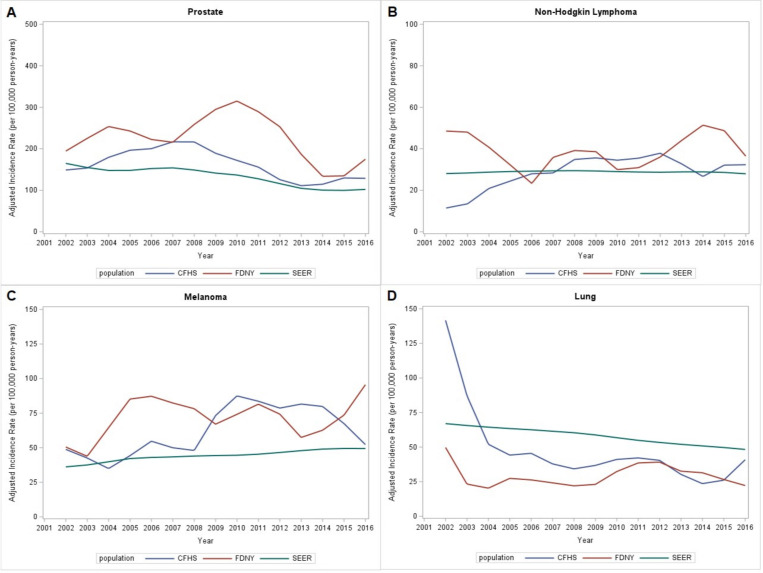
We identified 915 cancer cases in 841 FDNY firefighters and 1002 cases in 909 CFHS firefighters. FDNY had: higher rates for all cancers (RR=1.13; 95% CI 1.02 to 1.25), prostate (RR=1.39; 95% CI 1.19 to 1.63) and thyroid cancer (RR=2.53; 95% CI 1.37 to 4.70); younger median ages at diagnosis (55.6 vs 59.4; p<0.001, all cancers); and more cases with localised disease when compared with CFHS. Compared with US males, both firefighter cohorts had elevated SIRs for prostate cancer and melanoma. Control for surveillance bias in FDNY reduced most differences.
Conclusions
Excess cancers occurred in WTC-exposed firefighters relative to each comparison group, which may partially be explained by heightened surveillance. Two decades post-9/11, clearer understanding of WTC-related risk requires extended follow-up and modelling studies (laboratory or animal based) to identify workplace exposures in all firefighters. -
Subjects:
-
Source:Occup Environ Med. 2021; 78(10):707-714
-
Pubmed ID:34507965
-
Pubmed Central ID:PMC8458058
-
Document Type:
-
Funding:U01 OH011309/OH/NIOSH CDC HHSUnited States/ ; HHSN261201800032C/CA/NCI NIH HHSUnited States/ ; HHSN261201800009C/CA/NCI NIH HHSUnited States/ ; NU58DP006344/DP/NCCDPHP CDC HHSUnited States/ ; HHSN261201800015I/CA/NCI NIH HHSUnited States/ ; U01 OH011934/OH/NIOSH CDC HHSUnited States/ ; HHSN261201800032I/CA/NCI NIH HHSUnited States/ ; HHSN261201800015C/CA/NCI NIH HHSUnited States/ ; P30 CA013330/CA/NCI NIH HHSUnited States/ ; HHSN261201800009I/CA/NCI NIH HHSUnited States/
-
Place as Subject:
-
Volume:78
-
Issue:10
-
Download URL:
-
File Type:
 [PDF - 731.61 KB]
 -
Collection(s):
-
Main Document Checksum:urn:sha256:7a9b0aa24db4ef4eb635ed5f88c61bcfc94819b1c8d009822548f6791132526b
Supporting Files


File Language:
English
 Was this page helpful?
 Found an issue?

CDC STACKS serves as an archival repository of CDC-published products including
scientific findings, journal articles, guidelines, recommendations, or other public health information authored or
co-authored by CDC or funded partners.
As a repository, CDC STACKS retains documents in their original published format to ensure public access to scientific information.
As a repository, CDC STACKS retains documents in their original published format to ensure public access to scientific information.
You May Also Like
COLLECTION
CDC Public Access