



Comparison of seven modelling algorithms for GABA-edited 1H-MRS
Supporting Files

-
2022/07/01
-
Available in CDC Stacks on 2022-07-01T00:00:00Z
File Language:
English
Details
-
Alternative Title:NMR Biomed
-
Personal Author:Craven, Alexander R. ; Bhattacharyya, Pallab K. ; Clarke, William T. ; Dydak, Ulrike ; Edden, Richard A. E. ; Ersland, Lars ; Mandal, Pravat K. ; Mikkelsen, Mark ; Murdoch, James B. ; Near, Jamie ; Rideaux, Reuben ; Shukla, Deepika ; Wang, Min ; Wilson, Martin ; Zöllner, Helge J. ; Hugdahl, Kenneth ; Oeltzschner, Georg
-
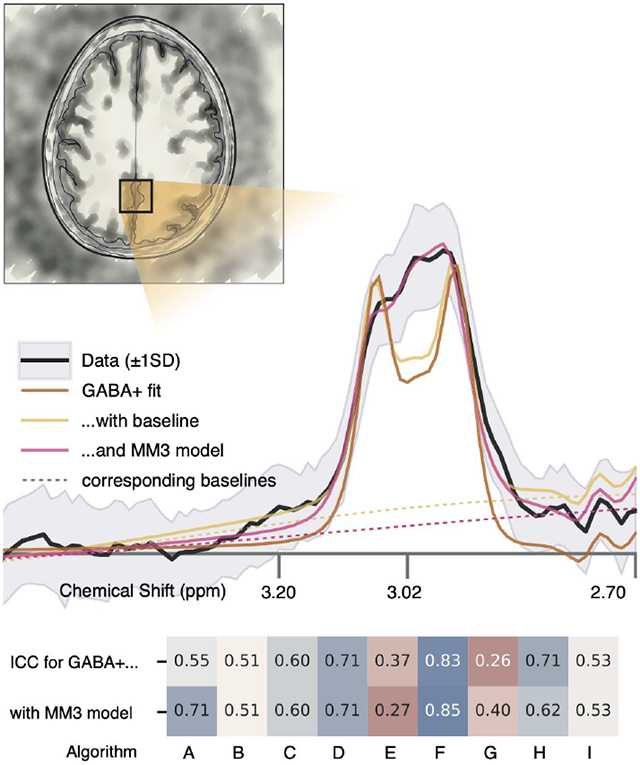
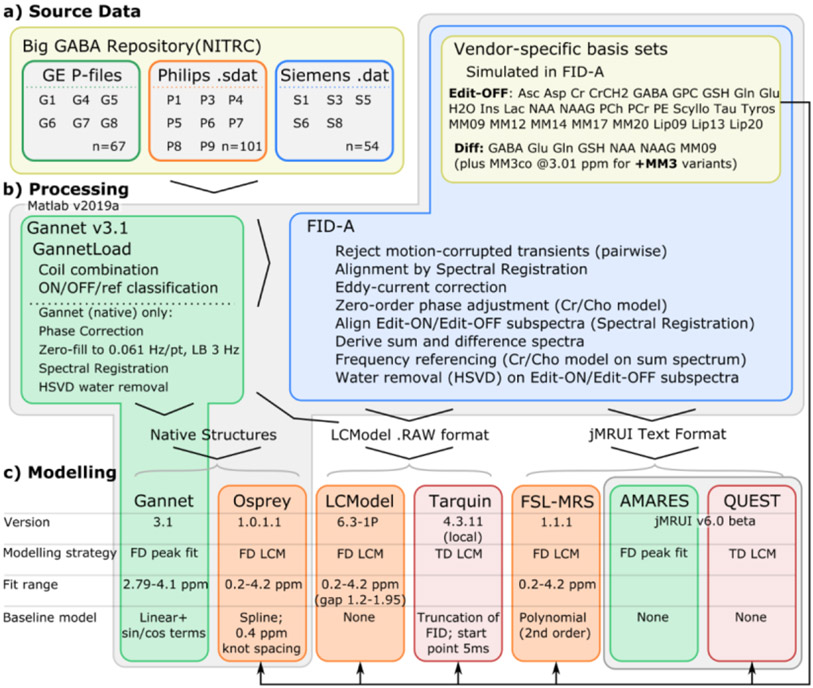
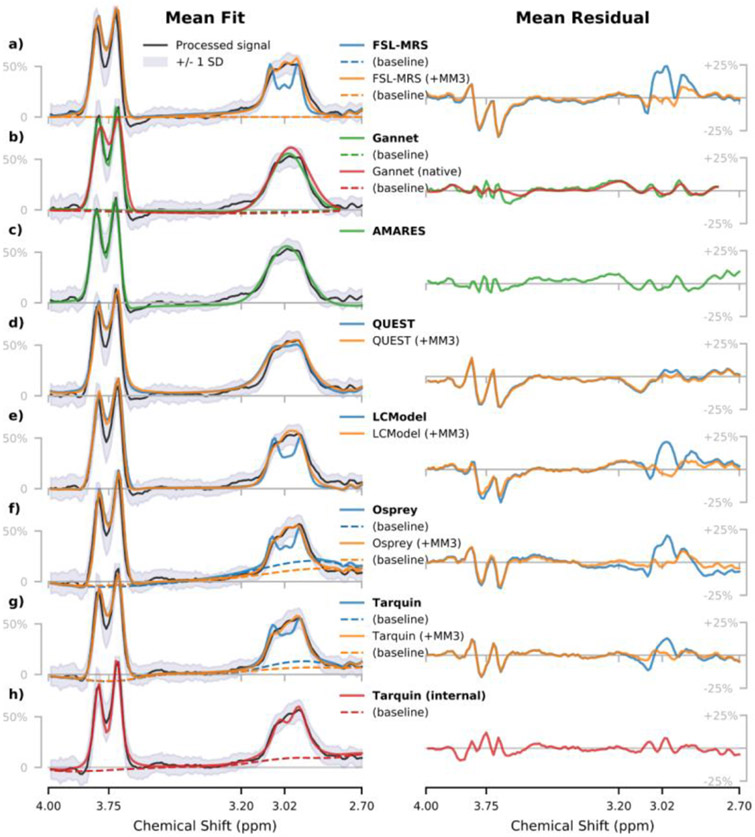
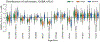
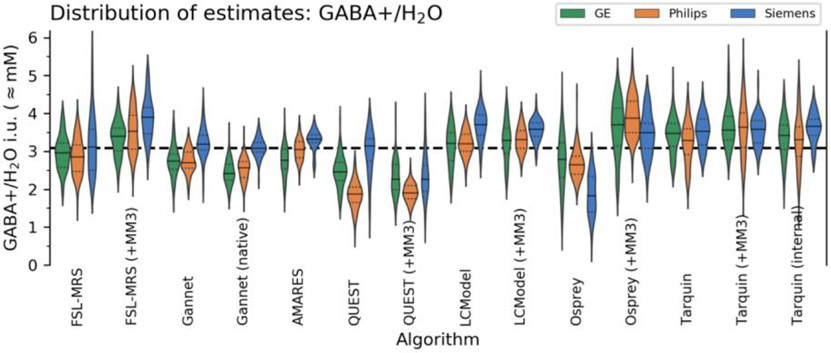
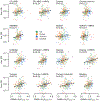
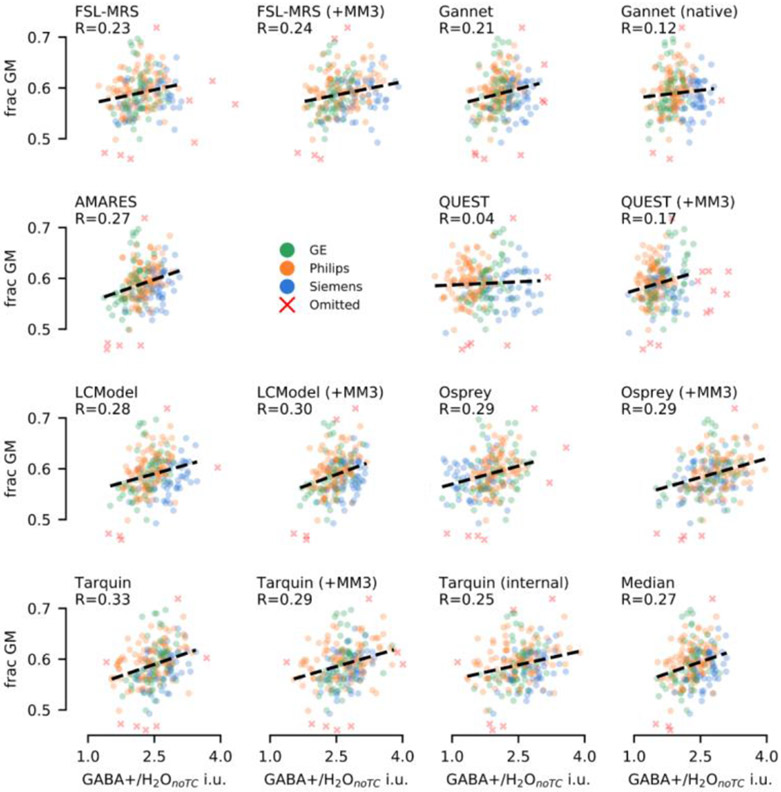
Description:Edited MRS sequences are widely used for studying γ-aminobutyric acid (GABA) in the human brain. Several algorithms are available for modelling these data, deriving metabolite concentration estimates through peak fitting or a linear combination of basis spectra. The present study compares seven such algorithms, using data obtained in a large multisite study. GABA-edited (GABA+, TE = 68 ms MEGA-PRESS) data from 222 subjects at 20 sites were processed via a standardised pipeline, before modelling with FSL-MRS, Gannet, AMARES, QUEST, LCModel, Osprey and Tarquin, using standardised vendor-specific basis sets (for GE, Philips and Siemens) where appropriate. After referencing metabolite estimates (to water or creatine), systematic differences in scale were observed between datasets acquired on different vendors' hardware, presenting across algorithms. Scale differences across algorithms were also observed. Using the correlation between metabolite estimates and voxel tissue fraction as a benchmark, most algorithms were found to be similarly effective in detecting differences in GABA+. An interclass correlation across all algorithms showed single-rater consistency for GABA+ estimates of around 0.38, indicating moderate agreement. Upon inclusion of a basis set component explicitly modelling the macromolecule signal underlying the observed 3.0 ppm GABA peaks, single-rater consistency improved to 0.44. Correlation between discrete pairs of algorithms varied, and was concerningly weak in some cases. Our findings highlight the need for consensus on appropriate modelling parameters across different algorithms, and for detailed reporting of the parameters adopted in individual studies to ensure reproducibility and meaningful comparison of outcomes between different studies.
-
Subjects:
-
Source:NMR Biomed. 35(7):e4702
-
Pubmed ID:35078266
-
Pubmed Central ID:PMC9203918
-
Document Type:
-
Funding:R00 AG062230/AG/NIA NIH HHSUnited States/ ; #693124/H2020 European Research Council Advanced/ ; K99/R00 AG062230/National Institutes of Health (NIH)/ ; S10 OD021648/CD/ODCDC CDC HHSUnited States/ ; P41 EB031771/EB/NIBIB NIH HHSUnited States/ ; P41 EB015909/EB/NIBIB NIH HHSUnited States/ ; R01 EB016089/EB/NIBIB NIH HHSUnited States/ ; R01 EB023963/EB/NIBIB NIH HHSUnited States/ ; R01 EB028259/EB/NIBIB NIH HHSUnited States/ ; R21 HD100869/HD/NICHD NIH HHSUnited States/ ; 102584/Z/13/Z/Wellcome Trust and the Royal Society/ ; BT/Indo-Aus/10/31/2016/PKM/India-Australia Strategic Biotechnology Funding/ ; DE210100790/Australian Research Council/
-
Genre:
-
Volume:35
-
Issue:7
-
Download URL:
-
File Type:
 [PDF - 1.60 MB]
 -
Collection(s):
-
Main Document Checksum:urn:sha-512:09d648288e682266404b754be3e0b8fbed5553b7ed7bc720dd5011b37d3ee6a918d7a3a8f5fe29ec4b6db20096e72de519412c1e0832facc5b7391d7f57c7e60
Supporting Files


File Language:
English
 Was this page helpful?
 Found an issue?




CDC STACKS serves as an archival repository of CDC-published products including
scientific findings, journal articles, guidelines, recommendations, or other public health information authored or
co-authored by CDC or funded partners.
As a repository, CDC STACKS retains documents in their original published format to ensure public access to scientific information.
As a repository, CDC STACKS retains documents in their original published format to ensure public access to scientific information.
You May Also Like
COLLECTION
CDC Public Access