


Per- and Polyfluoroalkyl Substances and Incident Diabetes in Midlife Women: The Study of Women's Health Across the Nation
Supporting Files

-
2022/07/01
-

File Language:
English
Details
-
Journal Article:Diabetologia
-
Personal Author:
-
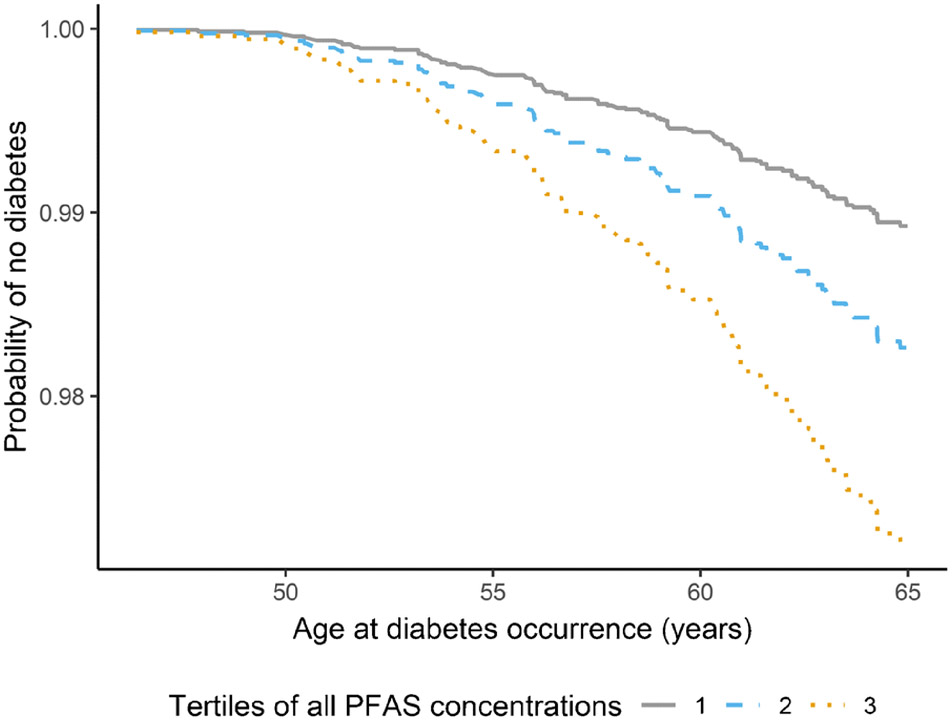
Description:Aims/hypothesis: Diabetogenic effects of per- and polyfluoroalkyl substances (PFAS) have been suggested. However, evidence based on prospective cohort studies is limited. We examined the association between serum PFAS concentrations and incident diabetes in the Study of Women's Health Across the Nation Multi-Pollutant Study (SWAN-MPS). Methods: We included 1237 diabetes-free women aged 45-56 years at baseline (1999-2000) who were followed up to 2017. At each follow-up visit, women with incident diabetes were identified by the presence of one or more of the following conditions: (1) use of a glucose-lowering medication at any visit; (2) fasting glucose >=7 mmol/l on two consecutive visits while not on steroids; and (3) any two visits with self-reported diabetes and at least one visit with fasting blood glucose >=7 mmol/l. Serum concentrations of 11 PFAS were quantified by online solid-phase extraction-HPLC-isotope dilution-tandem MS. Seven PFAS with high detection rates (>96%) (n-perfluorooctanoic acid [n-PFOA], perfluorononanoic acid [PFNA], perfluorohexane sulfonic acid [PFHxS], n-perfluorooctane sulfonic acid [n-PFOS], sum of perfluoromethylheptane sulfonic acid isomers [Sm-PFOS], 2-[N-methyl-perfluorooctane sulfonamido] acetic acid [MeFOSAA] and 2-[N-ethyl-perfluorooctane sulfonamido] acetic acid) were included in data analysis. Cox proportional hazards models were used to compute HRs and 95% CIs. Quantile-based g-computation was used to evaluate the joint effects of PFAS mixtures. Results: After adjustment for race/ethnicity, site, education, smoking status, alcohol consumption, total energy intake, physical activity, menopausal status and BMI, the HR (95% CI) comparing the lowest with the highest tertile was 1.67 (1.21, 2.31) for n-PFOA (ptrend = 0.001), 1.58 (1.13, 2.21) for PFHxS (ptrend = 0.003), 1.36 (0.97, 1.90) for Sm-PFOS (ptrend = 0.05), 1.85 (1.28, 2.67) for MeFOSAA (ptrend = 0.0004) and 1.64 (1.17, 2.31) for the sum of four common PFAS (n-PFOA, PFNA, PFHxS and total PFOS) (ptrend = 0.002). Exposure to seven PFAS as mixtures was associated with an HR of 2.62 (95% CI 1.12, 6.20), comparing the top with the bottom tertiles for all seven PFAS. Conclusions/interpretation: This study suggests that PFAS may increase diabetes risk in midlife women. Reduced exposure to these 'forever and everywhere chemicals' may be an important preventative approach to lowering population-wide diabetes risk. [Description provided by NIOSH]
-
Subjects:
-
Keywords:
-
Source:Diabetologia 2022 Jul; 65(7):1157-1168
-
ISSN:0012-186X
-
Pubmed ID:35399113
-
Pubmed Central ID:PMC9177697
-
Document Type:
-
Funding:T42 OH008455/OH/NIOSH CDC HHSUnited States/ ; R01 AG062622/AG/NIA NIH HHSUnited States/ ; P30 DK092926/DK/NIDDK NIH HHSUnited States/ ; U01 AG012554/AG/NIA NIH HHSUnited States/ ; P30 AG024824/AG/NIA NIH HHSUnited States/ ; UL1 RR024131/RR/NCRR NIH HHSUnited States/ ; P30 ES017885/ES/NIEHS NIH HHSUnited States/ ; U01 AG012535/AG/NIA NIH HHSUnited States/ ; U01 AG012553/AG/NIA NIH HHSUnited States/ ; U01 NR004061/NR/NINR NIH HHSUnited States/ ; U01 AG012539/AG/NIA NIH HHSUnited States/ ; R01 ES026578/ES/NIEHS NIH HHSUnited States/ ; U01 AG012546/AG/NIA NIH HHSUnited States/ ; U19 AG063720/AG/NIA NIH HHSUnited States/ ; U01 AG012495/AG/NIA NIH HHSUnited States/ ; P30 DK020572/DK/NIDDK NIH HHSUnited States/ ; U01 AG012505/AG/NIA NIH HHSUnited States/ ; U01 AG012531/AG/NIA NIH HHSUnited States/ ; R01 ES026964/ES/NIEHS NIH HHSUnited States/ ; U01 AG017719/AG/NIA NIH HHSUnited States/
-
Genre:
-
Place as Subject:
-
CIO:
-
Topic:
-
Location:
-
Pages in Document:24 pdf pages
-
Volume:65
-
Issue:7
-
NIOSHTIC Number:nn:20064968
-
Contact Point Address:Sung Kyun Park, Department of Epidemiology, School of Public Health, University of Michigan, Ann Arbor, MI, USA
-
Email:sungkyun@umich.edu
-
CAS Registry Number:
-
Federal Fiscal Year:2022
-
Performing Organization:University of Michigan, Ann Arbor
-
Peer Reviewed:True
-
Collection(s):
-
Main Document Checksum:urn:sha-512:60890d48792bb8f376d7842fbedeee575f69ea2694fb02ce0683ffb1ac0cf12d994b009df854dc8baecf00f7bd5d63c46b97e2f36baf273cfd590a1ed66238a5
-
Download URL:
-
File Type:
 [PDF
- 532.34 KB
]
[PDF
- 532.34 KB
]

Supporting Files


File Language:
English
ON THIS PAGE




CDC STACKS serves as an archival repository of CDC-published products including
scientific findings,
journal articles, guidelines, recommendations, or other public health information authored or
co-authored by CDC or funded partners.
As a repository, CDC STACKS retains documents in their original published format to ensure public access to scientific information.
As a repository, CDC STACKS retains documents in their original published format to ensure public access to scientific information.
You May Also Like