



Estimating vaccination threshold and impact in the 2017-2019 hepatitis A virus outbreak among persons experiencing homelessness or who use drugs in Louisville, Kentucky, United States
Supporting Files

-
12 03 2021 ; 12-03-
-
Available in CDC Stacks on 2022-05-24T00:00:00Z
File Language:
English
Details
-
Alternative Title:Vaccine
-
Personal Author:
-
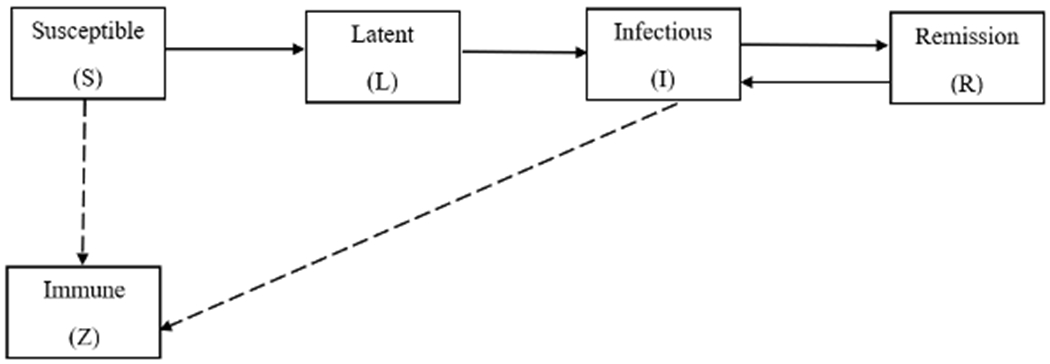
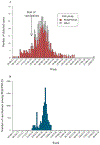
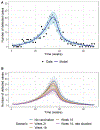
Description:Background ; Between September 2017 and June 2019, an outbreak of hepatitis A virus (HAV) occurred in Louisville, Kentucky, resulting in 501 cases and 6 deaths, predominantly among persons who experience homelessness or who use drugs (PEH/PWUD). The critical vaccination threshold (Vc) required to achieve herd immunity in this population is unknown. We investigated Vc and vaccination impact using epidemic modeling. ; Methods ; To determine which population subgroups had high infection risks, we employed a technique based on comparing the proportion of cases arising before and after the epidemic peak. We developed a dynamic deterministic model of HAV transmission among PEH/PWUD to estimate the basic reproduction number (R0), herd immunity threshold, Vc and the effect of timing of the vaccination intervention on epidemic and economic outcomes. ; Results ; Of the 501 confirmed or probable cases, 385 (76.8%) were among PEH/PWUD. Among PEH/PWUD and within the general population, homelessness was a significant risk factor for infection in the initial stages of the outbreak (odds ratios for homeless versus not homeless: 2.62; 95% confidence interval (CI): 1.62-4.25 for PEH/PWUD and 2.39; 95% CI: 1.51-3.78 for all detected cases). Our estimate for R0 ranges between 2.85 and 3.54, corresponding to an estimate of 69% (95% CI: 65-72) for herd immunity threshold and 76% (95% CI: 72%-80%) for Vc, assuming a vaccine with 90% efficacy. The observed vaccination program was estimated to have averted 30 hospitalizations (95% CI: 19-43), associated with over US$490,000 (95% CI: $310,000–700,000) in hospitalization cost. Greater impact was observed with earlier and faster vaccination implementation. ; Conclusions ; Vaccination coverage of at least 77% is likely required to prevent outbreaks of HAV among PEH/PWUD in Louisville, assuming a 90% vaccine efficacy. Proactive hepatitis A vaccination programs among PEH/PWUD will maximize health and economic benefits of these programs and reduce the likelihood of another outbreak.
-
Subjects:
-
Keywords:
-
Source:Vaccine. 39(49):7182-7190
-
Pubmed ID:34686394
-
Pubmed Central ID:PMC9128446
-
Document Type:
-
Funding:
-
Volume:39
-
Issue:49
-
Download URL:
-
File Type:
 [PDF - 594.90 KB]
 -
Collection(s):
-
Main Document Checksum:urn:sha-512:fcffb336aadcbef0e054efe1c7e7f2b14b84750d81ea029eeeec7a12740d0fd6112d32d8895cba6de89ba1afa8d8f1b5a4e95cdf74693d009bfccba0738ec632
Supporting Files


File Language:
English
 Was this page helpful?
 Found an issue?




CDC STACKS serves as an archival repository of CDC-published products including
scientific findings, journal articles, guidelines, recommendations, or other public health information authored or
co-authored by CDC or funded partners.
As a repository, CDC STACKS retains documents in their original published format to ensure public access to scientific information.
As a repository, CDC STACKS retains documents in their original published format to ensure public access to scientific information.
You May Also Like
COLLECTION
CDC Public Access