



Comparative Review of Asthma in Farmers and Horses
Supporting Files
Peer Reviewed

-
2019/10/10
-
Available in CDC Stacks on 2022-05-18T00:00:00Z

File Language:
English
Details
-
Journal Article:Current Allergy & Asthma Reports
-
Personal Author:
-
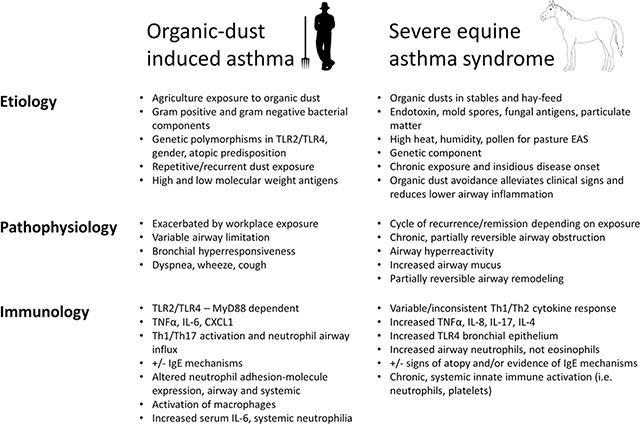
Description:Purpose of Review: Farmers are routinely exposed to organic dusts and aeroallergens that can have adverse respiratory health effects including asthma. Horses are farm-reared large animals with similar exposures and can develop equine asthma syndrome (EAS). This review aims to compare the etiology, pathophysiology, and immunology of asthma in horses compared to farmers and highlights the horse as a potential translational animal model for organic dust-induced asthma in humans. Recent Findings: Severe EAS shares many clinical and pathological features with various phenotypes of human asthma including allergic, non-allergic, late onset, and severe asthma. EAS disease features include variable airflow obstruction, cough, airway hyperresponsiveness, airway inflammation/remodeling, neutrophilic infiltrates, excess mucus production, and chronic innate immune activation. Summary: Severe EAS is a naturally occurring and biologically relevant, translational animal disease model that could contribute to a more thorough understanding of the environmental and immunologic factors contributing to organic dust-induced asthma in humans. Description provided by NIOSH
-
Subjects:
-
Keywords:
-
Source:Curr Allergy Asthma Rep 2019 Nov; 19(11):50
-
ISSN:1529-7322
-
Pubmed ID:31599358
-
Pubmed Central ID:PMC9116535
-
Document Type:
-
Funding:
-
Genre:
-
Place as Subject:
-
CIO:
-
Topic:
-
Location:
-
Pages in Document:15 pdf pages
-
Volume:19
-
Issue:11
-
NIOSHTIC Number:nn:20065180
-
Contact Point Address:M. Katie Sheats, Comparative Medicine Institute, Department of Clinical Sciences, North Carolina State University College of Veterinary Medicine, Raleigh, NC, 27607, USA
-
Email:mkpeed@ncsu.edu
-
Federal Fiscal Year:2020
-
NORA Priority Area:
-
Performing Organization:University of Nebraska Medical Center - Omaha
-
Peer Reviewed:True
-
Download URL:
-
File Type:
 [PDF - 395.92 KB]
 -
Collection(s):
-
Main Document Checksum:urn:sha-512:66d261c80472a2a6ac3183abd3047ec77471f8e26822ab4bfb52b7ce97d75fdd568a419881fdbf4533f8665e3d80f7980d7a2f3d9f4b2da81dbd9d48b8c75163
Supporting Files


File Language:
English
 Was this page helpful?
 Found an issue?


CDC STACKS serves as an archival repository of CDC-published products including
scientific findings, journal articles, guidelines, recommendations, or other public health information authored or
co-authored by CDC or funded partners.
As a repository, CDC STACKS retains documents in their original published format to ensure public access to scientific information.
As a repository, CDC STACKS retains documents in their original published format to ensure public access to scientific information.
You May Also Like