



Improved Cancer Coping from a Web-based Intervention for Prostate Cancer Survivors: A Randomized Controlled Trial
Supporting Files

-
9 2021 ; 9-2021
-
Available in CDC Stacks on 2022-09-01T00:00:00Z
File Language:
English
Details
-
Alternative Title:Psychooncology
-
Personal Author:Tagai, Erin K. ; Miller, Suzanne M. ; Hudson, Shawna V. ; Diefenbach, Michael A. ; Handorf, Elizabeth ; Bator, Alicja ; Marziliano, Allison ; Kutikov, Alexander ; Hall, Simon J. ; Vira, Manish ; Schwartz, Michael ; Kim, Issac Yi ; Kim, Sung
-
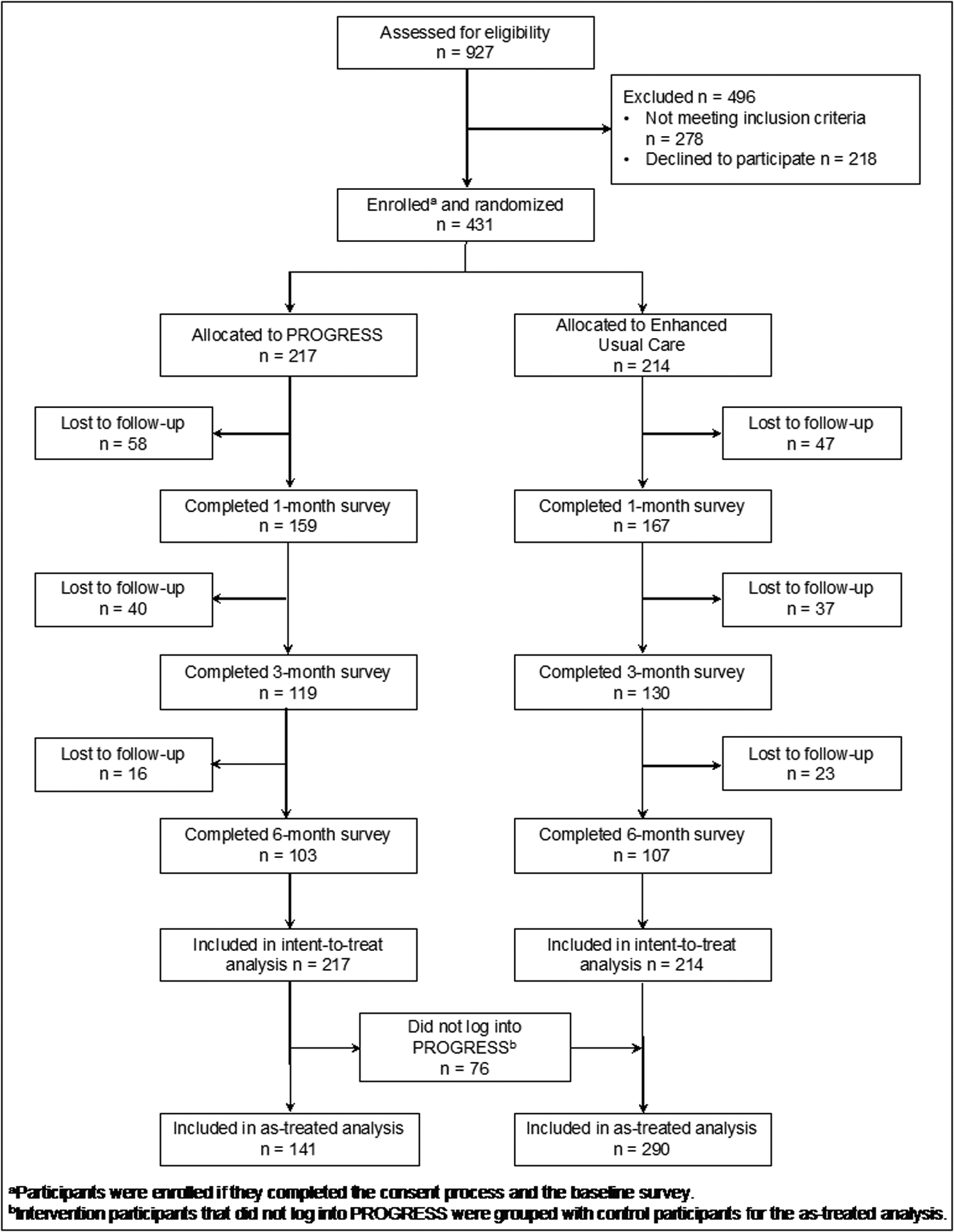
Description:Objectives: ; Prostate cancer (PCa) survivors report poor physical functioning alongside negative psychological outcomes as they cope with treatment side effects and practical concerns after treatment completion. This study evaluated PROGRESS, a web-based intervention designed to improve adaptive coping among PCa survivors. ; Methods: ; Localized PCa patients (N=431) within one year of treatment completion were randomized to receive educational booklets or PROGRESS + educational booklets. Surveys completed at baseline, 1-, 3-, and 6-months assessed patient characteristics; functional quality of life and coping (primary outcomes); and psychosocial outcomes (e.g., self-efficacy, marital communication; secondary outcomes). Intent-to-treat and as-treated analyses were completed to assess change in outcomes from baseline to 6 months using linear mixed effects regression models. ; Results: ; In the intent-to-treat analyses, participants randomized to the intervention group had improved diversion coping (i.e., healthy redirection of worrying thoughts about their cancer), but more difficulties in marital communication (ps<.05). However, PROGRESS usage was low among those randomized to the intervention group (38.7%). The as-treated analyses found PROGRESS users reported fewer practical concerns but had worse positive coping compared to PROGRESS non-users (ps<.05). ; Conclusions: ; The findings suggest PROGRESS may improve certain aspects of adaptive coping among PCa survivors that use the website, but does not adequately address the remaining coping and psychosocial domains. Additional research is needed to better understand the gaps in intervention delivery contributing to low engagement and poor improvement across all domains of functional quality of life and adaptive coping.
-
Subjects:
-
Source:Psychooncology. 30(9):1466-1475
-
Pubmed ID:33855796
-
Pubmed Central ID:PMC9053312
-
Document Type:
-
Funding:P30 CA072720/CA/NCI NIH HHSUnited States/ ; U01 OH011690/OH/NIOSH CDC HHSUnited States/ ; R01 CA224918/CA/NCI NIH HHSUnited States/ ; U01OH011690/ACL/ACL HHSUnited States/ ; R01 CA158019/CA/NCI NIH HHSUnited States/ ; UL1 TR003017/TR/NCATS NIH HHSUnited States/ ; P30 CA006927/CA/NCI NIH HHSUnited States/ ; T32 CA009035/CA/NCI NIH HHSUnited States/
-
Volume:30
-
Issue:9
-
Download URL:
-
File Type:
 [PDF - 566.12 KB]
 -
Collection(s):
-
Main Document Checksum:urn:sha256:2da1dd9514ec95a0c117e28ed9c089e8b5b8ba818c462ce990600dfd920b58c0
Supporting Files


File Language:
English
 Was this page helpful?
 Found an issue?

CDC STACKS serves as an archival repository of CDC-published products including
scientific findings, journal articles, guidelines, recommendations, or other public health information authored or
co-authored by CDC or funded partners.
As a repository, CDC STACKS retains documents in their original published format to ensure public access to scientific information.
As a repository, CDC STACKS retains documents in their original published format to ensure public access to scientific information.
You May Also Like
COLLECTION
CDC Public Access