



Mapping the Risk for West Nile Virus Transmission, Africa
Supporting Files
Public Domain

-
4 2022
File Language:
English
Details
-
Alternative Title:Emerg Infect Dis
-
Personal Author:
-
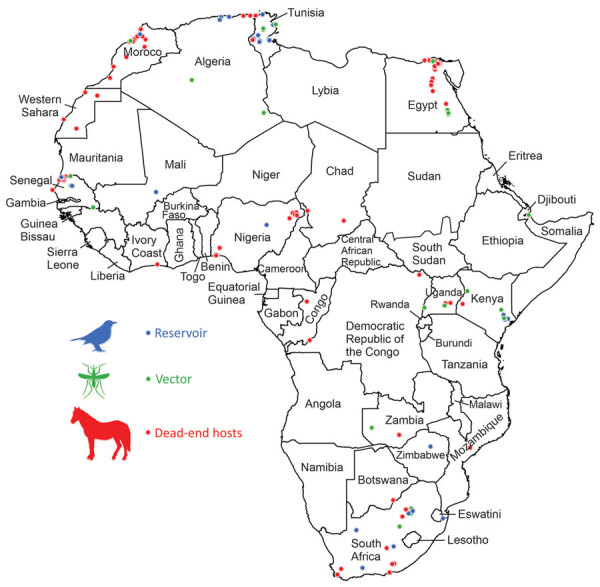
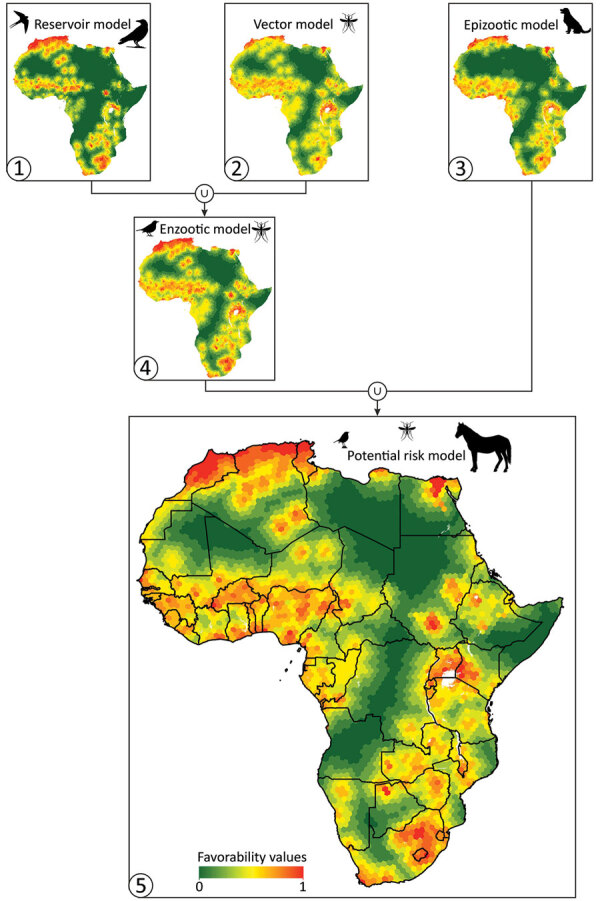
Description:West Nile virus (WNV) is an emergent arthropodborne virus that is transmitted from bird to bird by mosquitoes. Spillover events occur when infected mosquitoes bite mammals. We created a geopositioned database of WNV presence in Africa and considered reports of the virus in all animal components: reservoirs, vectors, and nonhuman dead-end hosts. We built various biogeographic models to determine which drivers explain the distribution of WNV throughout Africa. Wetlands of international importance for birds accounted for the detection of WNV in all animal components, whereas human-related drivers played a key role in the epizootic cases. We combined these models to obtain an integrative and large-scale perspective of the areas at risk for WNV spillover. Understanding which areas pose the highest risk would enable us to address the management of this spreading disease and to comprehend the translocation of WNV outside Africa through avian migration routes.
-
Subjects:
-
Source:Emerg Infect Dis. 2022; 28(4):777-785
-
Pubmed ID:35318911
-
Pubmed Central ID:PMC8962882
-
Document Type:
-
Place as Subject:
-
Volume:28
-
Issue:4
-
Download URL:
-
File Type:
 [PDF - 1.96 MB]
 -
Collection(s):
-
Main Document Checksum:urn:sha256:8553097aa5efafc2c6b213d5e2131c526eb37ae0ee170fa9514290193a44387a
Supporting Files


File Language:
English
 Was this page helpful?
 Found an issue?



CDC STACKS serves as an archival repository of CDC-published products including
scientific findings, journal articles, guidelines, recommendations, or other public health information authored or
co-authored by CDC or funded partners.
As a repository, CDC STACKS retains documents in their original published format to ensure public access to scientific information.
As a repository, CDC STACKS retains documents in their original published format to ensure public access to scientific information.
You May Also Like
COLLECTION
Emerging Infectious Diseases