



Finding “Bright Spots”: Using Multiple Measures to Examine Local-Area Racial Equity in Cancer Mortality Outcomes
Supporting Files

-
4 06 2021
-
Available in CDC Stacks on 2022-04-06T00:00:00Z
File Language:
English
Details
-
Alternative Title:Am J Epidemiol
-
Personal Author:
-
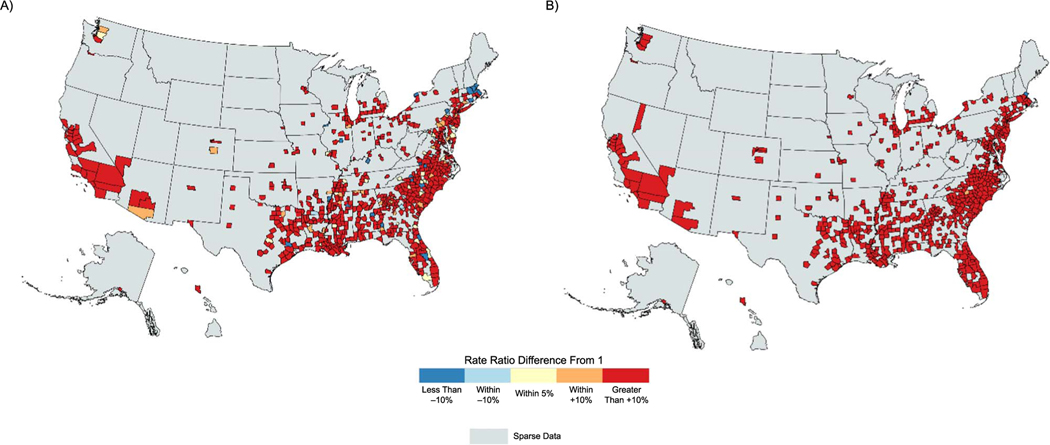
Description:In this article, we present a variety of measures that quantify equity in cancer mortality outcomes, demonstrate how the measures perform with various cancer types, and identify counties, or "bright spots," that meet the criteria of those measures. Using county-level age-adjusted mortality rates for 2007-2016 from the National Center for Health Statistics, we identified counties that had both equitable and optimal outcomes for Black and White death rates across 5 types of cancer: cancers of the lung/bronchus, prostate, female breast, colorectum, and liver. The number of counties that met the criteria ranged from 0 to 442, depending on cancer type and measure used. Prostate cancer and male liver cancer consistently had the lowest number of "bright spots," with a maximum of 3 counties meeting the most lenient criteria. This paper presents several ways to examine equity, using rate ratios and standard error measures, in cancer mortality outcomes. It highlights areas with positive progress toward equity and areas with a potential need for equity-focused cancer-control planning. Examining local areas of positive deviance can inform cancer-control programming and planning around health equity.
-
Subjects:
-
Source:Am J Epidemiol. 190(4):673-680
-
Pubmed ID:33073838
-
Pubmed Central ID:PMC8026676
-
Document Type:
-
Funding:
-
Place as Subject:
-
Volume:190
-
Issue:4
-
Download URL:
-
File Type:
 [PDF - 752.26 KB]
 -
Collection(s):
-
Main Document Checksum:urn:sha256:50491dd34e0271408043fdd3de1e74b70cb94cb848169058b77f4e5a6b4db50a
Supporting Files


File Language:
English
 Was this page helpful?
 Found an issue?


CDC STACKS serves as an archival repository of CDC-published products including
scientific findings, journal articles, guidelines, recommendations, or other public health information authored or
co-authored by CDC or funded partners.
As a repository, CDC STACKS retains documents in their original published format to ensure public access to scientific information.
As a repository, CDC STACKS retains documents in their original published format to ensure public access to scientific information.
You May Also Like
COLLECTION
CDC Public Access