



Geographic Access to Cancer Care and Mortality Among Adolescents
Supporting Files

-
2 2018
-
Available in CDC Stacks on September 06, 2018, 12:00 AM
File Language:
English
Details
-
Alternative Title:J Adolesc Young Adult Oncol
-
Personal Author:
-
Description:Purpose:
Adolescents with cancer have had less improvement in survival than other populations in the United States. This may be due, in part, to adolescents not receiving treatment at Children’s Oncology Group (COG) institutions, which have been shown to increase survival for some cancers. The objective of this ecologic study was to examine geographic distance to COG institutions and adolescent cancer mortality.
Methods:
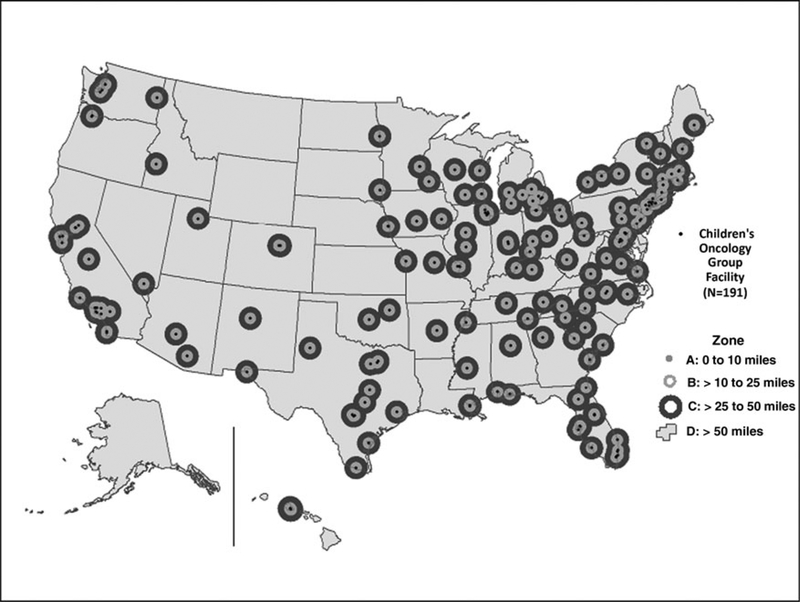
We calculated cancer mortality among adolescents and sociodemographic and healthcare access factors in four geographic zones at selected distances surrounding COG facilities: Zone A (area within 10 miles of any COG institution), Zones B and C (concentric rings with distances from a COG institution of >10–25 miles and >25–50 miles, respectively), and Zone D (area outside of 50 miles).
Results:
The adolescent cancer death rate was highest in Zone A at 3.21 deaths/100,000, followed by Zone B at 3.05 deaths/100,000, Zone C at 2.94 deaths/100,000, and Zone D at 2.88 deaths/100,000. The United States-wide death rate for whites without Hispanic ethnicity, blacks without Hispanic ethnicity, and persons with Hispanic ethnicity was 2.96 deaths/100,000, 3.10 deaths/100,000, and 3.26 deaths/100,000, respectively. Zone A had high levels of poverty (15%), no health insurance coverage (16%), and no vehicle access (16%).
Conclusions:
Geographic access to COG institutions, as measured by distance alone, played no evident role in death rate differences across zones. Among adolescents, socioeconomic factors, such as poverty and health insurance coverage, may have a greater impact on cancer mortality than geographic distance to COG institution. -
Keywords:
-
Source:J Adolesc Young Adult Oncol. 7(1):22-29
-
Pubmed ID:28933979
-
Pubmed Central ID:PMC6125785
-
Document Type:
-
Funding:
-
Volume:7
-
Issue:1
-
Download URL:
-
File Type:
 [PDF - 1.23 MB]
 -
Collection(s):
-
Main Document Checksum:urn:sha256:4028f9d1b97358680ff0608a9cedc6173228f5d1d16209b1bd1a6666411ca7ba
Supporting Files


File Language:
English
 Was this page helpful?
 Found an issue?


CDC STACKS serves as an archival repository of CDC-published products including
scientific findings, journal articles, guidelines, recommendations, or other public health information authored or
co-authored by CDC or funded partners.
As a repository, CDC STACKS retains documents in their original published format to ensure public access to scientific information.
As a repository, CDC STACKS retains documents in their original published format to ensure public access to scientific information.
You May Also Like
COLLECTION
CDC Public Access