


Antigen Test Performance Among Children and Adults at a SARS-CoV-2 Community Testing Site
Supporting Files

-
12 31 2021
-
File Language:
English
Details
-
Alternative Title:J Pediatric Infect Dis Soc
-
Personal Author:Ford, Laura ; Whaley, Melissa J. ; Shah, Melisa M. ; Salvatore, Phillip P. ; Segaloff, Hannah E. ; Delaney, Augustina ; Currie, Dustin W. ; Boyle-Estheimer, Lauren ; O'Hegarty, Michelle ; Morgan, Clint N. ; Meece, Jennifer ; Ivacic, Lynn ; Thornburg, Natalie J.
 ;
Tamin, Azaibi
;
Harcourt, Jennifer L.
;
Folster, Jennifer M.
;
Medrzycki, Magdalena
;
Jain, Shilpi
;
Wong, Phili
;
Goffard, Kimberly
;
Gieryn, Douglas
;
Kahrs, Juliana
;
Langolf, Kimberly
;
Zochert, Tara
;
Tate, Jacqueline E.
;
Hsu, Christopher H.
;
Kirking, Hannah L.
;
Tamin, Azaibi
;
Harcourt, Jennifer L.
;
Folster, Jennifer M.
;
Medrzycki, Magdalena
;
Jain, Shilpi
;
Wong, Phili
;
Goffard, Kimberly
;
Gieryn, Douglas
;
Kahrs, Juliana
;
Langolf, Kimberly
;
Zochert, Tara
;
Tate, Jacqueline E.
;
Hsu, Christopher H.
;
Kirking, Hannah L.
-
Description:Background.
Performance characteristics of SARS-CoV-2 antigen tests among children are limited despite the need for point-of-care testing in school and childcare settings. We describe children seeking SARS-CoV-2 testing at a community site and compare antigen test performance to real-time reverse transcription-polymerase chain reaction (RT-PCR) and viral culture.
Methods.
Two anterior nasal specimens were self-collected for BinaxNOW antigen and RT-PCR testing, along with demographics, symptoms, and exposure information from individuals ≥5 years at a community testing site. Viral culture was attempted on residual antigen or RT-PCR-positive specimens. Demographic and clinical characteristics, and the performance of SARS-CoV-2 antigen tests, were compared among children (<18 years) and adults.
Results.
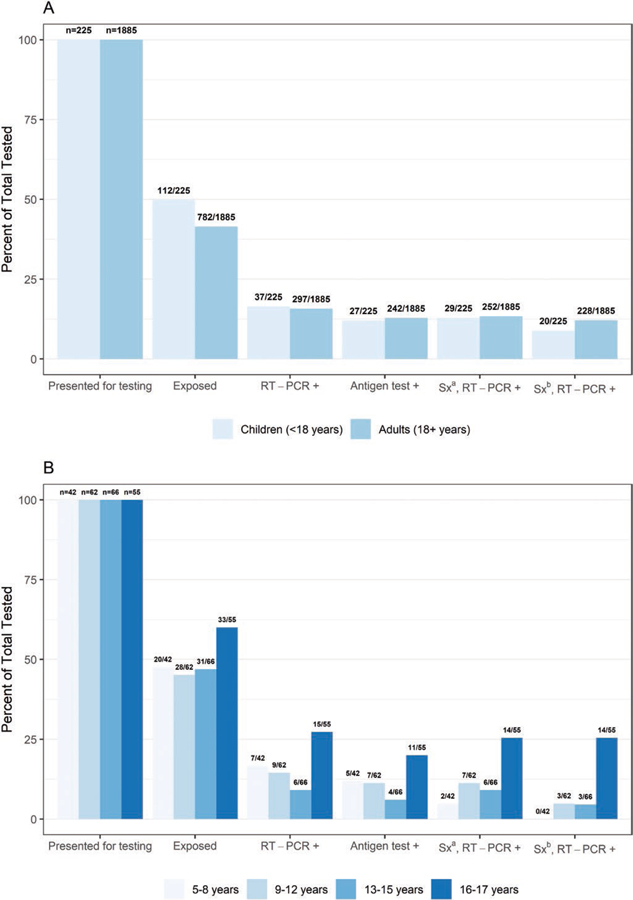
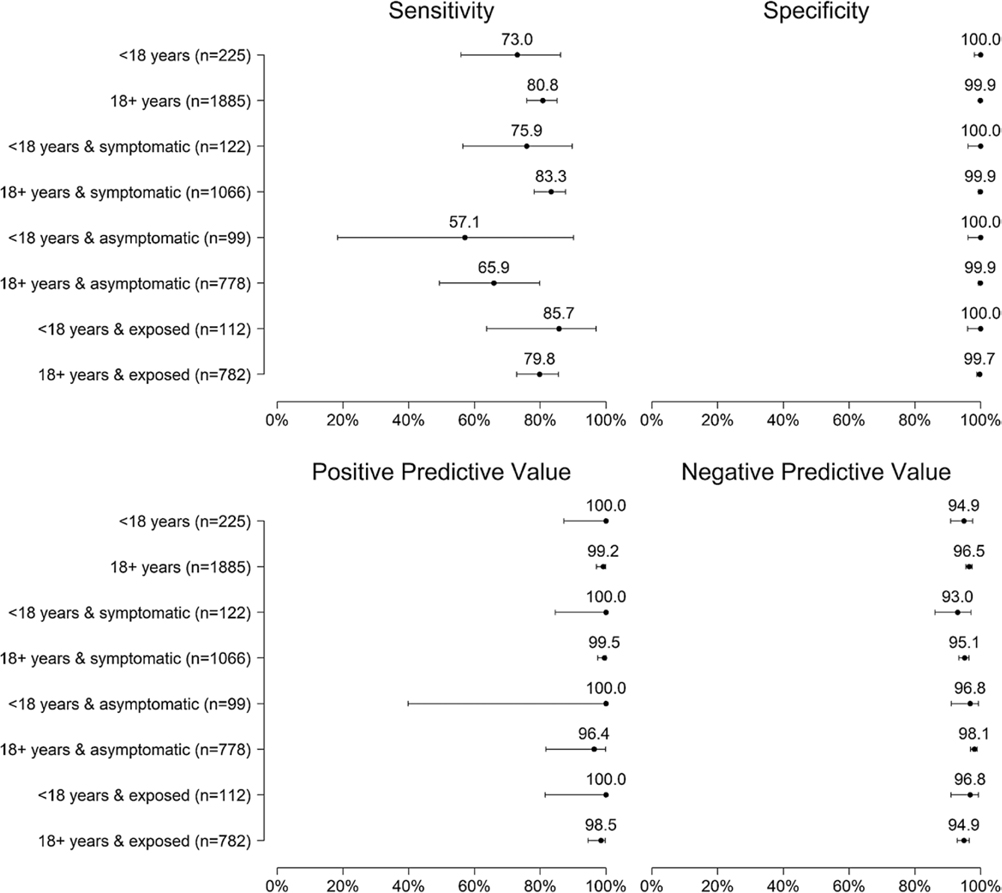
About 1 in 10 included specimens were from children (225/2110); 16.4% (37/225) were RT-PCR-positive. Cycle threshold values were similar among RT-PCR-positive specimens from children and adults (22.5 vs 21.3, P = .46) and among specimens from symptomatic and asymptomatic children (22.5 vs 23.2, P = .39). Sensitivity of antigen test compared to RT-PCR was 73.0% (27/37) among specimens from children and 80.8% (240/297) among specimens from adults; among specimens from children, specificity was 100% (188/188), positive and negative predictive values were 100% (27/27) and 94.9% (188/198), respectively. Virus was isolated from 51.4% (19/37) of RT-PCR-positive pediatric specimens; all 19 had positive antigen test results.
Conclusions.
With lower sensitivity relative to RT-PCR, antigen tests may not diagnose all positive COVID-19 cases; however, antigen testing identified children with live SARS-CoV-2 virus.
-
Subjects:
-
Source:J Pediatric Infect Dis Soc. 10(12):1052-1061
-
Pubmed ID:34468732
-
Pubmed Central ID:PMC8932441
-
Document Type:
-
Funding:
-
Volume:10
-
Issue:12
-
Collection(s):
-
Main Document Checksum:urn:sha256:c44e1fc04b97bd400e1f4c0de6490a6c3077669b8b4e5f6b62b4c62f2733e1cd
-
Download URL:
-
File Type:
 [PDF
- 716.68 KB
]
[PDF
- 716.68 KB
]
Supporting Files


File Language:
English
ON THIS PAGE



CDC STACKS serves as an archival repository of CDC-published products including
scientific findings,
journal articles, guidelines, recommendations, or other public health information authored or
co-authored by CDC or funded partners.
As a repository, CDC STACKS retains documents in their original published format to ensure public access to scientific information.
As a repository, CDC STACKS retains documents in their original published format to ensure public access to scientific information.
You May Also Like
COLLECTION
CDC Public Access