


Translating Violence Prevention Programs from Research to Practice: SafERteens Implementation In an Urban Emergency Department
Supporting Files

-
1 2022
-
File Language:
English
Details
-
Alternative Title:J Emerg Med
-
Personal Author:
-
Description:Background:
Youth violence is a leading cause of adolescent mortality, underscoring the need to integrate evidence-based violence prevention programs into routine Emergency Department (ED) care.
Objectives:
To examine the translation of the SafERteens program into clinical care.
Methods:
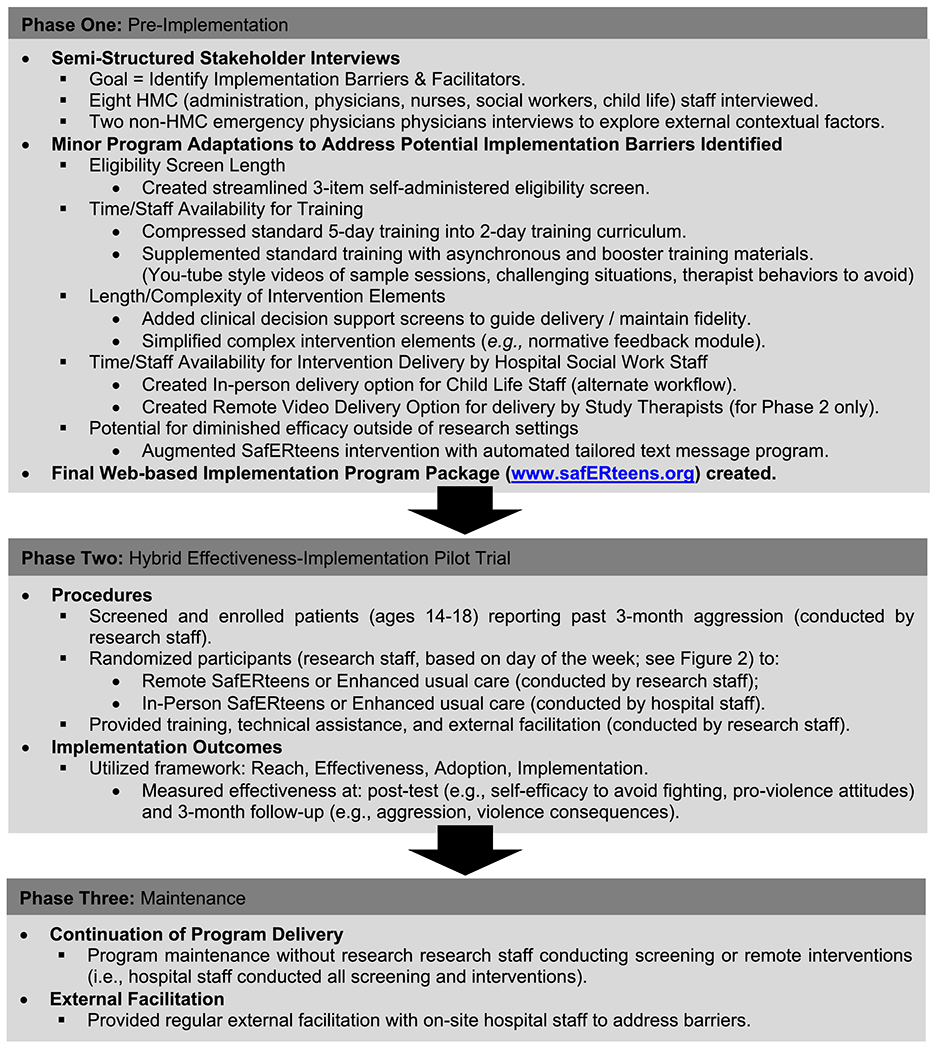
Hospital staff provided input on implementation facilitators/barriers to inform toolkit development. Implementation was piloted in a 4-arm effectiveness-implementation trial, with youth (age: 14-18) screening positive for past 3-month aggression randomized to either SafERteens (delivered remotely or in-person) or enhanced usual care (EUC; remote or in-person), with follow-up at post-test and 3-months. During maintenance, ED staff continued in-person SafERteens delivery and external facilitation was provided. Outcomes were measured using the RE-AIM implementation framework.
Results:
SafERteens completion rates were 77.6% (52/67) for remote and 49.1% (27/55) for in-person delivery. In addition to high acceptability ratings (e.g., helpfulness), post-test data demonstrated increased self-efficacy to avoid fighting among patients receiving remote (IRR=1.22; 95%CI=1.09-1.36) and in-person (IRR=1.23; 95%CI=1.12-1.36) SafERteens, as well as decreased pro-violence attitudes among patients receiving remote (IRR=0.83; 95%CI=0.75-0.91) and in-person (IRR=0.87; 95%CI=0.77-0.99) SafERteens when compared to their respective EUC groups. At 3-months, youth receiving remote SafERteens reported less non-partner aggression (IRR=0.52; 95% CI=0.31-0.87; Cohen’s d=−0.39) and violence consequences (IRR=0.47; 95%CI=0.22-1.00; Cohen’s d=−0.49) compared to remote-EUC; no differences were noted for in-person SafERteens delivery. Barriers to implementation maintenance included limited staff availability and a lack of reimbursement codes.
Conclusions:
Implementing behavioral interventions such as SafERteens into routine ED care is feasible using remote delivery. Policymakers should consider reimbursement for violence prevention services to sustain long-term implementation.
-
Subjects:
-
Source:J Emerg Med. 62(1):109-124
-
Pubmed ID:34688506
-
Pubmed Central ID:PMC8810595
-
Document Type:
-
Funding:
-
Volume:62
-
Issue:1
-
Collection(s):
-
Main Document Checksum:urn:sha256:816fdaecf74824fbc64f4167671d3d41203bee7260697a36a9144ed2a65ce01f
-
Download URL:
-
File Type:
 [PDF
- 732.92 KB
]
[PDF
- 732.92 KB
]
Supporting Files


File Language:
English
ON THIS PAGE


CDC STACKS serves as an archival repository of CDC-published products including
scientific findings,
journal articles, guidelines, recommendations, or other public health information authored or
co-authored by CDC or funded partners.
As a repository, CDC STACKS retains documents in their original published format to ensure public access to scientific information.
As a repository, CDC STACKS retains documents in their original published format to ensure public access to scientific information.
You May Also Like
COLLECTION
CDC Public Access