


CLASSIFICATION OF NECK/SHOULDER PAIN IN EPIDEMIOLOGICAL RESEARCH: A COMPARISON OF PERSONAL AND OCCUPATIONAL CHARACTERISTICS, DISABILITY AND PROGNOSIS AMONG 12,195 WORKERS FROM 18 COUNTRIES
Supporting Files

-
5 2016
-
File Language:
English
Details
-
Alternative Title:Pain
-
Personal Author:Sarquis, Leila M M ; Coggon, David ; Ntani, Georgia ; Walker-Bone, Karen ; Palmer, Keith T ; Felli, Vanda E ; Harari, Raul ; Barrero, Lope H ; Felknor, Sarah A. ; Gimeno, David ; Cattrell, Anna ; Vargas-Prada, Sergio ; Bonzini, Matteo ; Solidaki, Eleni ; Merisalu, Eda ; Habib, Rima R. ; Sadeghian, Farideh ; Kadir, M Masood ; Warnakulasuriya, Sudath SP ; Matsudaira, Ko ; Nyantumbu, Busisiwe ; Sim, Malcolm R ; Harcombe, Helen ; Cox, Ken ; Marziale, Maria H ; Harari, Florencia ; Freire, Rocio ; Harari, Natalia ; Monroy, Magda V ; Quintana, Leonardo A ; Rojas, Marianela ; Harris, E Clare ; Serra, Consol ; Martinez, J Miguel ; Delclos, George ; Benavides, Fernando G ; Carugno, Michele ; Ferrario, Marco M ; Pesatori, Angela C ; Chatzi, Leda ; Bitsios, Panos ; Kogevinas, Manolis ; Oha, Kristel ; Freimann, Tiina ; Sadeghian, Ali ; Peiris-John, Roshini J ; Sathiakumar, Nalini ; Wickremasinghe, A Rajitha ; Yoshimura, Noriko ; Kelsall, Helen L ; Hoe, Victor C W ; Urquhart, Donna M ; Derrett, Sarah ; McBride, David ; Herbison, Peter ; Gray, Andrew ; Salazar Vega, Eduardo J.
-
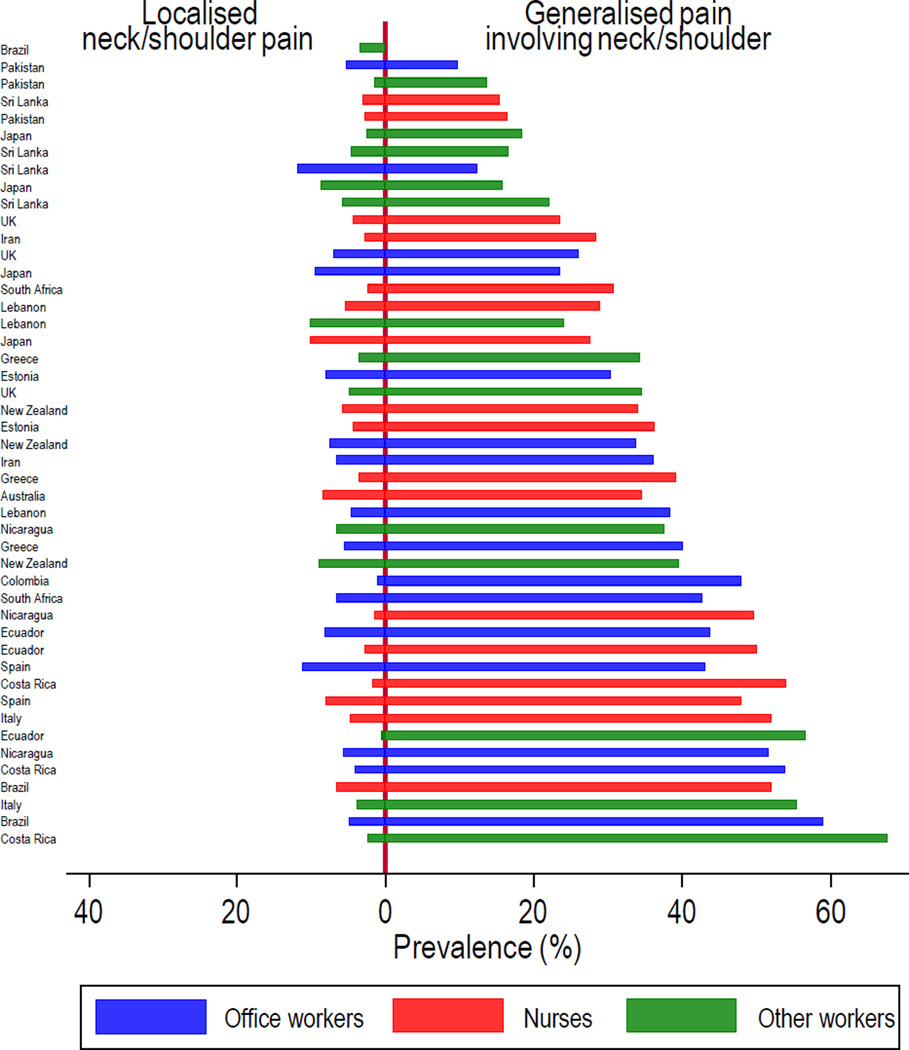
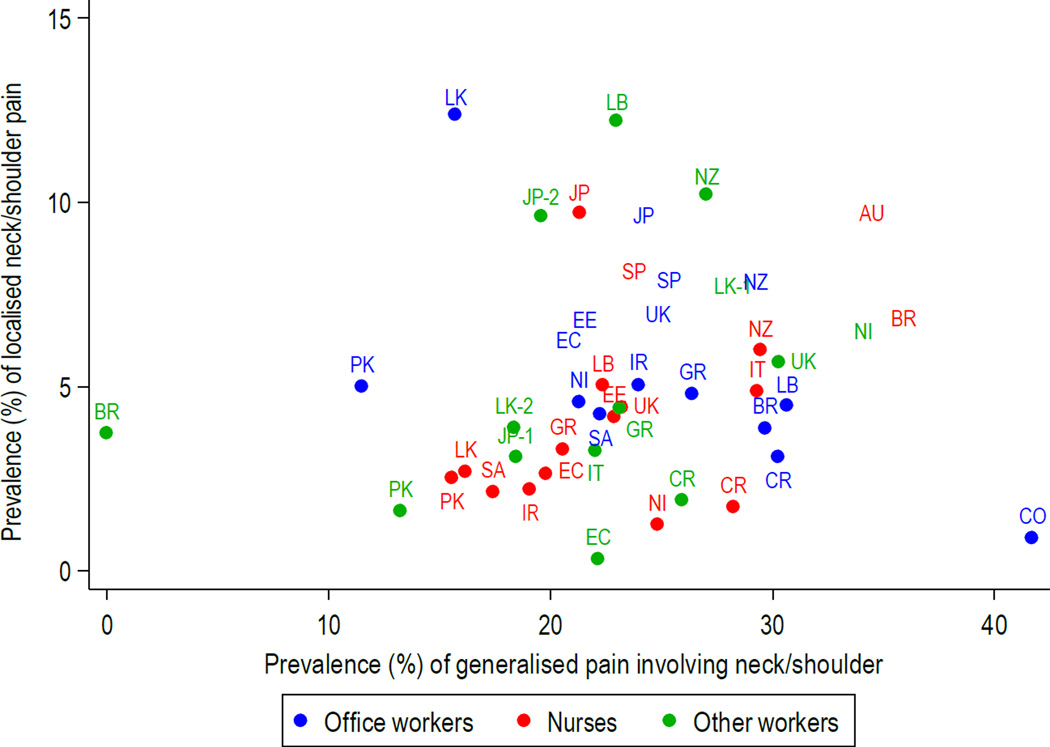
Description:To inform case definition for neck/shoulder pain in epidemiological research, we compared levels of disability, patterns of association, and prognosis for pain that was limited to the neck or shoulders (LNSP) and more generalised musculoskeletal pain that involved the neck or shoulder(s) (GPNS). Baseline data on musculoskeletal pain, disability, and potential correlates were collected by questionnaire from 12,195 workers in 47 occupational groups (mostly office workers, nurses, and manual workers) in 18 countries (response rate = 70%). Continuing pain after a mean interval of 14 months was ascertained through a follow-up questionnaire in 9150 workers from 45 occupational groups. Associations with personal and occupational factors were assessed by Poisson regression and summarised by prevalence rate ratios (PRRs). The 1-month prevalence of GPNS at baseline was much greater than that of LNSP (35.1% vs 5.6%), and it tended to be more troublesome and disabling. Unlike LNSP, the prevalence of GPNS increased with age. Moreover, it showed significantly stronger associations with somatising tendency (PRR 1.6 vs 1.3) and poor mental health (PRR 1.3 vs 1.1); greater variation between the occupational groups studied (prevalence ranging from 0% to 67.6%) that correlated poorly with the variation in LNSP; and was more persistent at follow-up (72.1% vs 61.7%). Our findings highlight important epidemiological distinctions between subcategories of neck/shoulder pain. In future epidemiological research that bases case definitions on symptoms, it would be useful to distinguish pain that is localised to the neck or shoulder from more generalised pain that happens to involve the neck/shoulder region.
-
Subjects:
-
Source:Pain. 157(5):1028-1036
-
Pubmed ID:26761390
-
Pubmed Central ID:PMC4833635
-
Document Type:
-
Funding:MC_UP_A620_1018/MRC_/Medical Research CouncilUnited Kingdom/ ; 20665/ARC_/Arthritis Research UKUnited Kingdom/ ; MC_PC_15015/MRC_/Medical Research CouncilUnited Kingdom/ ; D43 TW000644/TW/FIC NIH HHSUnited States/ ; G0400490/MRC_/Medical Research CouncilUnited Kingdom/ ; MC_UU_12011/5/MRC_/Medical Research CouncilUnited Kingdom/ ; T42 OH008421/OH/NIOSH CDC HHSUnited States/
-
Volume:157
-
Issue:5
-
Collection(s):
-
Main Document Checksum:urn:sha256:209253233fae327a202d3537013e4a7b125b1e96638678361dc4bd100865b994
-
Download URL:
-
File Type:
 [PDF
- 758.31 KB
]
[PDF
- 758.31 KB
]
Supporting Files


File Language:
English
ON THIS PAGE


CDC STACKS serves as an archival repository of CDC-published products including
scientific findings,
journal articles, guidelines, recommendations, or other public health information authored or
co-authored by CDC or funded partners.
As a repository, CDC STACKS retains documents in their original published format to ensure public access to scientific information.
As a repository, CDC STACKS retains documents in their original published format to ensure public access to scientific information.
You May Also Like
COLLECTION
CDC Public Access