



Longitudinal Associations between Objective and Perceived Healthy Food Environment and Diet: The Multi-Ethnic Study of Atherosclerosis
Supporting Files

-
1 2022
-
File Language:
English
Details
-
Alternative Title:Soc Sci Med
-
Personal Author:
-
Description:Introduction:
Research examining the influence of neighborhood healthy food environment on diet has been mostly cross-sectional and lacked robust characterization of the food environment. We examined longitudinal associations between features of the local food environment and healthy diet, and whether associations were modified by race/ethnicity.
Methods:
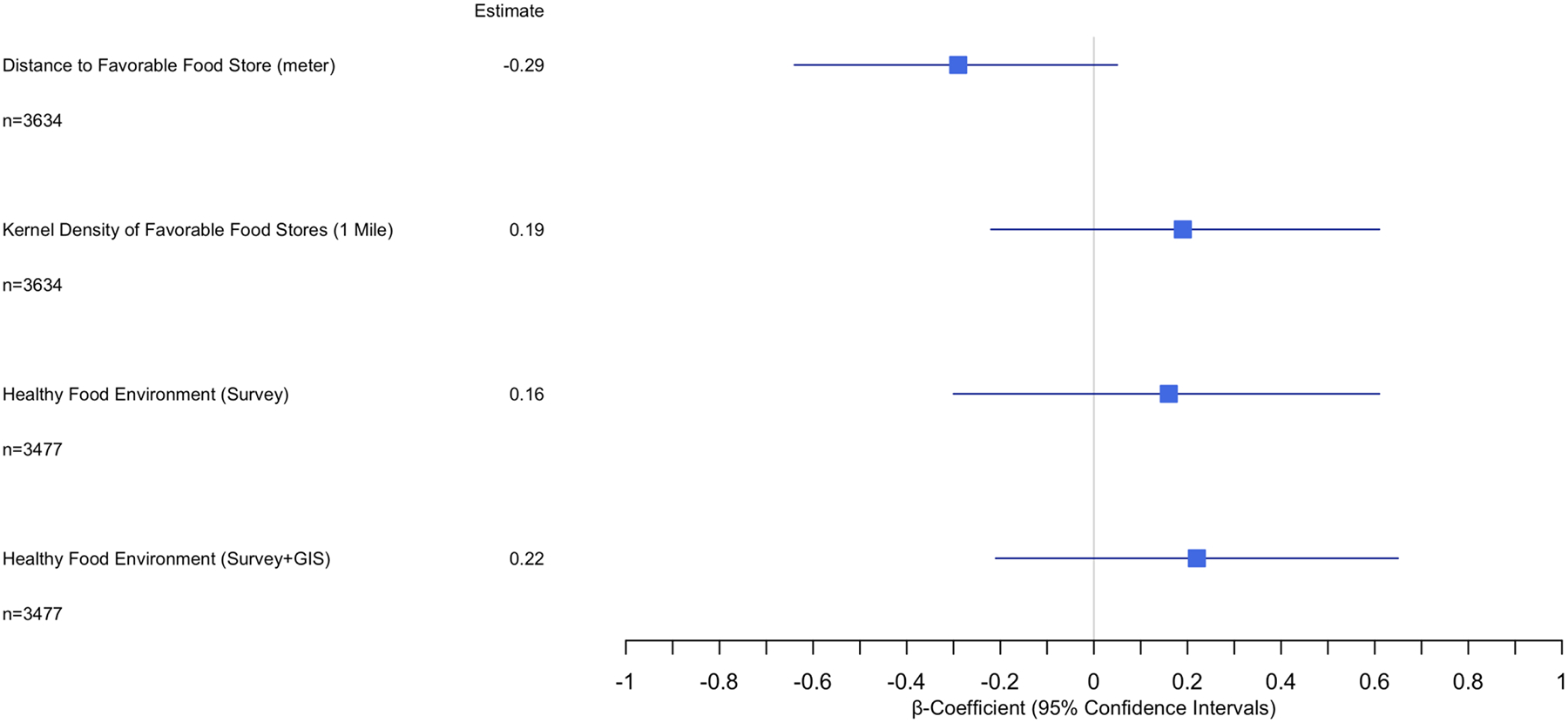
Data on 3,634 adults aged 45–84 at Exam 1 and followed for 10 years were obtained from the Multi-Ethnic Study of Atherosclerosis. Diet quality was assessed using the Alternative Healthy Eating Index at Exam 1 (2000–2002) and Exam 5 (2010–2012). We assessed four measures of local food environment using survey-based measures (e.g. perceptions of healthier food availability) and geographic information system (GIS)-based measures (e.g. distance to and density of healthier food stores) at Exam 1 and Exam 5. Random effects models adjusted for age, sex, education, moving status, per capita adjusted income, and neighborhood socioeconomic status and interactions terms to assess effect modification by race/ethnicity.
Results:
Net of confounders, one standard z-score higher average composite local food environment was associated with higher average AHEI diet score (1.39, 95% CI: 1.05, 1.73) over the follow-up period from Exam 1 to 5. This pattern of association was consistent across both GIS-based and survey-based measures of local food environment and was more pronounced among minoritized racial/ethnic groups. There was no association between changes in neighborhood environment and change in AHEI score, or effect modification by race/ethnicity.
Conclusion:
Our findings suggest that neighborhood-level food environment is associated with better diet quality, especially among racially/ethnically minoritized populations.
-
Subjects:
-
Keywords:
-
Source:Soc Sci Med. 292:114542
-
Pubmed ID:34802783
-
Pubmed Central ID:PMC8748383
-
Document Type:
-
Funding:
-
Volume:292
-
Collection(s):
-
Main Document Checksum:urn:sha-512:28e16b44351e211119309385e3b84ead96805b1ce0deb54c438d0fc1fd0de7a9c8f7ab42b2d5aad7b7f972e7ea6b45834f07455e8ff1babc8f8253625d57c4f1
-
Download URL:
-
File Type:
 [PDF
- 284.10 KB
]
[PDF
- 284.10 KB
]
Supporting Files


File Language:
English
 Was this page helpful?
 Found an issue?

CDC STACKS serves as an archival repository of CDC-published products including
scientific findings,
journal articles, guidelines, recommendations, or other public health information authored or
co-authored by CDC or funded partners.
As a repository, CDC STACKS retains documents in their original published format to ensure public access to scientific information.
As a repository, CDC STACKS retains documents in their original published format to ensure public access to scientific information.
You May Also Like
COLLECTION
CDC Public Access