



Cervical Cancer Screening Among Women by Birthplace and Percent of Lifetime Living in the United States
Supporting Files

-
10 2018
-
Available in CDC Stacks on October 01, 2019, 12:00 AM
File Language:
English
Details
-
Journal Article:J Low Genit Tract Dis
-
Personal Author:
-
Description:Objective:
The aim of the study was to provide national estimates of Pap test receipt, by birthplace, and percent of lifetime in the United States (US).
Materials and Methods:
Pooled nationally representative data (2005, 2008, 2013, 2015) from the National Health Interview Survey were used to examine differences in Pap test receipt among adult US women by birthplace and percent of lifetime in the US. Descriptive estimates were age-adjusted. Regression models were adjusted for selected sociodemographic and healthcare access and utilization factors and presented as predicted margins.
Results:
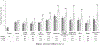
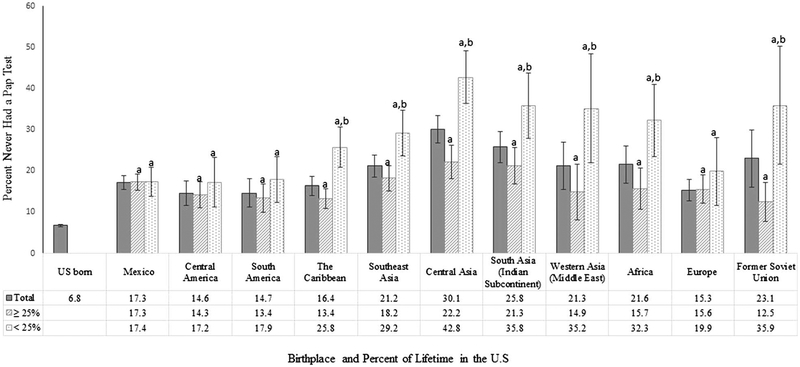
Foreign-born women 18 years and older were more than twice as likely to have never received a Pap test compared with US-born women(18.6% vs 6.8%). Regression models showed that foreign-born women from Mexico (9.8%), South America (12.6%), Caribbean (14.6%), Southeast Asia (13.7%), Central Asia (20.4%), South Asia (22.9%), Middle East (25.0%), Africa (27.8%), Europe (16.4%), and Former Soviet Union (28.2%) were more likely to be unscreened compared with US-born women (7.6%). Foreign-born women who spent less than 25% of their life in the US had higher prevalence of never having a Pap test (20%) compared with foreign-born who spent more than 25% of their life in the US (12.7%).
Conclusions:
Using national survey, we found that where a woman is born and the percent of her lifetime spent residing in the US do impact whether she gets screened at least once in her lifetime.
Impact:
These findings may inform cervical cancer screening efforts targeting foreign-born women. -
Subjects:
-
Keywords:
-
Source:J Low Genit Tract Dis. 22(4):280-287
-
DOI:
-
Pubmed ID:30063576
-
Pubmed Central ID:PMC6664302
-
Document Type:
-
Funding:
-
Genre:
-
Volume:22
-
Issue:4
-
Download URL:
-
File Type:
 [PDF - 270.75 KB]
 -
Collection(s):
-
Main Document Checksum:urn:sha-512:548c376da94b5f0ca697771ae481e8592f9984fe1314e164ee4f248ec3baf441be2e0075843954030af673cf4aa86e845c1db643eff5fe602408d6283ee4d09c
Supporting Files


File Language:
English
 Was this page helpful?
 Found an issue?

CDC STACKS serves as an archival repository of CDC-published products including
scientific findings, journal articles, guidelines, recommendations, or other public health information authored or
co-authored by CDC or funded partners.
As a repository, CDC STACKS retains documents in their original published format to ensure public access to scientific information.
As a repository, CDC STACKS retains documents in their original published format to ensure public access to scientific information.
You May Also Like
COLLECTION
CDC Public Access