



Malondialdehyde-Acetaldehyde Adducts and Antibody Responses in Rheumatoid Arthritis-Interstitial Lung Disease
Supporting Files
Peer Reviewed

-
2019/09/01
-
Available in CDC Stacks on 2020-09-01T00:00:00Z
File Language:
English
Details
-
Journal Article:Arthritis and Rheumatology
-
Personal Author:Ascherman, Dana P. ; Caplan, Liron ; Deane, Kevin D. ; Demoruelle, M. Kristen ; Duryee, Michael J. ; England, Bryant R. ; Klassen, Lynell W. ; Mahajan, Tina D. ; Mikuls, Ted R. ; Poole, Jill A. ; Roul, Punyasha ; Singh, Namrata ; Thiele, Geoffrey M.
-
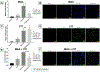
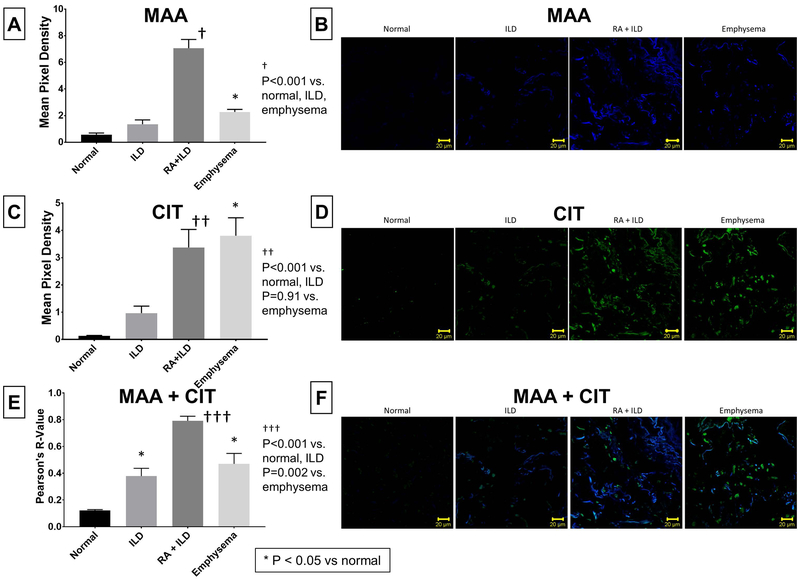
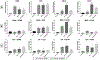
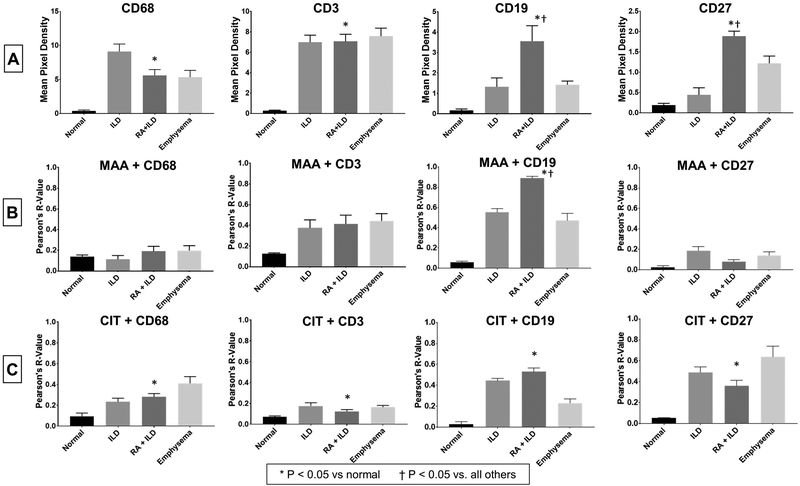
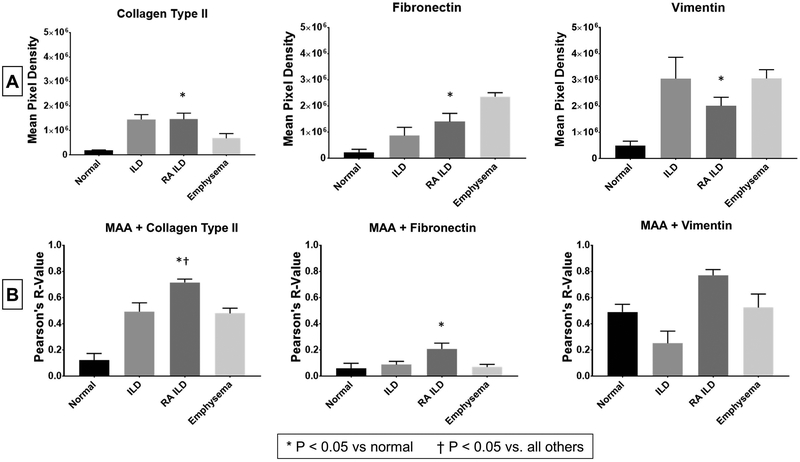
Description:Objective: To compare serum anti-malondialdehyde-acetaldehyde (anti-MAA) antibody levels and MAA expression in lung tissue from patients with rheumatoid arthritis-associated interstitial lung disease (RA-ILD) to those found in controls. Methods: Anti-MAA antibody (IgA, IgM, IgG) concentrations were measured in patients with RA-ILD and compared to those of RA patients with chronic obstructive pulmonary disease (COPD) and RA patients without lung disease. Associations between anti-MAA antibody with RA-ILD were assessed using multivariable logistic regression. Lung tissue from patients with RA-ILD, other ILD, or emphysema, and from controls (n = 3 per group) were stained for MAA, citrulline, macrophages (CD68), T cells (CD3), B cells (CD19/CD27), and extracellular matrix proteins (type II collagen, fibronectin, vimentin). Tissue expression and colocalization with MAA were quantified and compared. Results: Among 1,823 RA patients, 90 had prevalent RA-ILD. Serum IgA and IgM anti-MAA antibody concentrations were higher in RA-ILD than in RA with COPD or RA alone (P = 0.005). After adjustment for covariates, the highest quartiles of IgA anti-MAA antibody concentration (odds ratio 2.09 95% confidence interval 1.11-3.90) and IgM (odds ratio 2.23 95% confidence interval 1.19-4.15) were significantly associated with the presence of RA-ILD. MAA expression in RA-ILD lung tissue was greater than in tissue from all other groups (P < 0.001), and it colocalized with citrulline (r = 0.79), CD19+ B cells (r = 0.78), and extracellular matrix proteins (type II collagen r = 0.72 and vimentin r = 0.77) to the greatest degree in RA-ILD. Conclusion: Serum IgA and IgM anti-MAA antibody is associated with ILD among RA patients. MAA is highly expressed in RA-ILD lung tissue, where it colocalizes with other RA autoantigens, autoreactive B cells, and extracellular matrix proteins, highlighting its potential role in the pathogenesis of RA-ILD. Description provided by NIOSH
-
Subjects:
-
Keywords:
-
Source:Arthritis Rheumatol 2019 Sep; 71(9):1483-1493
-
ISSN:2326-5191
-
Pubmed ID:30933423
-
Pubmed Central ID:PMC6717041
-
Document Type:
-
Funding:CX000896/US Department of Veterans AffairsInternational/ ; Internal Medicine Scientist Development Award, and Mentored Scholars ProgramInternational/ ; R01 ES019325/ES/NIEHS NIH HHSUnited States/ ; U54 OH010162/OH/NIOSH CDC HHSUnited States/ ; U54 GM115458/GM/NIGMS NIH HHSUnited States/ ; University of Nebraska Medical Center Physician-Scientist Training ProgramInternational/
-
Genre:
-
Place as Subject:
-
CIO:
-
Topic:
-
Location:
-
Pages in Document:19 pdf pages
-
Volume:71
-
Issue:9
-
NIOSHTIC Number:nn:20065183
-
Contact Point Address:Bryant R. England, MD, 986270 Nebraska Medical Center, Omaha, NE 68198-6270
-
Email:bryant.england@unmc.edu
-
Federal Fiscal Year:2019
-
NORA Priority Area:
-
Performing Organization:University of Nebraska Medical Center - Omaha
-
Peer Reviewed:True
-
Download URL:
-
File Type:
 [PDF - 986.99 KB]
 -
Collection(s):
-
Main Document Checksum:urn:sha-512:89f3d52f813c4e7a814364fc8836637033ce2f0579acee02fdbe33d66d1236ed5432250e0e57ae3a75b4eac4d92d89b6dff63c9ada7cbe7f15eac018c32d1271
Supporting Files


File Language:
English
 Was this page helpful?
 Found an issue?

CDC STACKS serves as an archival repository of CDC-published products including
scientific findings, journal articles, guidelines, recommendations, or other public health information authored or
co-authored by CDC or funded partners.
As a repository, CDC STACKS retains documents in their original published format to ensure public access to scientific information.
As a repository, CDC STACKS retains documents in their original published format to ensure public access to scientific information.
You May Also Like