



Ischemic Heart and Cerebrovascular Disease Mortality in Uranium Enrichment Workers
Supporting Files

-
2 2021
-
Available in CDC Stacks on February 01, 2022, 12:00 AM
File Language:
English
Details
-
Alternative Title:Occup Environ Med
-
Personal Author:
-
Description:Objective:
Linear and non-linear dose-response relationships between radiation absorbed dose to the lung from internally deposited uranium and external sources and circulatory system disease (CSD) mortality were examined in a cohort of 23,731 male and 5552 female U.S. uranium enrichment workers.
Methods:
Rate ratios (RRs) for categories of lung dose and linear excess relative rates (ERRs) per unit lung dose were estimated to evaluate associations between lung absorbed dose and death from ischemic heart disease (IHD) and cerebrovascular disease (CeVD).
Results:
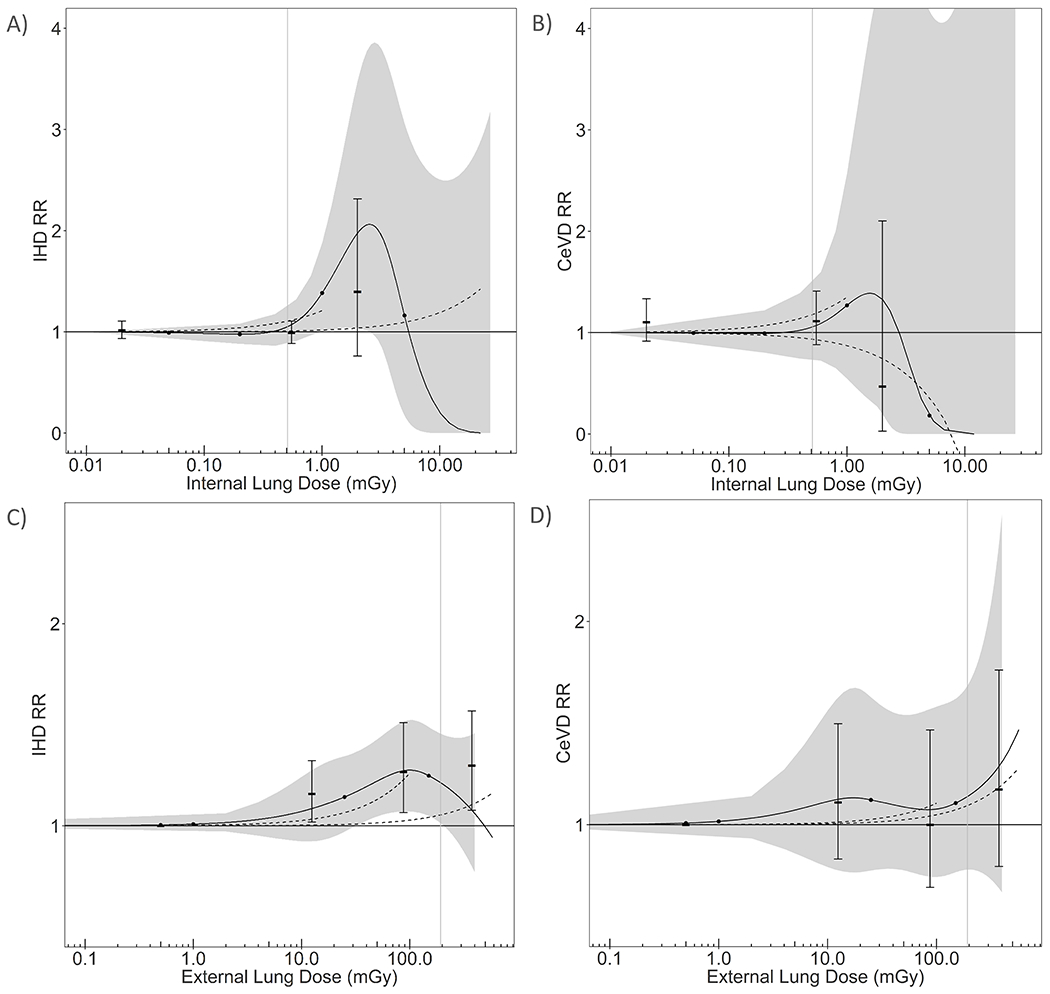
There was a suggestion of modestly increased IHD risk in workers with internal uranium lung dose above 1 milligray (mGy) (RR = 1.4; 95% CI: 0.76, 2.3) and a statistically significant increased IHD risk with external dose exceeding 150 mGy (RR = 1.3; 95% CI: 1.1, 1.6) compared to the lowest exposed groups. ERRs per mGy were positive for IHD and uranium internal dose and for both outcomes per Gy external dose, although confidence intervals generally included the null.
Conclusions:
Non-linear dose-response models using restricted cubic splines revealed sublinear responses at lower internal doses, suggesting that linear models that are common in radioepidemiological cancer studies may poorly describe the association between uranium internal dose and CSD mortality. -
Subjects:
-
Source:Occup Environ Med. 78(2):105-111
-
Pubmed ID:32883719
-
Pubmed Central ID:PMC8647719
-
Document Type:
-
Funding:
-
Volume:78
-
Issue:2
-
Download URL:
-
File Type:
 [PDF - 440.20 KB]
 -
Collection(s):
-
Main Document Checksum:urn:sha256:1de4a3406fee77f6b5027b967059865874887ac5e57ecf012c4c06c47affd072
Supporting Files


File Language:
English
 Was this page helpful?
 Found an issue?

CDC STACKS serves as an archival repository of CDC-published products including
scientific findings, journal articles, guidelines, recommendations, or other public health information authored or
co-authored by CDC or funded partners.
As a repository, CDC STACKS retains documents in their original published format to ensure public access to scientific information.
As a repository, CDC STACKS retains documents in their original published format to ensure public access to scientific information.
You May Also Like
COLLECTION
CDC Public Access