


Antimicrobial Resistance Creates Threat to Chimpanzee Health and Conservation in the Wild
Supporting Files

-
4 14 2021
-
File Language:
English
Details
-
Alternative Title:Pathogens
-
Personal Author:
-
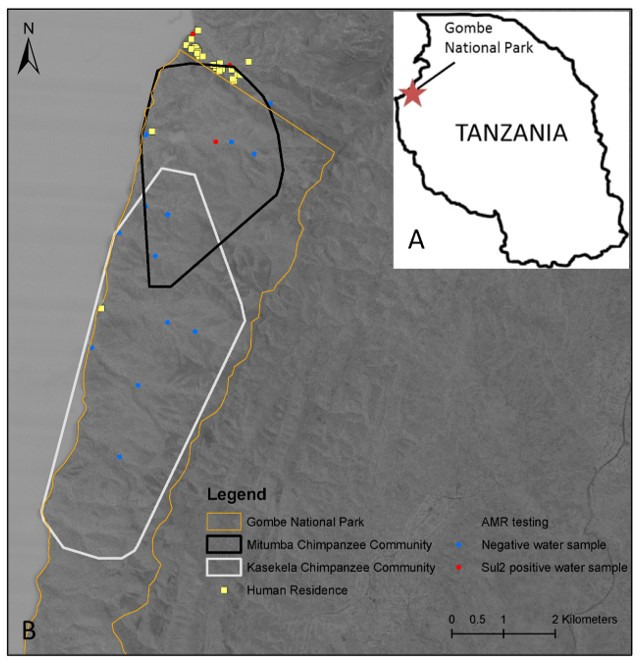
Description:Infectious disease is recognized as the greatest threat to the endangered chimpanzees made famous by the groundbreaking work of Dr. Jane Goodall at Gombe National Park (GNP), Tanzania. The permeable boundary of this small protected area allows for regular wildlife-human and wildlife-domestic animal overlap, which may facilitate cross-species transmission of pathogens and antimicrobial resistance. Few studies have examined the prevalence of antimicrobial resistance in wild ape populations. We used molecular techniques to investigate the presence of genes conferring resistance to sulfonamides (often used to treat diarrheal illness in human settings in this region) and tetracycline (used in the past-though much less so now) in fecal specimens from humans, domestic animals, chimpanzees, and baboons in and around GNP. We also tested stream water used by these groups. Sulfonamide resistance was common in humans (74%), non-human primates (43%), and domestic animals (17%). Tetracycline resistance was less common in all groups: humans (14%), non-human primates (3%), and domestic animals (6%). Sul resistance genes were detected from 4/22 (18%) of streams sampled. Differences in sul gene frequencies did not vary by location in humans nor in chimpanzees.
-
Subjects:
-
Source:Pathogens. 2021; 10(4)
-
Pubmed ID:33920028
-
Pubmed Central ID:PMC8071057
-
Document Type:
-
Funding:
-
Volume:10
-
Issue:4
-
Collection(s):
-
Main Document Checksum:urn:sha256:1be5ea03c6f4d937a6c81365103e390bb00cdfdf14b4cc3427c0ca284c7755ef
-
Download URL:
-
File Type:
 [PDF
- 657.63 KB
]
[PDF
- 657.63 KB
]
Supporting Files


File Language:
English
ON THIS PAGE


CDC STACKS serves as an archival repository of CDC-published products including
scientific findings,
journal articles, guidelines, recommendations, or other public health information authored or
co-authored by CDC or funded partners.
As a repository, CDC STACKS retains documents in their original published format to ensure public access to scientific information.
As a repository, CDC STACKS retains documents in their original published format to ensure public access to scientific information.
You May Also Like
COLLECTION
CDC Public Access