


Utility of linking survey and registry data to evaluate interventions and policies to address disparities in breast cancer survivorship among young women
Supporting Files

-
10 2021
-
File Language:
English
Details
-
Alternative Title:Eval Program Plann
-
Personal Author:
-
Description:Purpose:
There is limited research linking data sources to evaluate the multifactorial impacts on the quality of treatment received and financial burden among young women with breast cancer. To address this gap and support future evaluation efforts, we examined the utility of combining patient survey and cancer registry data.
Patient and Methods:
We administered a survey to women, aged 18–39 years, with breast cancer from four U.S. states. We conducted a systematic response-rate analysis and evaluated differences between racial groups. Survey responses were linked with cancer registry data to assess whether surveys could reliably supplement registry data.
Results:
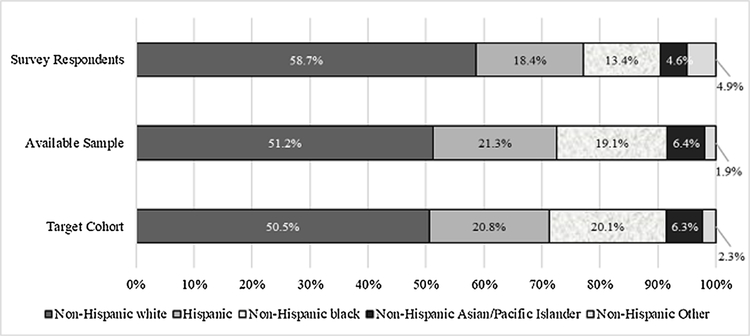
A total of 830 women completed the survey for a response rate of 28.4 %. Blacks and Asian/Pacific Islanders were half as likely to respond as white women. Concordance between survey and registry data was high for demographic variables (Cohen’s kappa [k]: 0.879 to 0.949), moderate to high for treatments received (k: 0.467 to 0.854), and low for hormone receptor status (k: 0.167 to 0.553). Survey items related to insurance status, employment, and symptoms revealed racial differences.
Conclusion:
Cancer registry data, supplemented by patient surveys, can provide a broader understanding of the quality of care and financial impacts of breast cancer among young women.
-
Subjects:
-
Source:Eval Program Plann. 88:101967
-
Pubmed ID:34091395
-
Pubmed Central ID:PMC8533048
-
Document Type:
-
Funding:
-
Volume:88
-
Collection(s):
-
Main Document Checksum:urn:sha256:7afdd0a5894058d008d31675ca7afc676b0533ce5e30dc9f4e3f172ffbc65833
-
Download URL:
-
File Type:
 [PDF
- 200.42 KB
]
[PDF
- 200.42 KB
]
Supporting Files


File Language:
English
ON THIS PAGE

CDC STACKS serves as an archival repository of CDC-published products including
scientific findings,
journal articles, guidelines, recommendations, or other public health information authored or
co-authored by CDC or funded partners.
As a repository, CDC STACKS retains documents in their original published format to ensure public access to scientific information.
As a repository, CDC STACKS retains documents in their original published format to ensure public access to scientific information.
You May Also Like
COLLECTION
CDC Public Access