



Translating research into practice: the role of provider based research networks in the diffusion of an evidence-based colon cancer treatment innovation
Supporting Files

-
8 2012 ; 8-2012
-
Available in CDC Stacks on August 01, 2013, 12:00 AM
File Language:
English
Details
-
Alternative Title:Med Care
-
Personal Author:
-
Description:Background
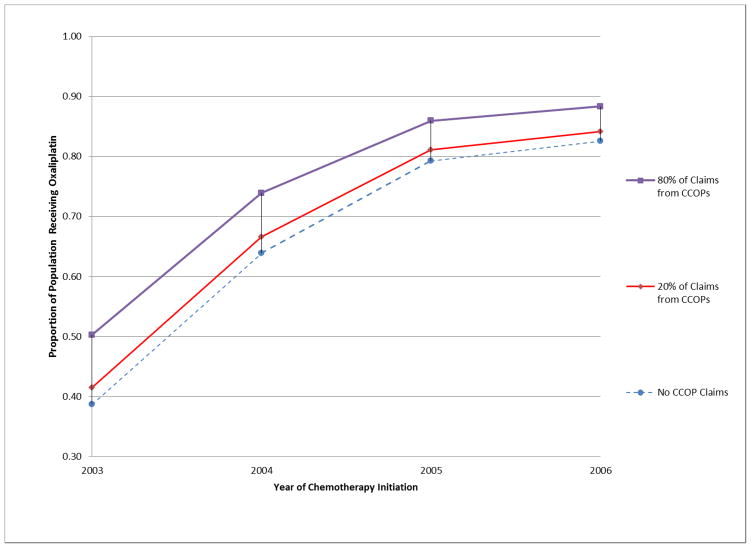
Provider-based research networks (PBRNs) – collaborative research partnerships between academic centers and community-based practitioners – are a promising model for accelerating the translation of research into practice; however, empirical evidence of accelerated translation is limited. Oxaliplatin in adjuvant combination chemotherapy is an innovation with clinical trial-proven survival benefit compared to prior therapies. The goal of this study is to examine the diffusion of oxaliplatin into community practice, and whether affiliation with the National Cancer Institute’s (NCI’s) Community Clinical Oncology Program (CCOP) – a nationwide cancer-focused PBRN – is associated with accelerated innovation adoption.
Design, Setting, and Participants
This retrospective observational study used linked SEER-Medicare and NCI-CCOP data to examine Medicare participants with stage III colon cancer initiating treatment in 2003 through 2006, the years surrounding oxaliplatin’s FDA approval. A fixed-effects analysis examined chemotherapy use among patients treated outside academic centers at CCOP-affiliated practices compared to non-CCOP practices. Two-group modeling controlled for multiple levels of clustering, year of chemotherapy initiation, tumor characteristics, patient age, race, comorbidity, Medicaid dual-eligibility status, and education.
Results
Of 4,055 community patients, 35% received 5-FU, 20% received oxaliplatin, 7% received another chemotherapy, and 38% received no chemotherapy. 25% of CCOP patients received oxaliplatin, compared to 19% of non-CCOP patients. In multivariable analysis, CCOP exposure was associated with higher odds of receiving guideline-concordant treatment in general, and oxaliplatin specifically.
Conclusions
These findings contribute to a growing set of evidence linking PBRNs with a greater probability of receiving treatment innovations and high quality cancer care, with implications for clinical and research policy. -
Subjects:
-
Keywords:
-
Source:Med Care. 50(8):737-748
-
Pubmed ID:22437624
-
Pubmed Central ID:PMC3389231
-
Document Type:
-
Funding:U55/CCR921930-02/PHS HHSUnited States/ ; N02 PC015105/PC/NCI NIH HHSUnited States/ ; 5R01CA124402/CA/NCI NIH HHSUnited States/ ; HHSN261200800726P/CO/NCI NIH HHSUnited States/ ; R01 CA124402-01A1/CA/NCI NIH HHSUnited States/ ; R01 CA124402/CA/NCI NIH HHSUnited States/ ; N01PC35136/CA/NCI NIH HHSUnited States/ ; N01PC35139/CA/NCI NIH HHSUnited States/ ; N01-PC-35136/PC/NCI NIH HHSUnited States/ ; N01-PC-35139/PC/NCI NIH HHSUnited States/ ; HHSN261200800726P/CD/ODCDC CDC HHSUnited States/
-
Volume:50
-
Issue:8
-
Download URL:
-
File Type:
 [PDF - 446.29 KB]
 -
Collection(s):
-
Main Document Checksum:urn:sha256:116e749d40d22ddde039b1740ae930e035b8bb9b2f39e8a3a5e635c6d6051f72
Supporting Files


File Language:
English
 Was this page helpful?
 Found an issue?

CDC STACKS serves as an archival repository of CDC-published products including
scientific findings, journal articles, guidelines, recommendations, or other public health information authored or
co-authored by CDC or funded partners.
As a repository, CDC STACKS retains documents in their original published format to ensure public access to scientific information.
As a repository, CDC STACKS retains documents in their original published format to ensure public access to scientific information.
You May Also Like
COLLECTION
CDC Public Access